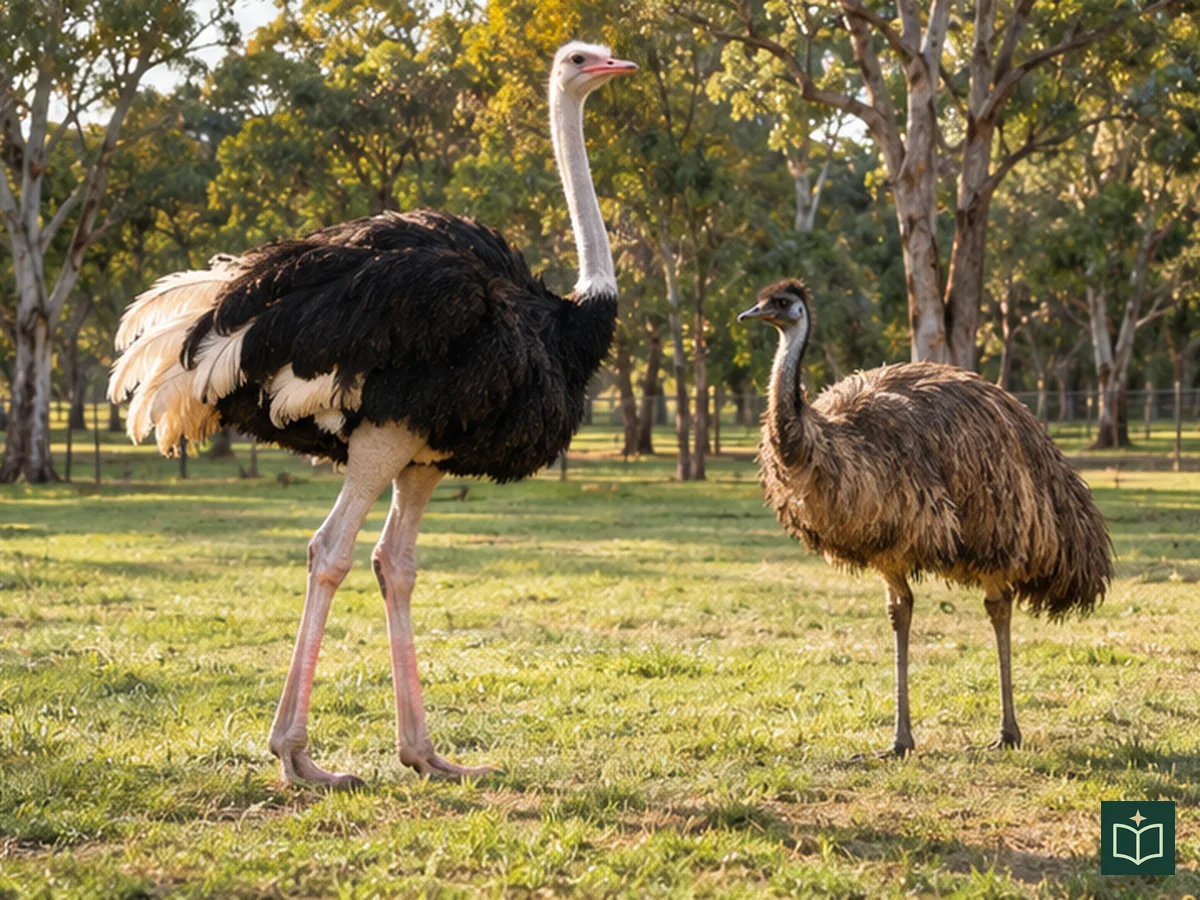
Two flightless giants
The ostrich and the emu are the two tallest living birds, and both have traded flight for powerful legs. They belong to a group called ratites, which also includes the rheas of South America, the cassowaries of Australia and New Guinea, and the kiwis of New Zealand. Ratites have small wings and a flat breastbone without the keel that anchors flight muscles in flying birds. Despite their similar lifestyle, ostriches and emus are not each other's closest relatives. Genetic studies suggest that flightlessness evolved several times within the ratite family, rather than once in a single flightless ancestor whose descendants drifted apart with the continents.
Size, speed and feet
The common ostrich is the largest living bird. Males can stand about 2.7 metres tall and weigh more than 100 kilograms. Emus are the second tallest, reaching around 1.9 metres and typically weighing 30 to 55 kilograms. Both are superb runners. Ostriches can sprint at about 70 kilometres per hour, faster than any other bird on land, and sustain high speeds over long distances, while emus can reach about 50 kilometres per hour. Their feet tell them apart instantly. Ostriches are unique among birds in having only two toes on each foot, an adaptation for speed, while emus have three forward-facing toes.
Feathers and faces
Plumage also differs. Male ostriches are black with white wing and tail plumes, which they display in courtship, while females are greyish brown. Their necks and legs are largely bare, the skin turning pink or blue in breeding males depending on the population. Emus of both sexes look much alike, with shaggy, hair-like brown feathers; each feather has two shafts from a single base, an unusual feature. Emu wings are tiny and hidden beneath the plumage, whereas ostriches use their larger wings for balance when turning at speed and for display. Ostriches have very large eyes, among the biggest of any land animal.
Family life
Breeding habits differ sharply. Among ostriches, a dominant female and several others lay eggs in one shallow nest scraped in the ground, and the dominant pair share incubation, with the female sitting by day and the darker male usually at night. Ostrich eggs are the largest of any living bird, weighing about 1.4 kilograms. In emus, the female lays dark green eggs and often leaves, and the male incubates them alone for about eight weeks, rarely eating or drinking and losing a considerable share of his body weight. He then guards the striped chicks for months. Female emus may go on to mate and lay with other males.
People and history
Ostriches once ranged into the Arabian Peninsula. The Arabian ostrich, a now-extinct subspecies, was hunted to disappearance during the 20th century, and ostrich eggshells and images appear in the region's archaeology. Ostriches have long been farmed in southern Africa, and later elsewhere, for feathers, leather and meat; farms also exist in the Gulf. Emus are a national symbol of Australia, appearing on its coat of arms alongside the kangaroo. In 1932 Western Australia saw the so-called Emu War, when soldiers with machine guns were sent to cull emus damaging wheat crops. The birds proved hard to hit, and the operation largely failed.
Myths and facts
The most famous myth is that ostriches bury their heads in the sand when frightened. They do not. The idea probably comes from birds lowering their heads to the ground to turn their eggs or lying flat with outstretched necks to avoid being seen, which can make the head seem to vanish from a distance. Another misconception is that both birds are slow or clumsy; a kick from either can be dangerous, and ostrich kicks can seriously injure predators. Neither the common ostrich nor the emu is considered globally threatened, though the separate Somali ostrich is listed as vulnerable. Telling them apart is simple once you know where to look: count the toes.
Sources & further reading
Figures are rounded and widely published; check the linked organisations for the latest editions. These organisations do not endorse this website.