Before the central station
By 1880 electric arc lights already lit some streets and large halls, but they were harsh and too bright for homes. Thomas Edison’s practical incandescent bulb, demonstrated in 1879, offered gentle indoor light. The problem was supply. Wealthy buyers could install a private generator in a basement, as some did, but that was costly and noisy. Edison wanted to sell light the way gas companies sold gas: from a central plant, through pipes under the street, to many paying customers. That required a complete system invented at once, including generators, distribution mains, fuses, switches, sockets and meters. Most of those parts did not yet exist in a form that could be manufactured and installed at scale.
Inside Pearl Street
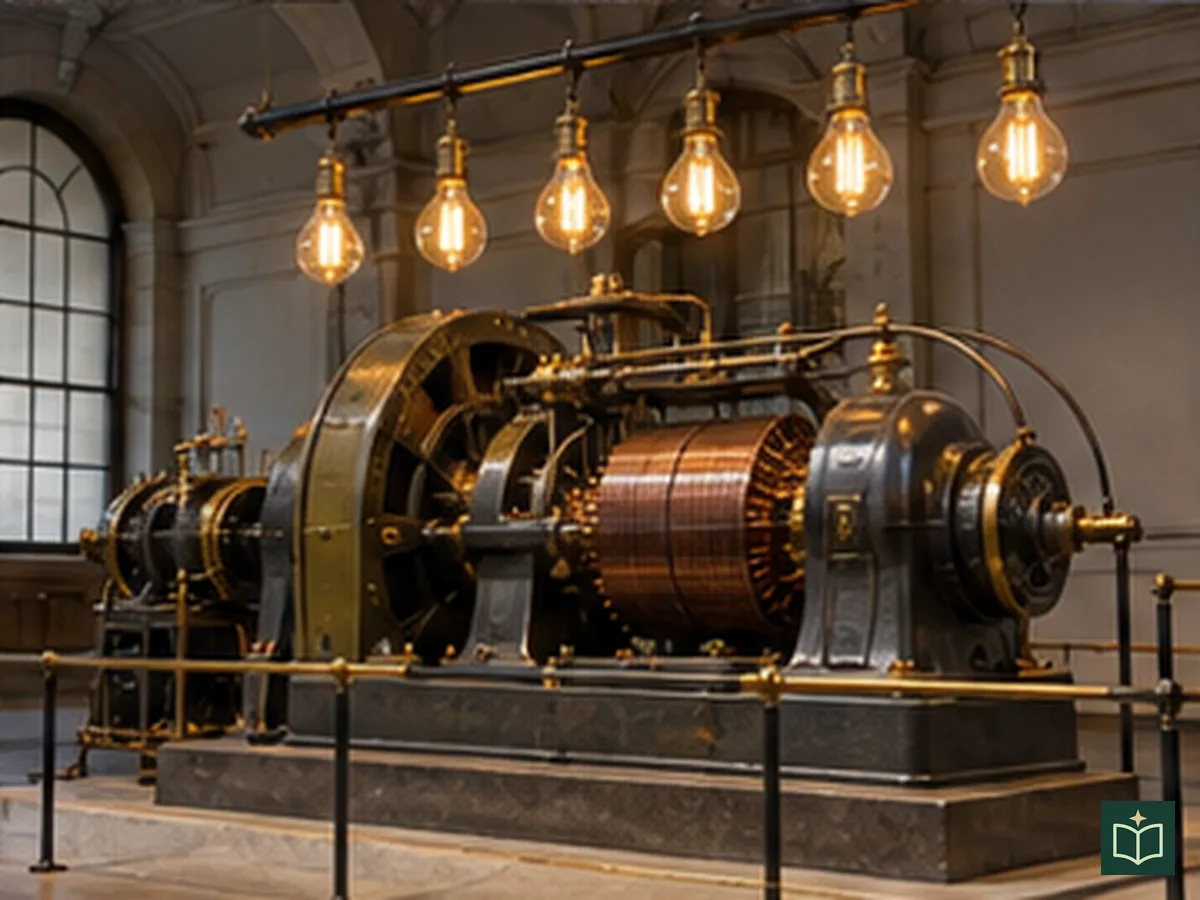
Edison chose a site at 255–257 Pearl Street in Lower Manhattan, close to the financial district and to newspapers whose endorsement he wanted. Coal-fired boilers fed steam engines connected directly to large dynamos, nicknamed ‘Jumbos’ after a famous circus elephant, each weighing many tonnes. On 4 September 1882 the station began supplying direct current at about 110 volts to customers within roughly a square mile. It started with dozens of customers and a few hundred lamps. Within about two years it served more than 500 customers and over 10,000 lamps. Exhaust steam was even piped to nearby buildings for heating, an early form of combined heat and power.
Selling electricity
Edison’s company at first supplied power without charge while the system was proven, and began billing in 1883. To charge fairly, Edison’s engineers developed a meter in which current deposited zinc onto metal plates; staff weighed the plates periodically to work out how much electricity had flowed. The business model was what mattered most. Customers no longer bought equipment; they bought a service measured in units. The company carried the investment risk, maintained the network and recovered its costs from many small bills. The underground conductors, insulated and laid in conduits, avoided the tangle of overhead wires that cluttered New York at the time and later caused deadly accidents.
Firsts and rivals
Pearl Street is usually called the first central power station in the United States, but claims of ‘first’ need care. In 1881 the English town of Godalming briefly lit streets and some buildings with a water-powered generator. Edison’s own Holborn Viaduct station in London began supply earlier in 1882 than Pearl Street, though it was a temporary demonstration. Pearl Street’s significance lies in its scale, permanence and commercial model. It ran until a fire in 1890 caused serious damage; the station was later rebuilt and finally closed in the mid-1890s as larger plants took over. The company behind it evolved into what is now Consolidated Edison, New York’s main utility.
The limits of direct current
Pearl Street’s weakness was distance. At about 110 volts, direct current lost too much energy in the copper if sent more than about a mile, so a city would need a power station in every neighbourhood. Alternating current, promoted by George Westinghouse and using Nikola Tesla’s motor patents, could be stepped up by transformers to high voltages for long-distance transmission and stepped down for safe use at home. The rivalry of the late 1880s, later called the war of the currents, ended with alternating current as the standard for grids. The idea of the central station survived, but stations became fewer, larger and farther from the customers they served.
The utility model it created
The business pattern that began at Pearl Street spread across the world. Large central plants could serve thousands of customers whose demand peaked at different times, so their equipment worked harder and cost less per unit. Executives such as Samuel Insull, a former Edison aide, later pushed this logic further, building bigger plants and accepting government regulation in exchange for exclusive service areas. That compact shaped most twentieth-century electricity systems, including the state-owned utilities that run Gulf grids today. Rooftop solar and batteries now let customers generate some of their own power again, reviving an older question that Pearl Street first answered: whether electricity is best made centrally or close to where it is used.
Sources & further reading
Figures are rounded and widely published; check the linked organisations for the latest editions. These organisations do not endorse this website.