A chemist turns to microbes
Louis Pasteur was born in eastern France in 1822 and trained as a chemist. His early work on crystals showed that some molecules exist in mirror-image forms. In the 1850s, while working in Lille, he was asked by local industrialists about problems with fermentation in the making of alcohol from beet. Under the microscope he found that healthy fermentation was carried out by living yeast, while spoiled batches contained other microorganisms. This was controversial. Many leading chemists saw fermentation as a purely chemical process. Pasteur argued that specific microbes caused specific fermentations, an idea that would lead him towards disease.
An old question
For centuries many people believed in spontaneous generation: that living things could arise from non-living matter. Maggots seemed to emerge from rotting meat, and microbes from broth left standing. Experiments in the seventeenth and eighteenth centuries had challenged the idea for larger creatures, but microbes were harder to rule out. In 1859 the French Academy of Sciences offered a prize for experiments that would settle the matter. The naturalist Félix Pouchet claimed to have produced microbes in sterilised conditions. Pasteur set out to show that whenever microbes appeared in such experiments, they had come in from outside, carried on dust or in the air.
The swan-neck flask
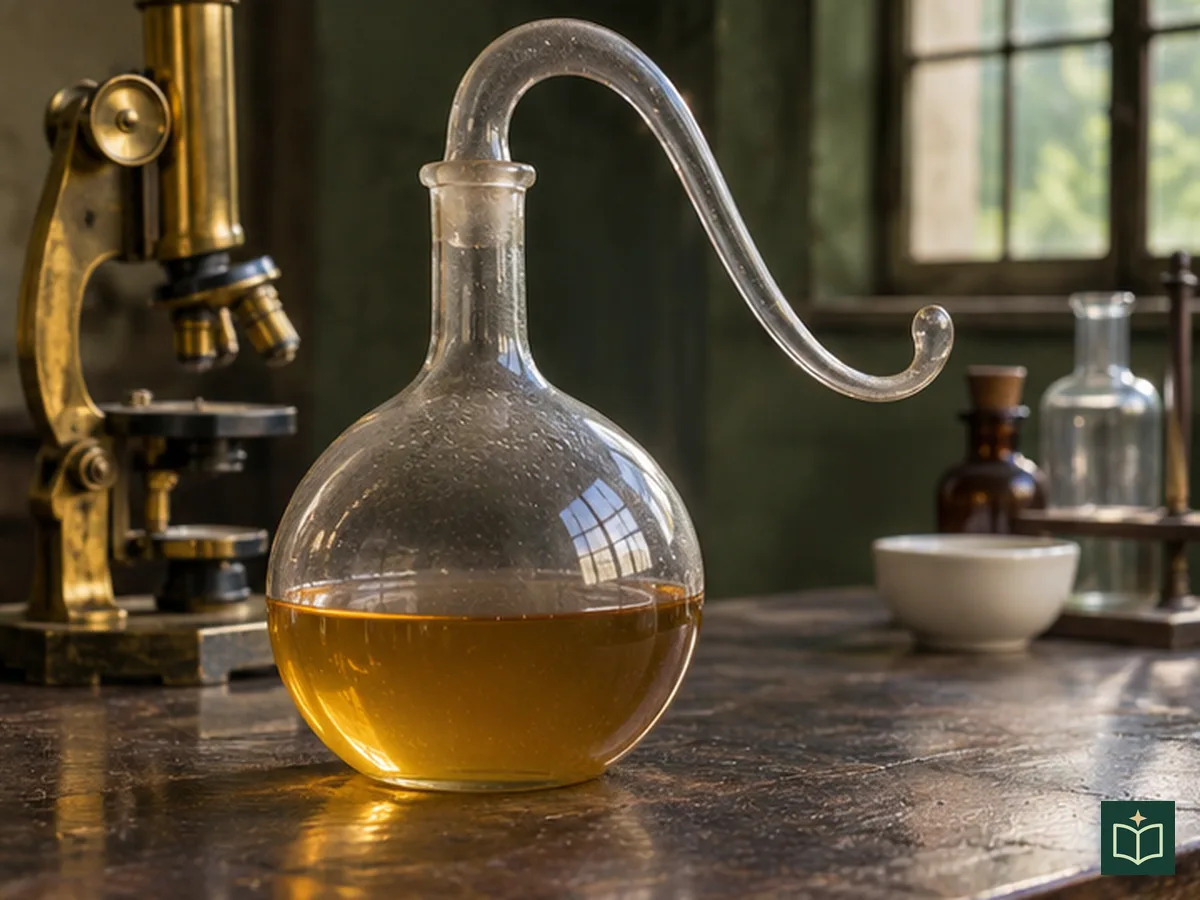
Pasteur's most famous experiment used flasks with long necks drawn out and bent into an S-shape, like a swan's neck. He filled them with nutrient broth and boiled it to kill any microbes. Air could still pass freely through the open neck, which answered critics who said that sealed flasks lacked a vital ingredient in air. But dust and microbes settled in the lowest bend and could not reach the broth. The broth stayed clear for long periods. When he tilted a flask so the broth touched the dust in the neck, or snapped the neck off, it soon filled with microbial growth. Some of his flasks are said to remain sterile today.
From wine to milk
If microbes caused spoilage, then killing them should prevent it. In the 1860s Pasteur showed that gently heating wine to moderate temperatures, well below boiling, stopped it turning sour without ruining its flavour. He patented the process in 1865. The method, named pasteurisation in his honour, was later applied to beer and especially milk, where it greatly reduced the spread of diseases such as tuberculosis. Pasteur also spent years studying diseases destroying France's silkworm industry, identifying their causes and recommending ways to select healthy eggs. Each project reinforced the idea that invisible organisms could explain problems that had seemed mysterious.
From germs to vaccines
Pasteur was one of several founders of germ theory. Robert Koch in Germany identified the bacteria causing anthrax and tuberculosis, and the British surgeon Joseph Lister, inspired by Pasteur, introduced antiseptic methods in surgery from 1867. Pasteur himself turned to prevention. Around 1879 he found that old cultures of chicken cholera bacteria protected birds rather than killing them. He developed an anthrax vaccine for livestock, demonstrated publicly in 1881, and then a rabies vaccine. In 1885 it was given to a boy, Joseph Meister, who had been badly bitten by a rabid dog. He survived, and the Pasteur Institute opened in Paris in 1888.
Hero and human
Pasteur became a national hero, but historians studying his private notebooks, opened to scholars in the 1970s, found a more complicated figure. He sometimes presented his methods selectively. His anthrax vaccine, for example, was prepared with a chemical method similar to that of a rival, rather than the oxygen-weakening process he publicly described. Such findings do not undo his achievements, but they show that science is done by competitive people working under pressure. His central lesson endures: diseases and decay have specific causes that can be studied, prevented and treated. Hand-washing, sterilised equipment, safe milk and modern vaccines all build on that insight.
Sources & further reading
Figures are rounded and widely published; check the linked organisations for the latest editions. These organisations do not endorse this website.