Wealth that travels
For nomadic and village families across Arabia, wealth had to be portable and secure. Livestock could sicken, and there were no banks in the desert. Silver jewellery solved part of the problem. Much of it was given to a bride as part of her mahr, the marriage gift that legally belongs to her, so it remained her property whatever happened to the household. In hard years a bracelet or a few coins could be sold by weight in the market. Because pieces were valued largely for their metal, they were often melted and remade when tastes changed, which is why surviving examples older than the nineteenth century are rare.
The pieces themselves
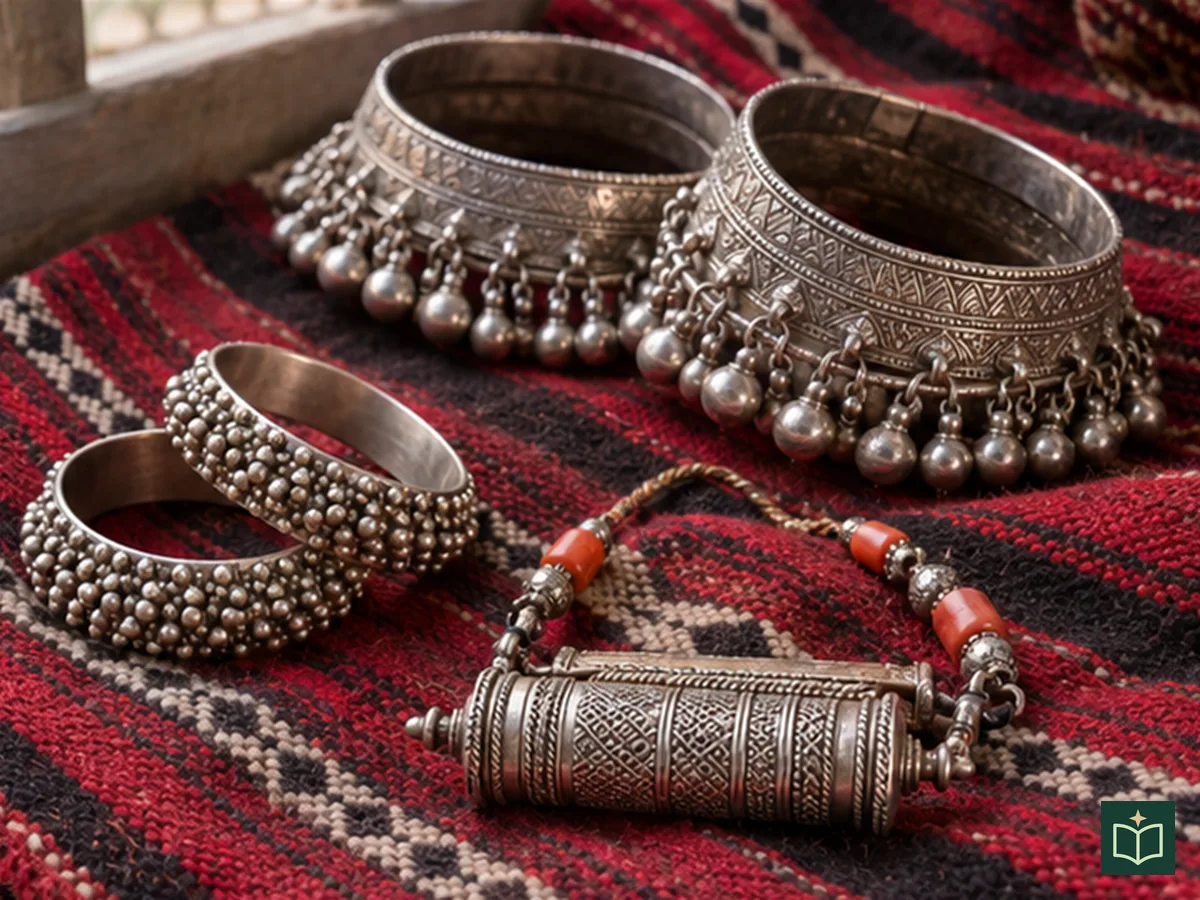
A well-dressed woman in Oman or the interior of Arabia might wear a striking amount of silver. Heavy anklets and bracelets, sometimes hollow and filled with pebbles so that they chimed, were common. Necklaces carried pendants, coins and beads of coral, carnelian or glass. Cylindrical or box-shaped amulet cases held folded papers bearing verses from the Quran, believed to offer protection. Rings for each finger, nose ornaments, hair pendants and forehead pieces completed the set. Children wore small bells and charms. For men, silver appeared mostly on weapons and accessories, above all the sheath and belt of the curved Omani dagger, the khanjar.
Why silver, not gold
Several reasons favoured silver. It was far cheaper, so a family could afford a substantial weight of it. Supply was steady because silver coins circulated widely along trade routes. Religious tradition also played a part: in Islamic teaching, gold ornaments are discouraged for men, so men’s decoration naturally used silver, and silver became the everyday metal of craft. Gold was worn by women in wealthier families, particularly in towns and along the coast, but silver dominated in the desert and the mountains. Its bright, cool colour was admired in its own right, and many pieces were partly gilded or set with red stones for contrast.
Coins into jewellery
Arabia has few silver mines, so the metal came from coins. The Maria Theresa thaler, an Austrian trade coin, was especially popular because its silver content was reliable. Each coin weighs about 28.07 grams and is 83.3% silver. Melting 20 thalers gives about 561 grams of alloy containing roughly 468 grams of pure silver, enough for a pair of heavy anklets. Indian rupees and other coins were also used. Silversmiths often worked the alloy without refining it, because the copper in it made the metal harder and better suited to wear. Some coins were simply pierced and strung whole onto necklaces and headdresses.
Techniques of the souk
Silversmiths, known in Arabic as sayegh, worked in small workshops in market towns such as Nizwa, Bahla, Ibri and Sur in Oman, and in oases and ports across the peninsula. They cast solid parts in moulds of stone or sand, hammered sheet over shaped tools and drew wire through holed plates. Granulation, which fuses tiny silver balls onto a surface in patterns, and filigree, made from twisted wire, were favourite decorations. Khanjar sheaths were often covered with fine silver thread stitched or woven onto leather. Many smiths belonged to families that passed skills from father to son, and some were renowned for distinctive regional styles.
From adornment to heritage
Rapid change after the discovery of oil transformed the craft. As incomes rose from the 1960s and 1970s, many families preferred gold jewellery bought from shops, and older silver was sold by weight, melted or bought by collectors and visitors. Fewer young people trained as silversmiths. Today, traditional pieces are displayed in museums such as Bait Al Zubair in Muscat, and Omani silver remains part of national dress through the khanjar, still worn by men at formal occasions. Workshops in Nizwa and elsewhere continue to make silver for weddings and for tourists, keeping alive designs that once doubled as a family’s savings.
Sources & further reading
Figures are rounded and widely published; check the linked organisations for the latest editions. These organisations do not endorse this website.