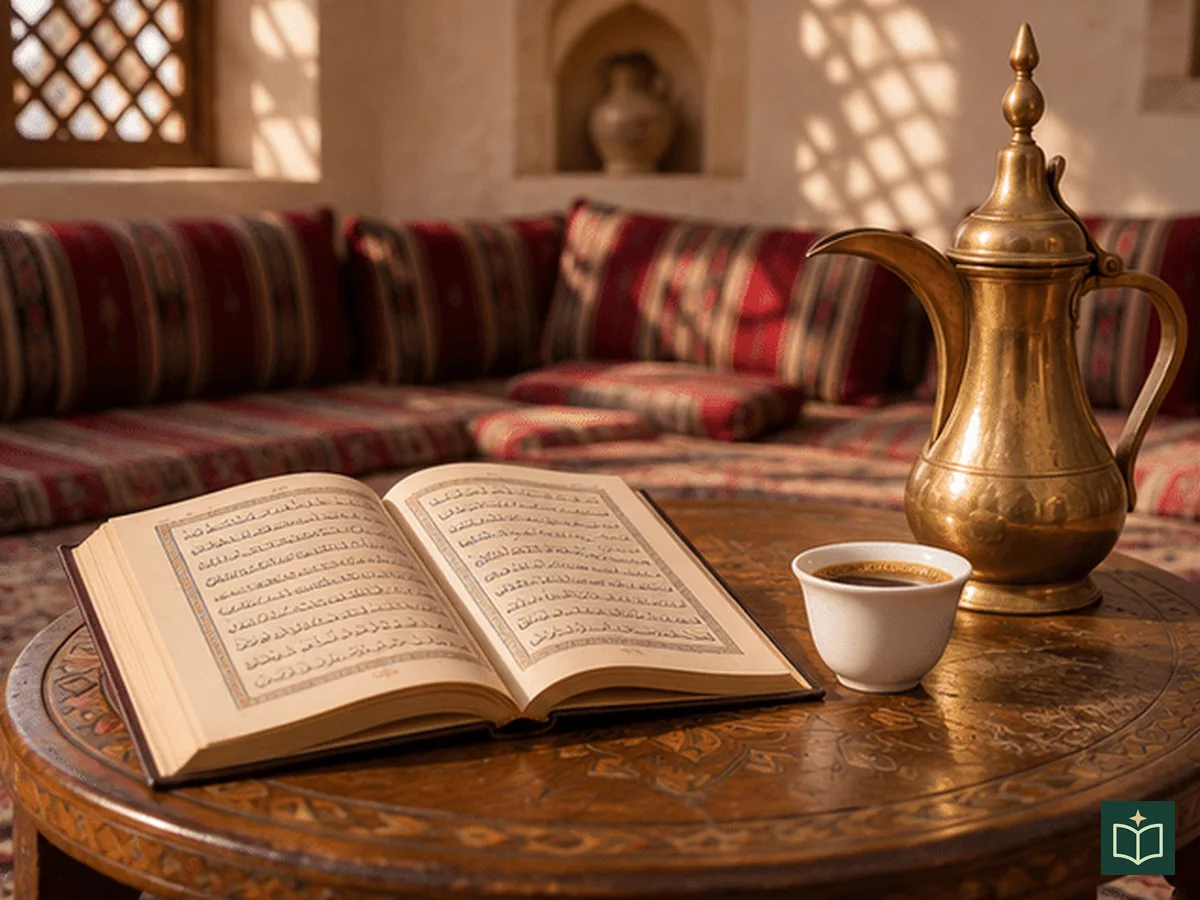
Diglossia: two forms side by side
Arabic is the classic example of what linguists call diglossia, a term popularised by the American linguist Charles Ferguson in 1959. Two forms of the same language coexist, each with its own role. Modern Standard Arabic, often called fusha, is the formal variety used in books, newspapers, official documents, news broadcasts and speeches across the Arab world. It descends from Classical Arabic, the language of the Quran and early literature, with modern vocabulary added. Regional dialects, by contrast, are the languages people actually grow up speaking. Gulf Arabic, or Khaleeji, is the family of dialects spoken in the UAE, Kuwait, Bahrain, Qatar, eastern Saudi Arabia and parts of Oman.
Differences in sound
Several sound changes make Gulf speech instantly recognisable. The letter qaf, pronounced at the back of the throat in Modern Standard Arabic, is often pronounced as a hard g, so qal, 'he said', becomes gal. In many Gulf dialects the letter jim softens to a y sound, so rajul, 'man', is heard as rayyal, and jamal, 'camel', can become yamal. The letter kaf may shift to ch in some words, especially in Kuwaiti and Emirati speech. Short vowels are often dropped or changed, and the case endings of standard grammar, small vowels that mark a word's role in a sentence, disappear entirely in normal conversation.
Differences in vocabulary
Everyday words often differ completely. Where Modern Standard Arabic asks madha, 'what?', an Emirati speaker may say shu and a Saudi speaker wesh. The standard urid, 'I want', becomes abgha. 'A lot' or 'very' is often wayed in Emirati speech. Gulf dialects also contain many loanwords reflecting centuries of trade across the Indian Ocean and later contact with English, from Persian, Hindi, Urdu, Turkish and English sources. Words for household items, food, tools and modern technology are common examples. Conversely, many formal words from Modern Standard Arabic, especially in law, science and politics, are used in speech only on formal occasions or when quoting written texts.
Differences in grammar
Grammar is simplified in the dialect. Modern Standard Arabic often places the verb first, as in 'wrote the student the lesson', while Gulf speech commonly uses subject-verb-object order, as English does. Standard grammar has separate dual forms for verbs and adjectives and distinct feminine plural verbs; Gulf dialects drop many of these. Negation differs: standard Arabic uses words such as la, lam and lan depending on tense, while Gulf speakers often use ma before verbs and mub or mu before nouns and adjectives. The dialect has its own future marker and many fixed expressions. Learners who study only Modern Standard Arabic can read a newspaper but may struggle to follow a conversation in a majlis.
Who uses which, and when
Children in the Gulf grow up speaking Khaleeji at home, then learn Modern Standard Arabic at school, where it is the language of textbooks and exams. Adults switch between the two by setting. A news presenter reads in standard Arabic; a talk show guest may answer in dialect. Friday sermons, court rulings and government statements are largely in the standard form, while television dramas, poetry recitals of the Nabati tradition, advertising and social media often use dialect. The boundary is not fixed. Educated speakers frequently mix the two in a single conversation, using standard terms for technical subjects and dialect for everything else, a practice sometimes called Educated Spoken Arabic.
Why the distinction matters
Modern Standard Arabic is what allows a reader in Rabat and a reader in Abu Dhabi to share the same books and news, even though their spoken dialects may be hard for each other to understand at first. Gulf Arabic carries identity, humour and the texture of local life, and it has gained new prominence through Gulf television, music and social media. For learners, the choice depends on goals: the standard form for reading, writing and formal work, the dialect for living and working in the region. Neither is a corrupted version of the other. Linguists treat dialects as full languages with their own rules, and the two forms are best seen as complementary.
Sources & further reading
- Britannica · Arabic language ↗
- United Nations · Official languages ↗
- UNESCO · World Arabic Language Day ↗
Figures are rounded and widely published; check the linked organisations for the latest editions. These organisations do not endorse this website.