Two ways to divide
Cells multiply by division, and complex organisms use two kinds. Mitosis is the everyday process. A single body cell copies its chromosomes and splits into two daughter cells that are genetically identical to it and to each other. It is how a fertilised egg grows into a person of tens of trillions of cells, and how skin, blood and the gut lining are constantly renewed. Meiosis is a specialised process that takes place only in the reproductive organs. It produces gametes, meaning eggs and sperm in animals, or spores in plants and fungi, and each one carries half the usual number of chromosomes.
How mitosis works
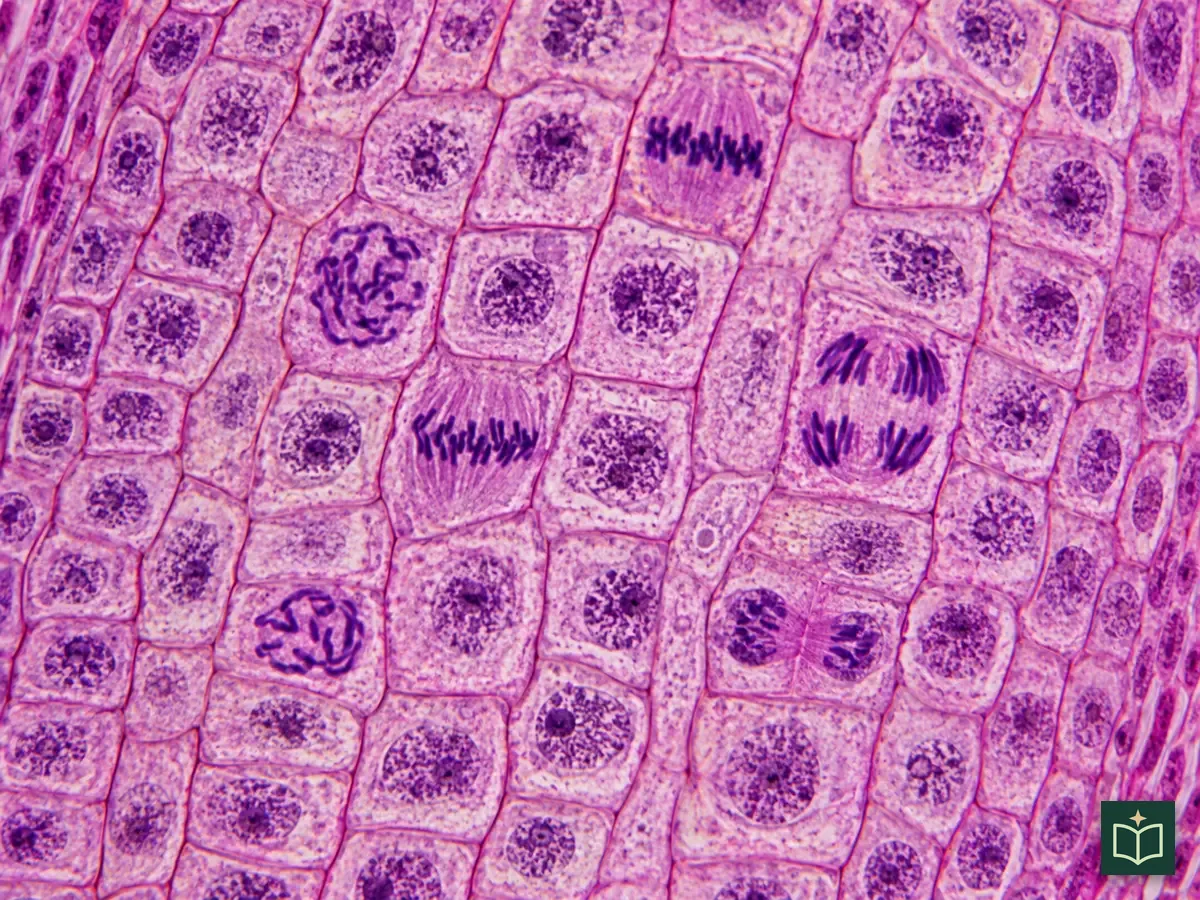
Before mitosis, the cell duplicates its DNA, so each chromosome consists of two identical strands called sister chromatids. During division, the chromosomes condense into compact shapes, line up across the middle of the cell and are pulled apart by a scaffold of protein fibres called the spindle. One copy of each chromosome moves to each end. The cell then pinches in two, a step called cytokinesis. The result is two cells with the full set of 46 chromosomes in humans. The process is tightly controlled by checkpoints that pause division if DNA is damaged or chromosomes are not properly attached.
How meiosis works
Meiosis also starts with copied chromosomes, but then divides twice. In the first division, matching chromosomes from mother and father pair up and exchange segments, a process called crossing over. The pairs are then separated, with each one sorted independently of the others. In the second division, the sister copies are pulled apart, much as in mitosis. One starting cell therefore yields four cells, each with 23 chromosomes, one from every pair. Through independent sorting alone, a human can make more than eight million different combinations, and crossing over multiplies that variety further. That is why siblings differ, apart from identical twins.
Where they are similar
The two processes share a great deal. Both are preceded by DNA replication, both use the same spindle apparatus and motor proteins to move chromosomes, and the second stage of meiosis closely resembles mitosis. Both pass through recognisable phases that biologists call prophase, metaphase, anaphase and telophase. Both depend on accurate checkpoints, and errors in either can be harmful. Both are also ancient: they are found across animals, plants and fungi, suggesting that they evolved early in the history of complex life. In short, meiosis can be thought of as a modified form of the same toolkit, adapted for reproduction.
Common confusions
Students often assume meiosis simply halves the DNA in one step. In fact the DNA is copied once and the cell divides twice, which is how the number is halved. Another misunderstanding is that every cell keeps dividing by mitosis. Many mature cells, including most neurons and heart muscle cells, rarely or never divide. It is also easy to forget that variation comes from meiosis, not mitosis: two cells produced by mitosis carry the same genetic information. Mutations can still arise during copying, but they are rare compared with the deliberate reshuffling built into meiosis. Health questions should always be discussed with a qualified professional.
Why it matters
The distinction underpins much of biology and medicine. Mitosis explains growth, healing and the turnover of tissues, and its failure explains many cancers. Meiosis explains inheritance, the reason children resemble but never exactly copy their parents, and the genetic diversity that helps populations adapt. Understanding both informs fertility treatment, prenatal screening, plant breeding and cancer research. The basic contrast is easy to remember: mitosis produces two identical body cells with a full set of chromosomes, and meiosis produces four unique sex cells with half a set, ready to combine at fertilisation. Errors in either process can cause disease, which is why both are closely studied.
Sources & further reading
- National Human Genome Research Institute · Mitosis ↗
- National Human Genome Research Institute · Meiosis ↗
- Britannica · Meiosis ↗
Figures are rounded and widely published; check the linked organisations for the latest editions. These organisations do not endorse this website.