Leftovers of planet-building
When the Sun and planets formed about 4.6 billion years ago, not all the material ended up in large worlds. Countless smaller bodies were left behind, and comets and asteroids are the two main kinds. Asteroids are rocky or metallic objects, ranging from boulders to Ceres, about 940 kilometres across, which is now classed as a dwarf planet. Comets are sometimes described as dirty snowballs: mixtures of ice, dust and rock, typically a few kilometres wide. Both are valuable to scientists because they preserve material from the solar system's earliest days, largely unchanged by the geological processes that reshaped the planets.
Where they live
Most known asteroids orbit in the main belt between Mars and Jupiter. Jupiter's gravity prevented them from assembling into a planet. Others share Jupiter's orbit or cross Earth's path. Comets come from much colder, more distant regions. Short-period comets, which return within 200 years, mostly come from the Kuiper Belt beyond Neptune. Long-period comets come from the Oort Cloud, a vast, distant shell thought to surround the solar system far beyond the planets. Comet orbits are usually long, stretched ellipses, carrying them close to the Sun and then back into the cold outer reaches. A few comets fall into the inner solar system from these reservoirs each year.
What happens near the Sun
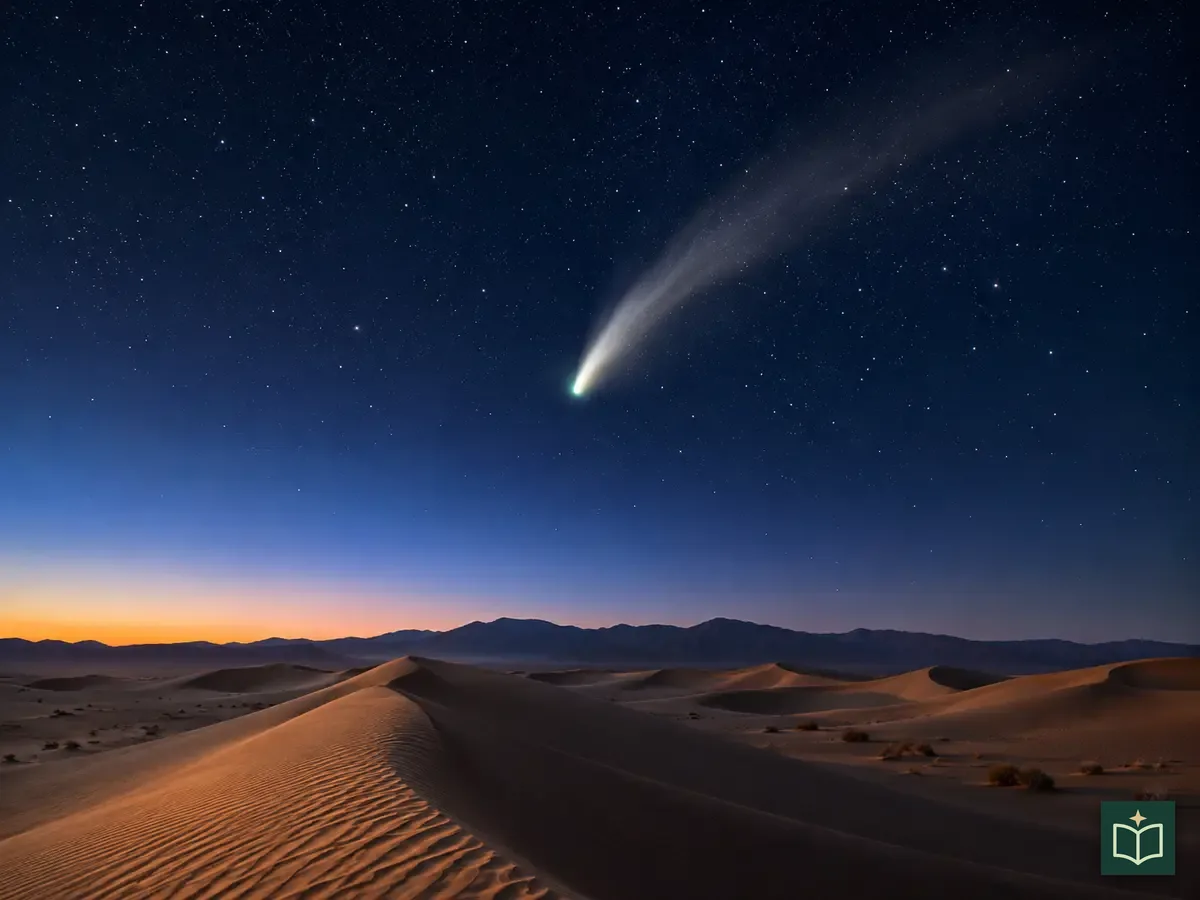
The clearest difference appears when an object approaches the Sun. A comet's ices turn directly from solid to gas, releasing dust. This forms a glowing cloud around the nucleus, called the coma, which can be larger than a planet. Sunlight and the solar wind push material away, creating tails that always point away from the Sun, whichever way the comet is travelling. Many comets have two tails: a curved dust tail and a straight, bluish tail of charged gas. Asteroids generally show no such activity. They simply reflect sunlight and appear as points of light through a telescope. Some bright comets are visible to the naked eye for weeks.
Where they are similar
The two have more in common than their images suggest. Both orbit the Sun and are far too small to be planets. Both are made from the same primordial material in different proportions; many asteroids contain some water-bearing minerals, and old comets that have lost their ice can look like asteroids. Scientists now recognise objects that blur the line, such as active asteroids that shed dust and main-belt comets that show tails. Both can strike planets, and both are tracked by survey telescopes. Both have also been visited by spacecraft that returned samples or detailed images to Earth. Telling them apart is mainly about activity, not origin alone.
Missions and examples
Halley's Comet, which returns roughly every 76 years, is the best-known comet and was last near Earth in 1986. The European Space Agency's Rosetta mission orbited Comet 67P from 2014 to 2016 and landed a probe on its surface. Asteroid missions include Japan's Hayabusa2, which returned samples from Ryugu in 2020, and NASA's OSIRIS-REx, which delivered samples from Bennu in 2023. NASA's DART mission deliberately struck the small asteroid Dimorphos in 2022 and changed its orbit. The UAE's Mohammed bin Rashid Space Centre is developing a mission to explore several asteroids in the main belt. Each mission has added detail to the picture of how these bodies differ.
Why it matters
Studying comets and asteroids helps explain how the planets formed and where Earth's water and some organic molecules may have come from. They also pose a long-term hazard. A large impact about 66 million years ago is widely linked to the extinction of the non-bird dinosaurs. Space agencies now map near-Earth objects and test ways to deflect one if needed. In future, asteroids may also provide resources such as metals or water for spacecraft. Telling the two apart is the starting point for all of this research, from planetary origins to planetary defence. Meteor showers, often linked to comet dust, offer an easy way to see their influence.
Sources & further reading
Figures are rounded and widely published; check the linked organisations for the latest editions. These organisations do not endorse this website.