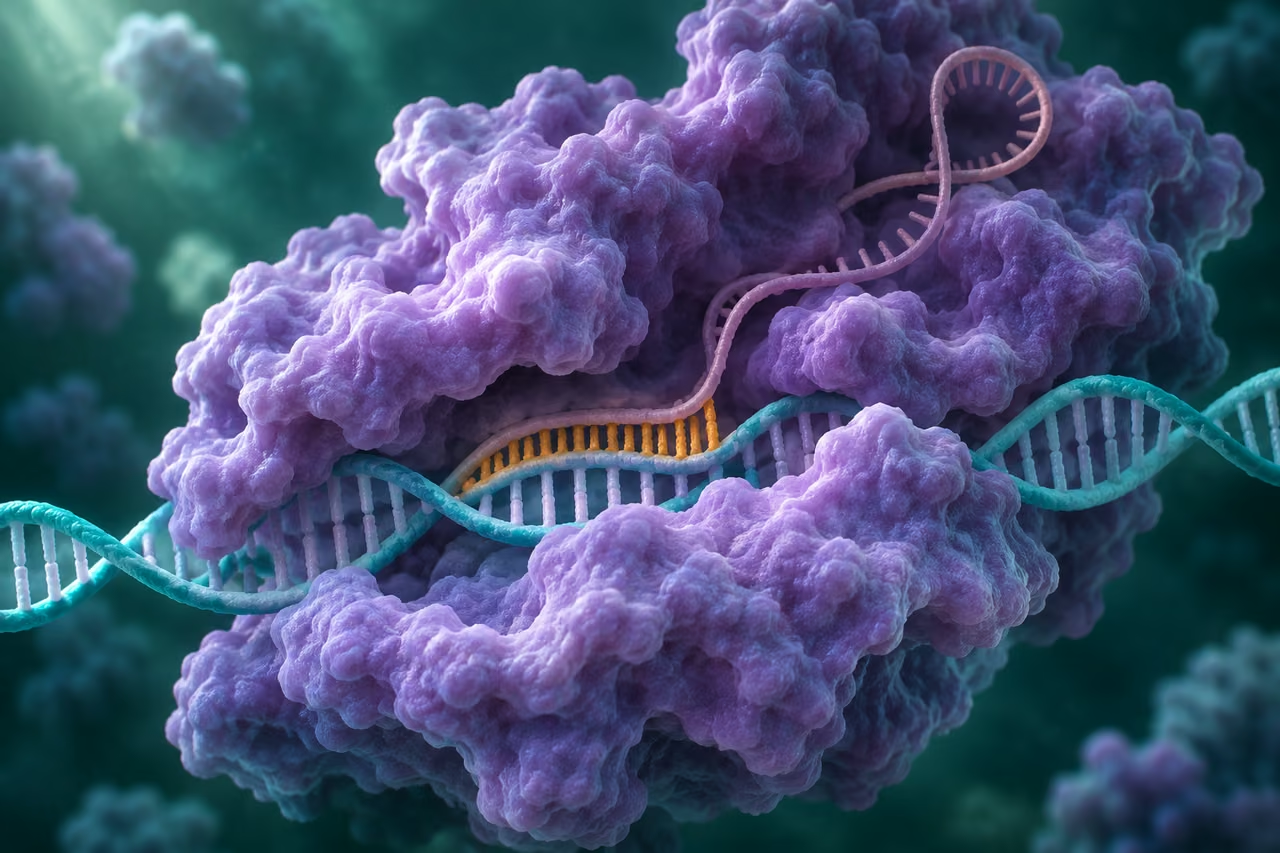
There are rotating motors inside you.
Across a mitochondrial membrane, a tiny electrical and chemical imbalance becomes motion—and motion helps make ATP.
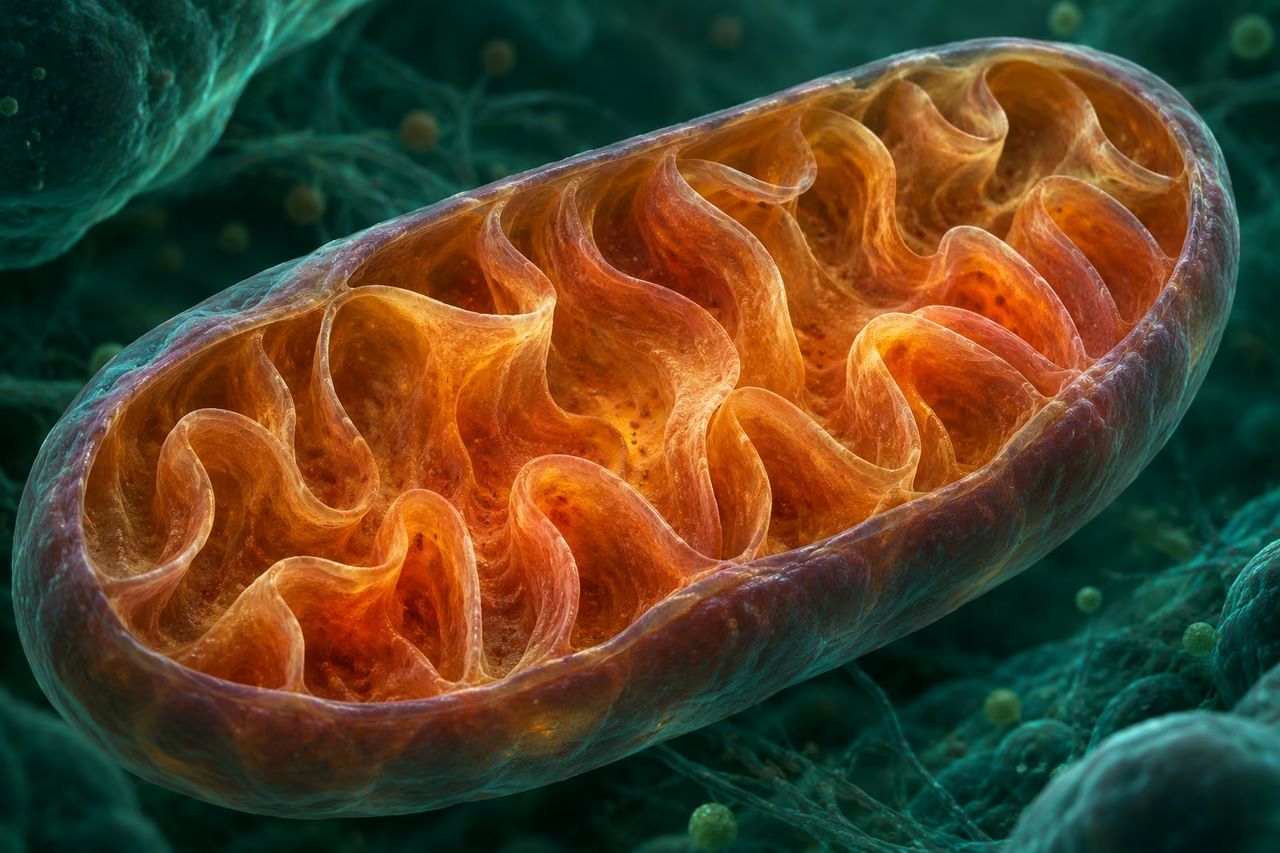
Conceptual AI illustration. Colours and scales are illustrative; not a documentary image or exact scientific model.
The phrase ‘powerhouse of the cell’ hides remarkable engineering. The membrane is part of the mechanism: separating charge and hydrogen ions allows one set of chemical reactions to drive another.
From mystery
to mechanism.
- 01
Move electrons
Nutrient breakdown supplies electron carriers. In the respiratory chain, electron transfer towards oxygen releases energy that can drive proton pumping.
- 02
Build the gradient
Several respiratory complexes move hydrogen ions from the mitochondrial matrix to the intermembrane space. Both a concentration difference and an electrical potential develop.
- 03
Let the rotor turn
Hydrogen ions returning through ATP synthase drive rotation. That motion changes catalytic sites, enabling ADP and inorganic phosphate to become ATP.
Follow the energy conversion
Swipe across the mechanism →
Respiratory complexes move H⁺ out of the matrix
Charge and concentration differences hold potential
H⁺ returns; rotation drives ATP synthesis
Simplified mechanism, not a quantitative energy-efficiency diagram.
A membrane with a job
Separating the two sides is essential. The gradient is an intermediate energy store linking electron transport to ATP synthesis. Oxygen accepts electrons at the respiratory chain’s end and contributes to water formation. It does not simply enter a turbine and emerge as energy; each stage has a distinct chemical role.
A machine made of molecules
ATP synthase has a membrane-embedded rotor, a central shaft and supporting structures. Rotation changes the shape of its catalytic machinery. This is genuine molecular motion, although the familiar turbine analogy is only an aid: the device is a protein complex operating in a thermal, molecular environment.
Paying for cellular work
Cells continually use and remake ATP. Its reactions can be coupled to processes such as muscle contraction, cellular transport and the construction of biological molecules. ATP production is therefore part of an ongoing energy budget. Nutrients supply chemical energy; the cell converts some into useful work and dissipates some as heat.
Sources & further reading.
Sources checked 15 November 2026. Explanations simplify complex systems and identify their limits. These organisations do not endorse Canvas of Knowledge.