The cut is only the beginning.
CRISPR made DNA easier to target. The deeper story is what the cell does after the molecular scissors arrive.
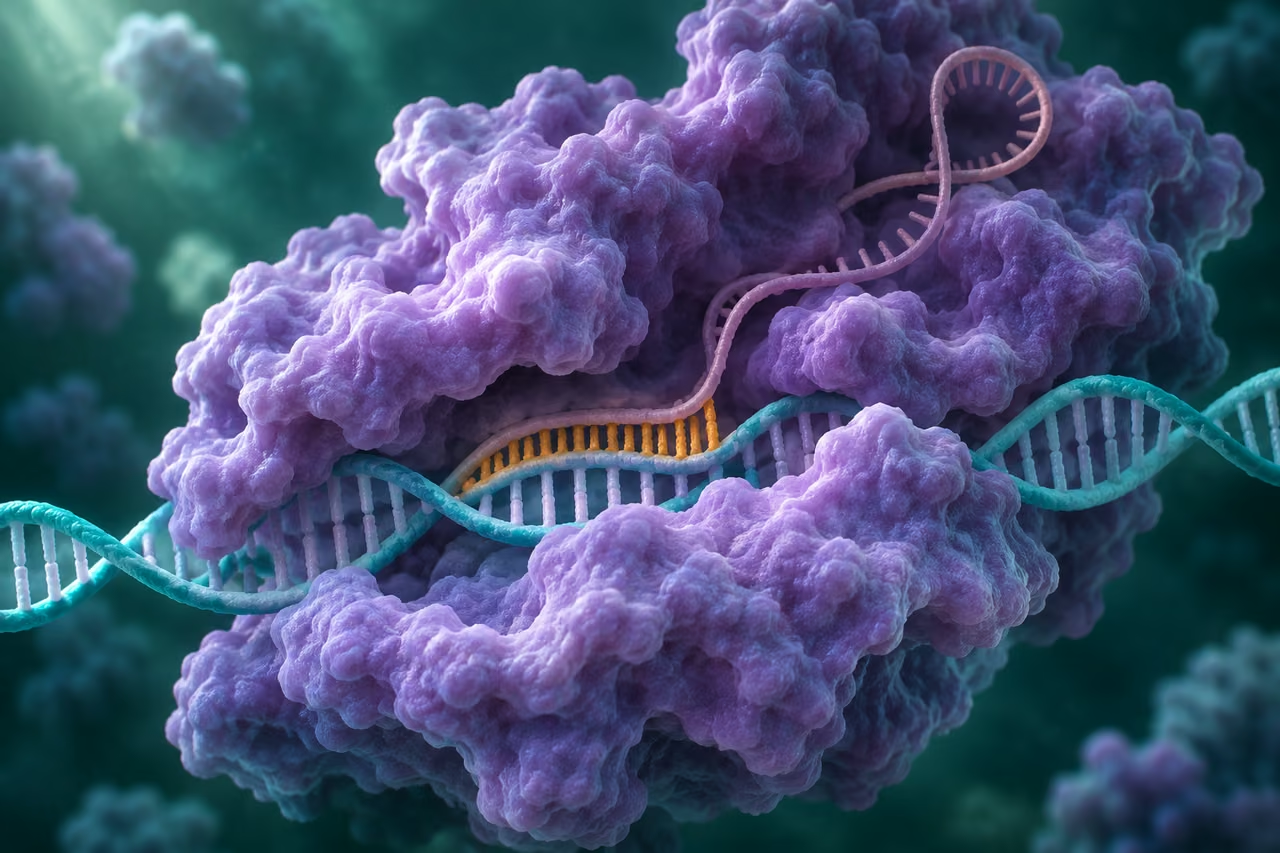
Conceptual AI illustration. Colours and scales are illustrative; not a documentary image or exact scientific model.
A tool adapted from microbial defence lets researchers intervene in biological questions. Instead of merely observing that a gene accompanies a trait, they can change a sequence and investigate what follows.
From mystery
to mechanism.
- 01
Guide the search
A designed guide RNA helps direct the Cas9 protein towards a compatible DNA target. Molecular recognition narrows the search; it does not guarantee perfect specificity.
- 02
Make the break
Nuclease-active Cas9 can cut the targeted DNA. The cut creates an opportunity for editing rather than automatically supplying a finished, corrected sequence.
- 03
Recruit cellular repair
The cell repairs the break. Repair can introduce small changes that disrupt a gene; with suitable methods, researchers can also seek a more specific sequence alteration.
The target is only one part of the outcome
Swipe across the mechanism →
Target a compatible DNA sequence
Create a site the cell must repair
Measure the sequence and resulting effects
Conceptual Cas9 pathway. Different cells and editing systems can yield different outcomes.
A defence system becomes a tool
CRISPR systems occur naturally in microbes, where they help defend against invading genetic material. Researchers adapted their sequence-directed machinery for experimental editing. The achievement was not the invention of DNA repair. It was making a biological targeting system programmable enough to investigate many different sequences.
The delivery problem
An editor must reach the intended cells and work in the appropriate place. Delivering it efficiently can be difficult, particularly when the target lies inside a complex organism. A successful experiment in isolated cells therefore cannot, by itself, establish that the same approach will work throughout a tissue.
A result needs checking
Editors can act at unintended locations, and repair may produce outcomes other than the intended one. Researchers must examine the resulting DNA and biological effects. More broadly, a changed sequence is an intervention, not a complete explanation: experimental controls help distinguish the intended effect from other changes.
Sources & further reading.
Sources checked 15 November 2026. Explanations simplify complex systems and identify their limits. These organisations do not endorse Canvas of Knowledge.