The ground is a slow-moving machine.
Ocean floors open, mountains rise and whole plates shift. A planet that feels immovable is continuously changing its arrangement.
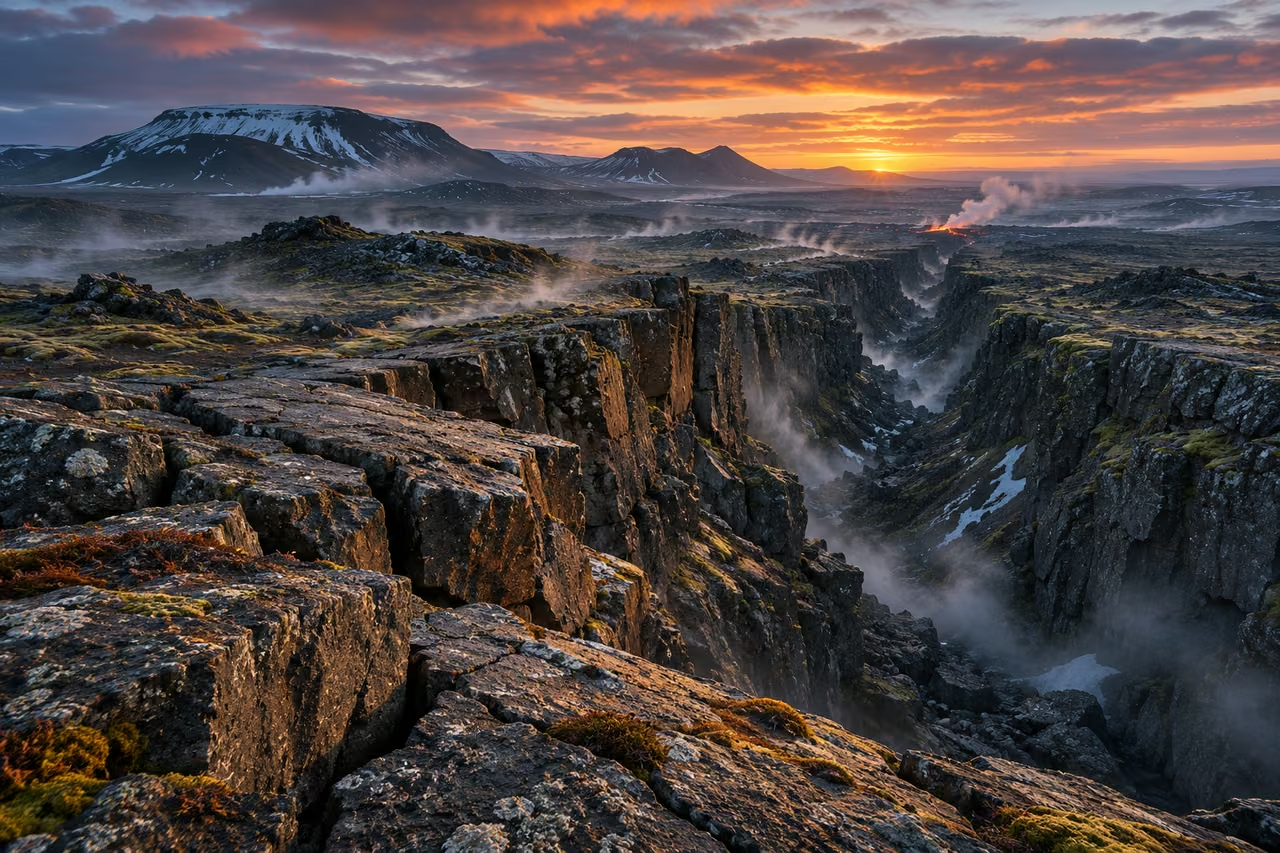
Conceptual AI illustration. Colours and scales are illustrative; not a documentary image or exact scientific model.
A human lifetime is too brief to watch an ocean basin open. Measuring movement, however, reveals a dynamic planet. The same framework connects distant ridges, trenches, mountain belts and earthquake zones.
From mystery
to mechanism.
- 01
Separate
At a divergent boundary, plates move apart. Rising mantle can partially melt as pressure falls, supplying magma that forms new oceanic crust.
- 02
Converge
At a convergent boundary, one plate may descend beneath another. Where continents collide, deformation can thicken the crust and build mountains.
- 03
Slide past
At a transform boundary, plates move sideways relative to one another. This motion can accumulate strain on faults and release it in earthquakes.
Three boundaries. Different consequences.
Swipe across the mechanism →
Spreading can create new oceanic crust
Subduction or continental collision
Sideways movement across faults
Conceptual comparison. Arrows describe relative movement, not measured speeds.
A small motion. A different planet.
Imagine motion at 5 centimetres per year. Change the duration to see how time turns a tiny yearly movement into a geological distance.
A hypothetical constant rate, not a forecast for a named plate. Real velocities and directions vary; continents are not simply rigid shapes sliding forever in straight lines.
Solid does not mean motionless
A plate includes the crust and rigid uppermost mantle, together called the lithosphere. Beneath it, hot mantle rock remains predominantly solid. Under sustained forces, it can deform over geological time. The widespread picture of continents floating on a planet-wide ocean of magma is therefore misleading.
Small rates, enormous consequences
Motion of a few centimetres per year becomes substantial when repeated over millions of years. But plates differ in direction and speed, and both can change. Geological reconstructions need evidence through time; multiplying one modern rate backwards indefinitely does not recover an exact ancient map.
How movement becomes measurable
Satellite positioning can track present motion across the ground. On longer timescales, patterns preserved in the ocean floor record spreading and changes in Earth’s magnetic field. These are different measurement windows: modern monitoring captures current movement, while geological records reveal a longer history.
Sources & further reading.
- USGS · Are tectonic plates floating on magma?
- USGS · How fast do tectonic plates move?
- USGS · Plate tectonics and volcanism, 2025
Sources checked 15 November 2026. Explanations simplify complex systems and identify their limits. These organisations do not endorse Canvas of Knowledge.