An old observation
People noticed copper’s effect long before they knew about microbes. Ancient medical texts from Egypt and Greece recommend copper compounds for wounds and drinking water, and travellers stored water in copper and brass vessels. In the twentieth century, scientists observed that bacteria grew poorly on copper doorknobs compared with steel ones. Laboratory studies since the 1990s have quantified the effect. Bacteria such as E. coli and MRSA, a drug-resistant Staphylococcus, are killed on clean copper surfaces within minutes to a few hours, depending on temperature, humidity and how many cells are present. On stainless steel or plastic, the same microbes can survive for days or weeks.
How contact killing works
Researchers call the process contact killing. Even a dry-looking surface carries a thin film of moisture, and copper atoms at the surface dissolve into it as ions. These ions attack the microbe’s outer membrane, making it leak and collapse the electrical charge the cell uses for energy. Inside, copper switches between two chemical states, generating reactive oxygen species that damage proteins and fats. Bacterial DNA is broken into fragments, which is one reason the effect seems hard for microbes to resist. Viruses lose their outer envelopes and their genetic material is degraded. The mechanism needs bare metal: lacquered or heavily coated copper loses most of its power.
Brass, bronze and limits
The effect is not limited to pure copper. Brasses and bronzes keep much of the activity as long as they contain a high share of copper, typically 60% or more. In 2008 the United States Environmental Protection Agency registered a range of copper alloys as antimicrobial surfaces, allowing makers to claim that they kill 99.9% of certain bacteria within two hours when cleaned regularly. Tarnish slows the effect slightly but does not stop it. Polishing to a shine is unnecessary. What reduces the benefit is dirt, grease or a protective coating, and very large loads of microbes. Copper is therefore a supplement to cleaning and handwashing, not a substitute.
The coronavirus test
Interest surged in 2020. A widely cited laboratory study published in The New England Journal of Medicine compared how long the virus behind Covid-19 stayed infectious on different materials. On copper, no infectious virus was detected after about four hours. On cardboard it lasted up to a day, and on plastic and stainless steel up to about three days. Earlier work had found similar results for other coronaviruses and for influenza. These were controlled laboratory conditions, with known amounts of virus, not real buildings. They show copper’s potential, but most coronavirus transmission happens through the air, so surfaces were only ever a partial answer.
Copper in the ward
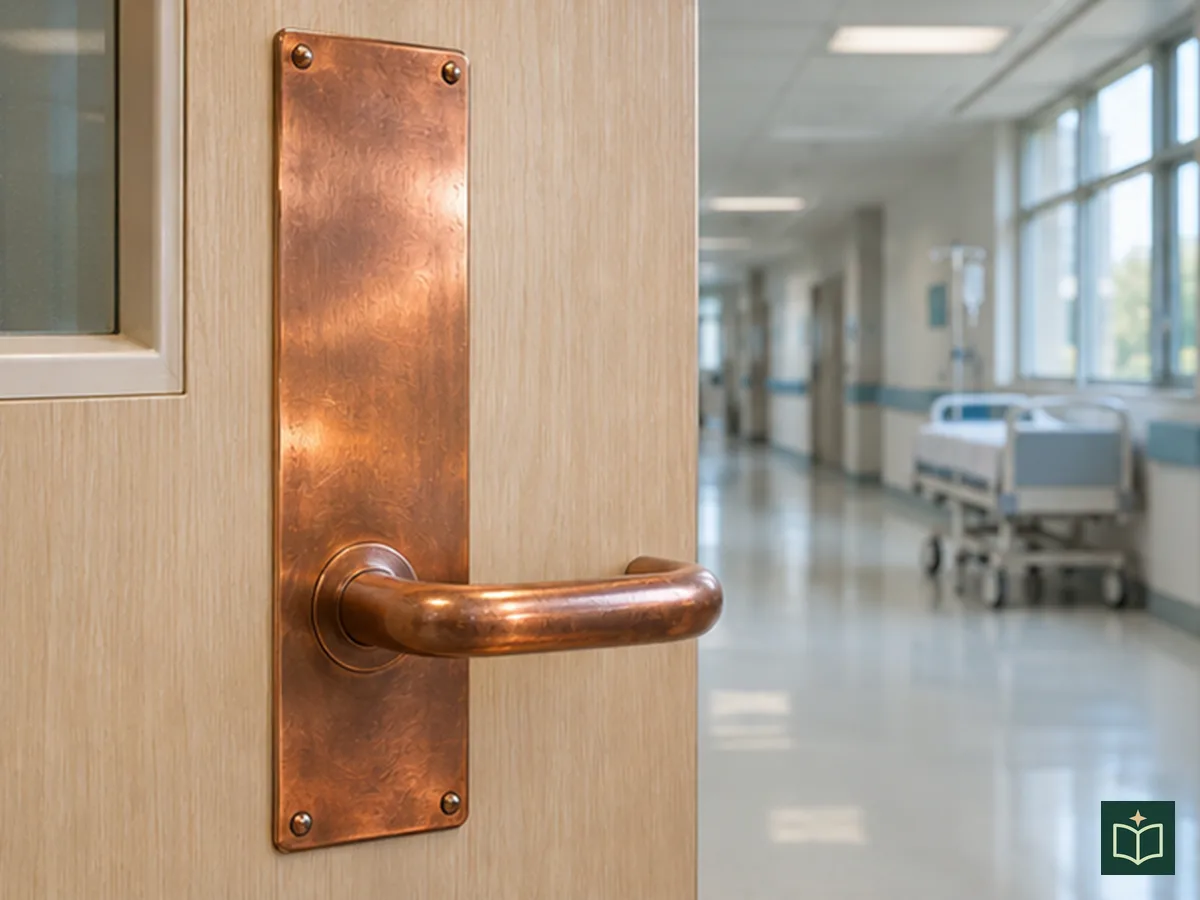
Hospitals are the obvious place to use the effect, because infections caught in hospital cause serious illness and death. Trials have replaced bed rails, door handles, taps, light switches and trolley handles with copper alloy versions, then measured microbial contamination and infection rates. A trial in intensive care units in the United States, published in 2013, reported fewer infections in rooms fitted with copper items. Other studies have found clear falls in bacterial counts but more mixed effects on infections, partly because studies are hard to design well. Copper fittings cost more than steel, though advocates argue they can pay back if they prevent even a few infections.
Why it matters
Copper touch surfaces are spreading beyond hospitals into schools, care homes, gyms and public transport, especially for items handled many times a day. In hot, busy public buildings, such as airports and malls across the Gulf, cleaners cannot wipe every handle after every touch, so a material that keeps working between cleans has obvious appeal. Questions remain about how much difference copper makes in practice compared with good cleaning, and about wear and appearance. The underlying chemistry, however, is well established. Copper is quietly toxic to most microbes, which is also why it is used in antifouling paints for ship hulls and in sprays that protect crops.
Sources & further reading
- The New England Journal of Medicine · Aerosol and surface stability of SARS-CoV-2 ↗
- Copper Development Association ↗
- Britannica · Copper ↗
Figures are rounded and widely published; check the linked organisations for the latest editions. These organisations do not endorse this website.