Measured end to end
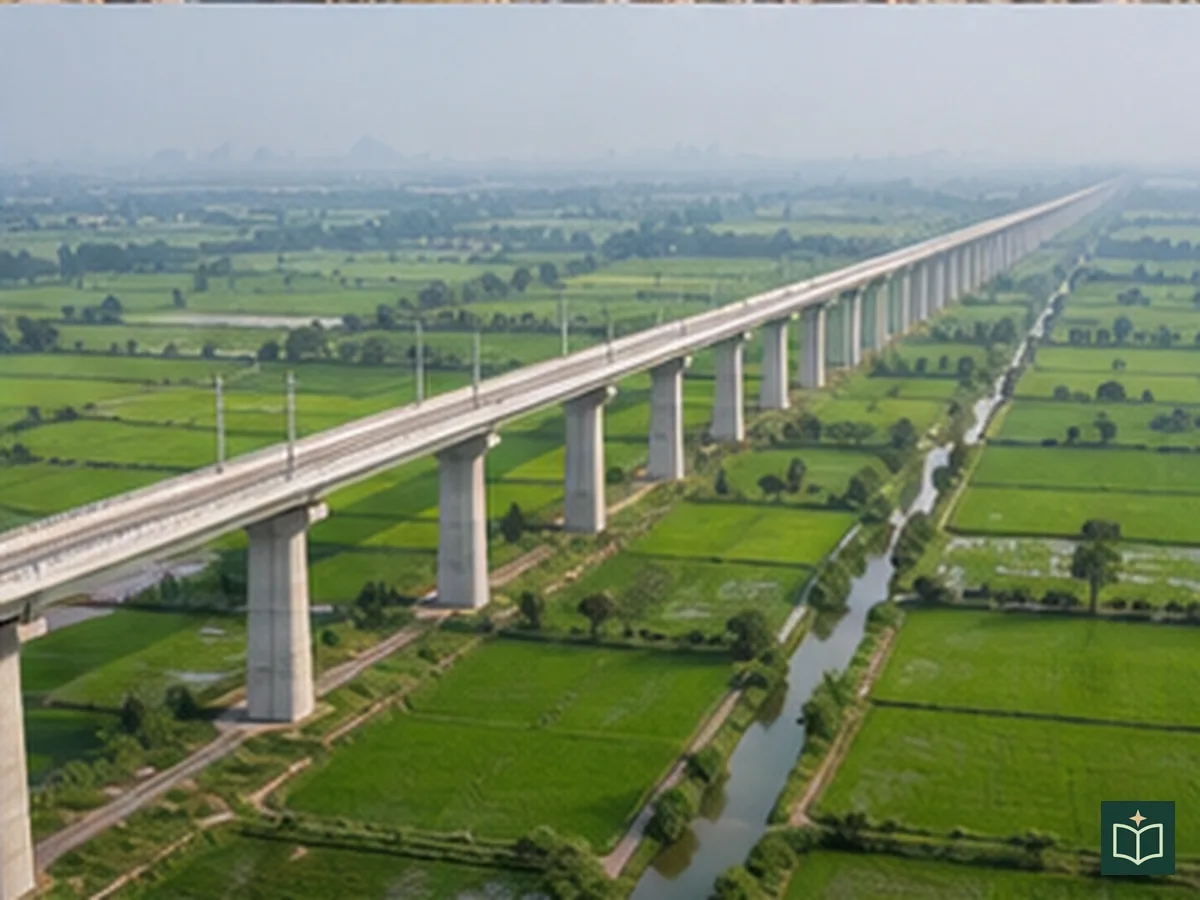
This ranking measures a bridge’s total length from one abutment to the other, which is different from the length of its longest single span. By that measure the leader is the Danyang–Kunshan Grand Bridge in Jiangsu province, about 164.8 kilometres long, which carries the Beijing–Shanghai high-speed railway. It opened in 2011. Taiwan’s Changhua–Kaohsiung Viaduct, about 157.3 kilometres, comes second and carries the island’s high-speed line. Four of the top five are Chinese railway viaducts. Lists differ in detail because builders and reference works count approaches, interchanges and connecting structures differently, so the figures here are rounded and the lower places can shift by a position or two.
Why viaducts win
High-speed trains need track that is nearly level and gently curved. In flat, densely farmed and flood-prone river plains, such as the Yangtze delta, a continuous viaduct is often cheaper and faster to build than an embankment. It uses less farmland, avoids settling on soft soil, lets roads, canals and animals pass underneath and reduces the need for level crossings. Much of the structure is assembled from identical box girders, typically about 32 metres long, cast in factories and lifted onto piers by specialised machines. Repetition makes extraordinary length practical. A sea crossing, by contrast, must resist waves, ship strikes and corrosion, which makes each kilometre far costlier.
The over-water exceptions
Only a few entries cross open water. The Hong Kong–Zhuhai–Macau Bridge, opened in 2018, links three cities across the Pearl River estuary. Its often-quoted 55 kilometres includes a 6.7-kilometre undersea tunnel and two artificial islands, so its bridge sections alone are shorter; some lists therefore rank it differently. Lake Pontchartrain Causeway in Louisiana, made of two parallel road bridges opened in 1956 and 1969, holds a Guinness record as the longest continuous bridge over water, at about 38.4 kilometres. Thailand’s Bang Na Expressway, completed in 2000, is an elevated road above a busy highway, carrying traffic on a deck that runs for about 54 kilometres.
Gulf and Asian neighbours
Some notable crossings fall just outside the ten. Kuwait’s Sheikh Jaber Al-Ahmad Al-Sabah Causeway, opened in 2019, carries a road about 36 kilometres across Kuwait Bay, linking Kuwait City with the Subiya area in the north. In Indonesia, the Sheikh Mohamed bin Zayed Skyway, an elevated toll road east of Jakarta about 36.4 kilometres long, was named in honour of the UAE leader. The King Fahd Causeway, opened in 1986, joins Saudi Arabia and Bahrain over roughly 25 kilometres of bridges and embankments. Each shows how causeways and elevated roads have become central to transport around the Gulf and across Asia.
Length is not difficulty
A long bridge is not necessarily a hard bridge. Most viaduct spans are short and repetitive, and the engineering challenge lies in logistics, foundations and precision over great distances. The hardest bridges to build are often those with very long single spans or great height, such as suspension bridges across deep straits or viaducts over deep gorges. Those are ranked separately, by main span or by height above the ground. A short bridge across a wide, deep, windy strait can demand far more design effort than a hundred kilometres of identical girders. When comparing lists, check whether a ranking measures total length, main span or height.
What to watch
China continues to extend its high-speed network, and new long viaducts appear on lines in the west and south of the country. However, few are likely to beat Danyang–Kunshan soon, because many newer routes run through hills where tunnels and shorter bridges suit the terrain better. Long sea crossings are being planned or built in several places, including links across bays and straits in China and South-East Asia. In the Gulf, new causeways and island links continue to be discussed as coastal cities grow. Whatever is built next, total length will remain dominated by railway viaducts across flat, crowded plains rather than by bridges across the sea.
Sources & further reading
Figures are rounded and widely published; check the linked organisations for the latest editions. These organisations do not endorse this website.