The rules of the list
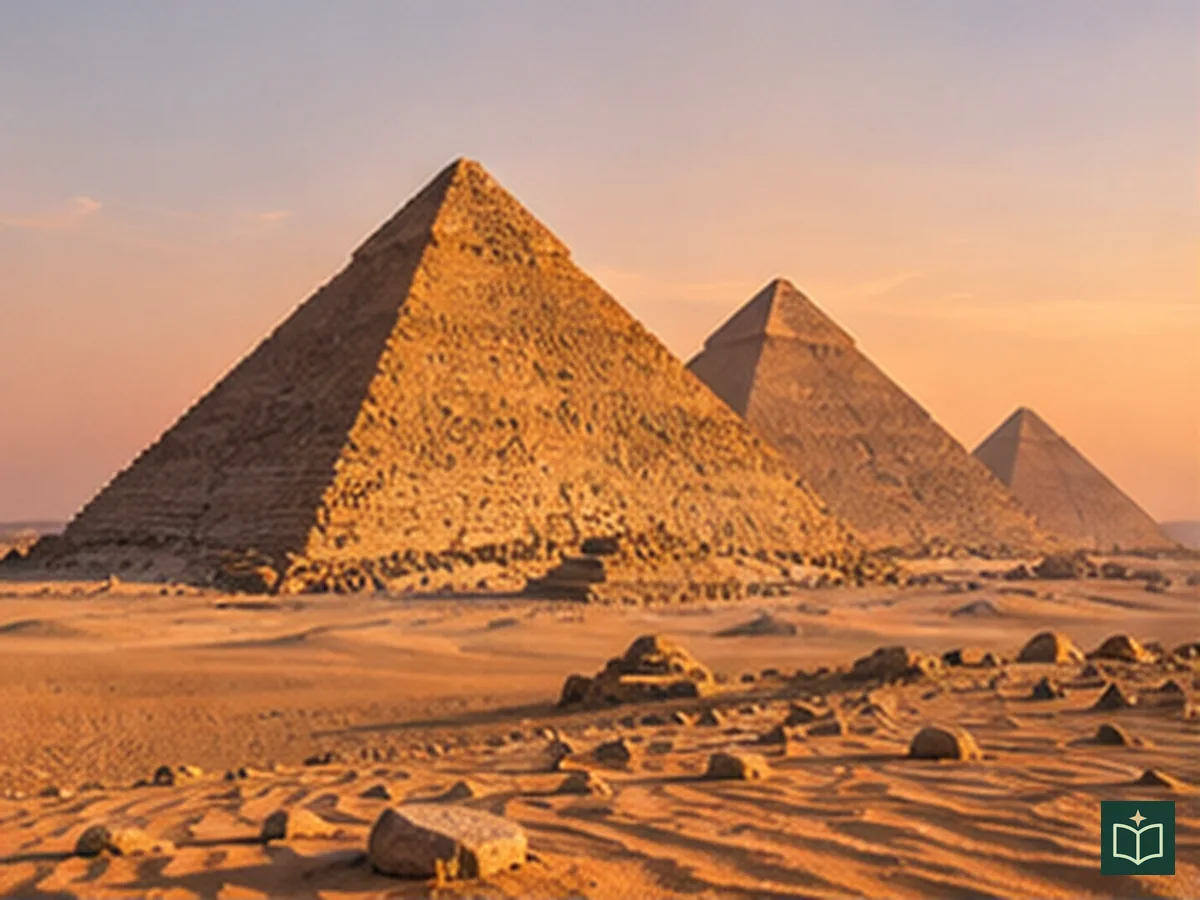
This ranking covers structures built before AD 500, measured by their original estimated height rather than what survives today. Several are ruined or vanished, so their heights come from ancient descriptions, surviving foundations and archaeological reconstruction. Where estimates vary widely, the table gives a central figure and labels it as an estimate. The Great Pyramid of Giza leads at about 146.6 metres when complete. Khafre’s pyramid, next to it, was about three metres lower but stands on higher ground, so it can look taller from some angles. Egypt’s great pyramids are covered in more detail elsewhere on this site; here they serve as the benchmark for the rest of the ancient world.
How ancient builders went high
Without steel frames, height depended on mass. Builders piled stone, rubble or brick into shapes with wide bases and sloping sides, so that each layer rested securely on the one below. A pyramid is the most stable possible tall structure, and the same principle governs ziggurats, temple mounds and stupas. The Great Pyramid contains roughly 2.3 million stone blocks. The approach had limits: Egypt’s Bent Pyramid changes angle partway up, probably because builders worried that the original slope was unstable, and the Meidum Pyramid partly collapsed. Those lessons led to the gentler, more successful profile of the Red Pyramid and then the pyramids at Giza.
Stupas of Sri Lanka
The most surprising entry is the Jetavanaramaya in Anuradhapura, Sri Lanka, built in the third and fourth centuries AD. Made of fired brick, it rose to about 122 metres and was among the tallest structures in the world when complete. It survives today at around 71 metres, much reduced but still one of the largest brick structures ever built, containing many millions of bricks. Stupas are Buddhist monuments that enshrine relics, and their solid domes were built for permanence rather than interior space. Other great stupas in Anuradhapura, such as Abhayagiri, were also very tall. The sacred city is a UNESCO World Heritage Site and a pilgrimage centre.
The lighthouse and the ziggurat
The Lighthouse of Alexandria, completed around 280 BC on the island of Pharos, guided ships into Egypt’s great harbour. Estimates of its height range from about 100 to 130 metres. It stood in three tiers and survived for well over a thousand years before earthquakes brought it down; by the 15th century its stones had been reused in a fort. Etemenanki, the great ziggurat of Babylon, is often linked with the biblical Tower of Babel. Rebuilt by Nebuchadnezzar II in the sixth century BC, it may have reached about 91 metres, but only its foundations remain in Iraq, so its true height is uncertain.
Disputed and missing
Some contenders are left out because their heights are too uncertain. The great stupa built by the Kushan king Kanishka near Peshawar, around AD 200, was described by Chinese pilgrims as enormously tall, and modern estimates range from about 120 to 170 metres; if the higher figures are right, it would have rivalled the Great Pyramid. Nothing survives above its foundations, however. China’s wooden Yongning Pagoda may also have been very tall but was built in the early sixth century, just after this list’s cut-off. In the Americas, La Danta at El Mirador in Guatemala was a vast Maya temple-platform, about 70 metres high on its base.
A record that lasted
The Great Pyramid remained the tallest structure on Earth until the spire of Lincoln Cathedral in England surpassed it around 1311, a reign of about 3,800 years. It is the only one of the Seven Wonders of the Ancient World that survives largely intact. Modern buildings have now multiplied its height: the Burj Khalifa in Dubai, at 828 metres, is more than five and a half times taller. Yet ancient monuments achieved something modern towers rarely aim for: permanence measured in millennia. Their surviving bulk still tells archaeologists about the organisation, labour and engineering knowledge of the societies that raised them.
Sources & further reading
- UNESCO · Memphis and its Necropolis ↗
- UNESCO · Sacred City of Anuradhapura ↗
- Britannica · Pyramids of Giza ↗
Figures are rounded and widely published; check the linked organisations for the latest editions. These organisations do not endorse this website.