The highest outside Asia
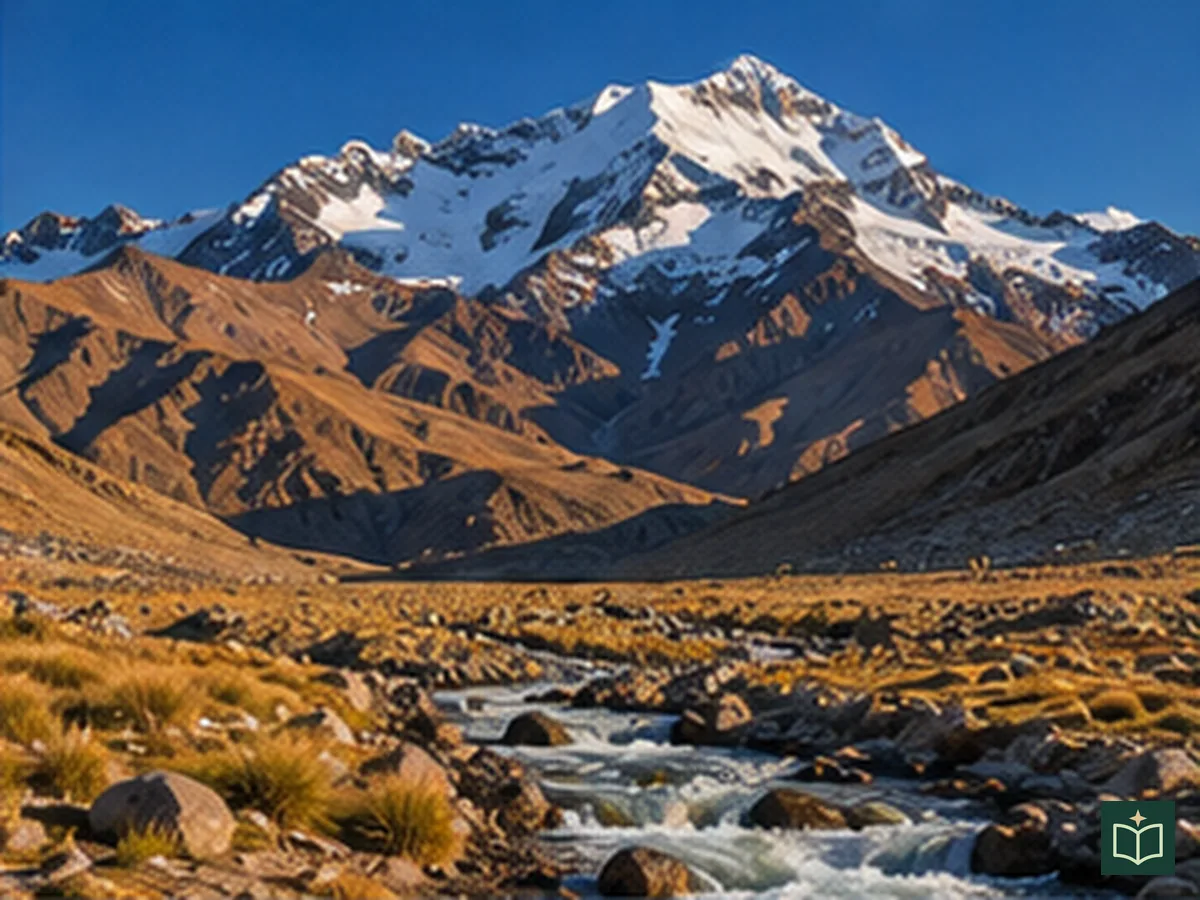
Aconcagua, at about 6,961 metres, is the highest mountain in the world outside the Himalaya and Karakoram, and the highest in both the Western and Southern hemispheres. It stands in Argentina, close to the Chilean border and about 110 kilometres from the city of Mendoza. It is roughly 1,900 metres lower than Everest. Despite its height, its normal route is not technically difficult, so it attracts thousands of climbers each season, though altitude sickness and violent winds make it serious. Aconcagua is not a volcano, although it contains volcanic rocks; it was raised by the folding and faulting of the crust as the Andes formed.
Built at a plate boundary
The Andes run for about 7,000 kilometres along the western edge of South America, the longest continental mountain range on Earth. They exist because the Nazca plate, beneath the Pacific, is sliding under the continent at several centimetres a year. That process, called subduction, squeezes and thickens the crust and generates magma that rises to form volcanoes. The result is a chain of high plateaus and peaks with frequent earthquakes. In the central Andes the crust is unusually thick, which supports the high Altiplano plateau of Bolivia and Peru and a remarkable concentration of summits above 6,000 metres along the border of Argentina and Chile.
Volcanoes in the desert
Most of the summits in this table are volcanoes. Ojos del Salado, second at about 6,893 metres, is the highest volcano on Earth and has fumaroles near its top. Llullaillaco, at about 6,739 metres, is famous for archaeology: in 1999 researchers found the remarkably preserved remains of three Inca children on its summit, left as offerings around 500 years ago, at one of the highest archaeological sites known. Many of these mountains rise from the edge of the Atacama Desert, one of the driest places on Earth. The arid air means that, unlike the Himalaya, some of these high peaks carry little permanent snow in summer.
Peru’s icy giant
Huascarán Sur, about 6,768 metres high in Peru’s Cordillera Blanca, is the only peak in the top ten outside the Argentina–Chile border region and the highest mountain in the tropics. The Cordillera Blanca holds the largest area of tropical glaciers in the world, but these are retreating fast. In 1970 an earthquake triggered a huge rock and ice avalanche from Huascarán that buried the town of Yungay, killing many thousands of people. Today the range’s meltwater supports farms and towns in the Santa valley, and scientists closely monitor its growing glacial lakes for the risk of sudden outburst floods that could threaten communities downstream.
Close calls and remeasurements
The heights of several Andean summits have been revised as satellite positioning replaced older surveys. Monte Pissis was long thought to be lower than nearby Bonete, while Mercedario was once given at more than 6,770 metres before modern surveys lowered it. Ojos del Salado was even suggested as a rival to Aconcagua in the 1950s, until measurements confirmed Aconcagua’s lead. Because many peaks in this table lie within about 100 metres of one another, small corrections can reorder them, and different lists also disagree over which subsidiary summits count as separate mountains. The heights here are rounded and should be treated as approximate.
Why the Andes matter
The Andes shape the climate of the whole continent. They block moist air from the Amazon, helping to create the Atacama’s extreme dryness on the Pacific side, and their glaciers and snowfields feed rivers relied on by cities such as Lima, La Paz and Santiago. They hold major deposits of copper, lithium and silver, which link the range to global supply chains, including those of the Gulf’s growing industries. Long before Europeans arrived, the Inca built roads and terraces across these mountains. For travellers from the Gulf, Aconcagua is a goal for climbers attempting the Seven Summits, the highest peak on each continent.
Sources & further reading
Figures are rounded and widely published; check the linked organisations for the latest editions. These organisations do not endorse this website.