What each one is
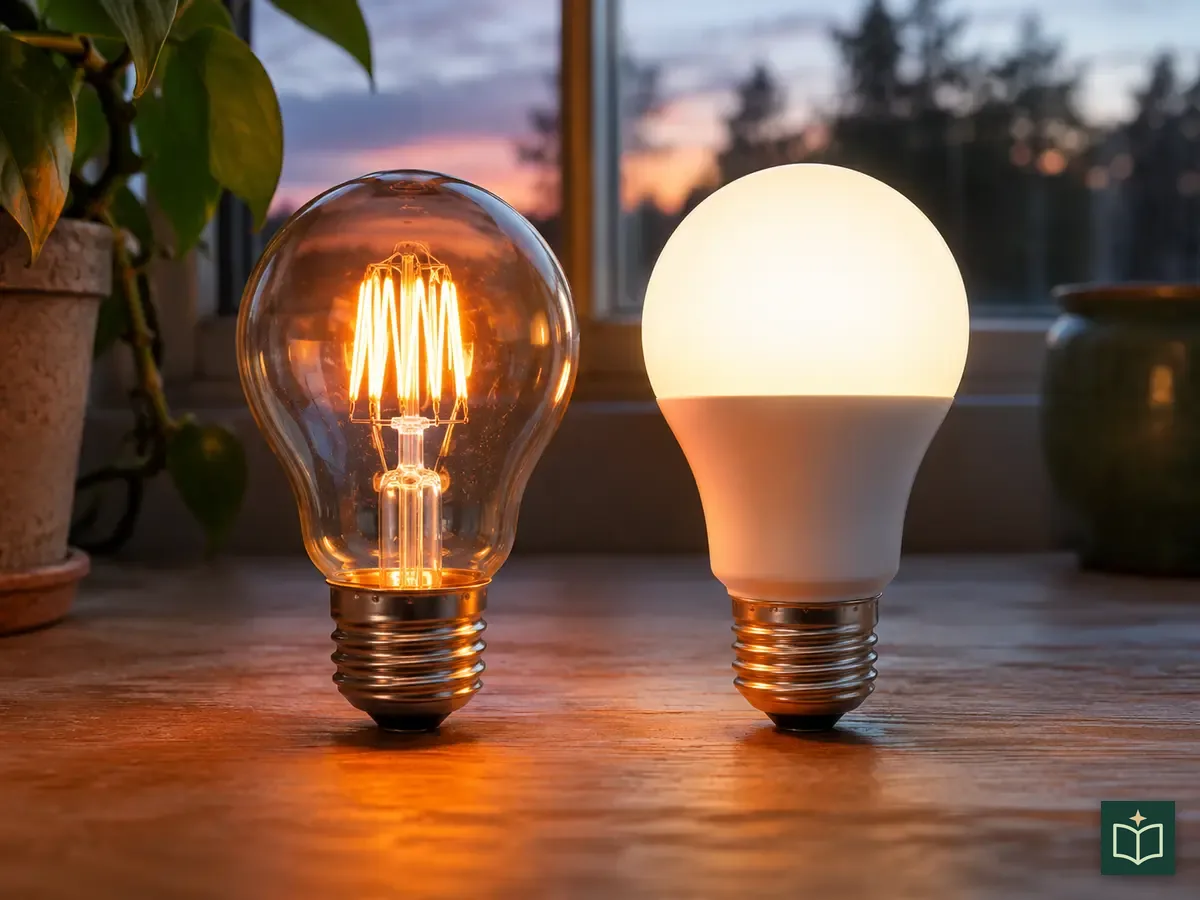
An incandescent bulb is one of the oldest electric technologies still in homes. Current flows through a thin tungsten filament, which resists it and heats to roughly 2,500°C. At that temperature the wire glows white-yellow. A light-emitting diode, or LED, is a small semiconductor chip. When current passes through it, electrons cross a junction between two layers of specially treated material and release energy as particles of light. There is no glowing wire and nothing needs to become extremely hot. Most white household LEDs use a blue chip coated with a phosphor, which converts part of the blue light into yellow and red so that the overall mix appears white to the eye.
Where the energy goes
The decisive difference is efficiency. A hot filament radiates across a broad spectrum, and most of that radiation is infrared heat that we cannot see. Only a small share, often quoted at around 10%, becomes visible light. An LED converts a much larger share of its electricity into visible light, and the rest becomes modest heat at the base, which is why good LED bulbs have metal or ceramic heat sinks. The practical result is that a bulb giving about 800 lumens, the brightness of a traditional 60 watt lamp, needs only around 8 to 10 watts as an LED. Comparing bulbs by lumens rather than watts avoids confusion when shopping.
A household example
Imagine a villa in Dubai with 40 bulbs, each burning five hours a day. As 60 watt incandescents they would use about 12 kilowatt-hours daily; as 9 watt LEDs, under 2 kilowatt-hours. Over a year the gap is roughly 3,700 kilowatt-hours. At an illustrative tariff of 0.30 AED per unit, that is more than 1,000 AED saved, before counting the cooling. In a hot climate the hidden cost of filaments is the heat they release indoors, which the air conditioner then has to remove. LEDs also last far longer, commonly rated at 15,000 to 25,000 hours, compared with about 1,000 hours for a standard incandescent bulb.
Where they are similar
For all their differences, the two share more than people assume. Both fit the same sockets, run on the same household supply and can be made in warm or cool tones. Both can produce pleasant, natural-looking light when well designed. Quality matters in each case: colour rendering, measured by an index called CRI, tells you how faithfully a lamp shows skin tones and food. Incandescent bulbs score very highly by nature, and better LEDs now score above 90. Both technologies can also be dimmed, although an LED needs compatible electronics and a suitable dimmer switch, or it may flicker or buzz at low settings.
How the change happened
Thomas Edison and Joseph Swan made filament bulbs practical around 1880, and the basic design barely changed for a century. Visible red LEDs appeared in the early 1960s, but they were dim and suited only to indicator lights. The breakthrough was the efficient blue LED, developed in Japan in the early 1990s, which made bright white LEDs possible; its inventors received the Nobel Prize in Physics in 2014. From the late 2000s many countries, including the European Union and the UAE, introduced efficiency standards that phased out most general-purpose incandescent bulbs. Prices then fell sharply as LED production scaled up.
Common misconceptions
LEDs are not completely cold, and they do not last forever. Their light output fades slowly, and the quoted lifespan usually means the point at which brightness falls to about 70% of the original. Heat is their main enemy: a bulb squeezed into a sealed fitting may fail early because the driver electronics overheat. Another myth is that all LEDs give harsh blue light. Warm-white versions, around 2,700 kelvin, closely resemble the colour of a filament. Finally, a cheap LED is not always a bargain; poor drivers can cause visible flicker, and weak colour rendering can make rooms look flat and dull.
Sources & further reading
- US Department of Energy · LED lighting ↗
- Britannica · Light-emitting diode ↗
- Nobel Prize · Physics 2014 ↗
Figures are rounded and widely published; check the linked organisations for the latest editions. These organisations do not endorse this website.