Height versus volume
Waterfall rankings usually celebrate height, which puts Venezuela’s Angel Falls, with a drop of 979 metres, at the top. Measured by volume, the picture changes completely. Angel Falls carries little water, while the greatest flows occur where very large rivers tumble over rapids and steps that may be only a few metres high. This list ranks waterfalls by their mean flow, the average volume of water passing each second over a year. Flow is given in cubic metres per second. One cubic metre is a thousand litres, so a flow of 25,000 cubic metres per second means 25 million litres every second.
The Congo’s great cascades
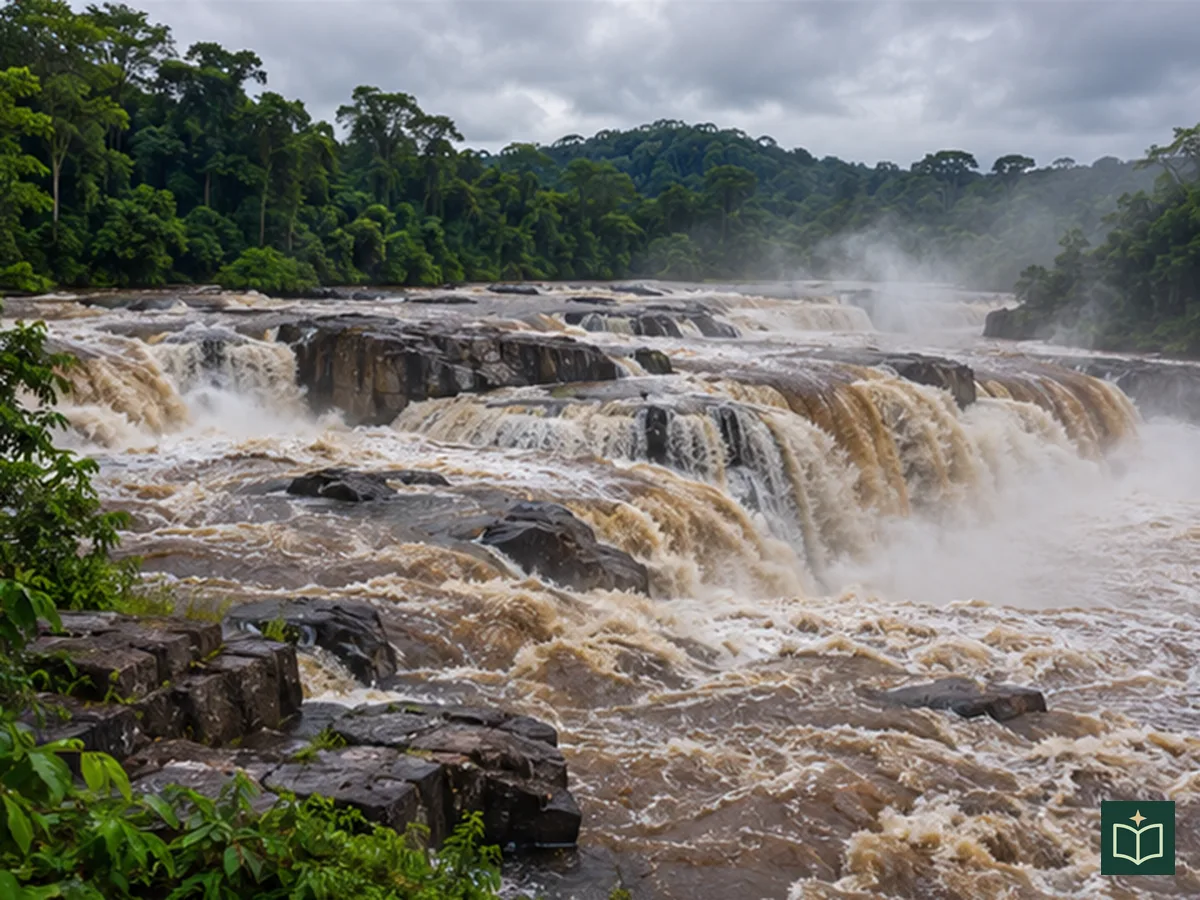
Three of the top four lie on the Congo, the river with the second-largest discharge in the world after the Amazon. Boyoma Falls, formerly Stanley Falls, is a chain of seven cataracts stretching about 100 kilometres along the river near Kisangani. Further downstream, below the capital Kinshasa, the river drops towards the Atlantic through Livingstone Falls, a long series of rapids, and Inga Falls, where the river plunges through a steep, narrow section. Inga’s average flow of about 25,800 cubic metres per second would fill around ten Olympic swimming pools every second. The site already hosts two hydroelectric dams, and much larger schemes have been proposed.
Khone Phapheng on the Mekong
Khone Phapheng Falls, in southern Laos near the border with Cambodia, is the largest waterfall in Southeast Asia by volume. There the Mekong breaks into hundreds of channels around islands in an area known as Si Phan Don, or the Four Thousand Islands, and drops over a series of rocky ledges. The falls block navigation on the river. In the colonial era the French built a short railway across the island of Don Det so that boats could be carried around the obstacle, and parts of it can still be seen. The falls are also important for fishing, with traditional traps set in the channels.
Niagara, Iguazú and Victoria
The world’s most famous waterfalls rank lower by flow. Niagara Falls, on the border of Canada and the United States, carries an average of about 2,400 cubic metres per second, but much of the river is diverted to hydroelectric plants, especially at night and outside the tourist season, under a treaty between the two countries. Iguazú, on the border of Argentina and Brazil, is a horseshoe of about 275 separate drops. Victoria Falls, between Zambia and Zimbabwe, averages about 1,100 cubic metres per second and does not make the top ten, though it forms the largest single sheet of falling water when the Zambezi floods.
Falls lost to dams
Some of the greatest falls no longer exist. Guaíra Falls, on the Paraná River between Brazil and Paraguay, carried an average of about 13,300 cubic metres per second and would rank fourth today. It was drowned in 1982 by the reservoir of the Itaipu Dam, one of the largest hydroelectric plants in the world. Celilo Falls on the Columbia River in the United States, an important fishing site for Native American peoples for thousands of years, disappeared beneath a reservoir in 1957. The same features that make a waterfall powerful, a large river and a steep drop, also make it attractive for generating electricity.
Flow that changes with the seasons
Average flows hide large swings. Rivers fed by monsoon or tropical rains can carry many times their mean flow during floods and far less in the dry season. Victoria Falls sends up a towering column of spray at high water but can shrink to separate trickles in a dry year. The Congo is unusually steady, because its huge basin straddles the equator and receives rain in both hemispheres at different times of year. For readers in the UAE, where there are no permanent rivers, the comparison is striking: the Congo at Inga moves more water in under a minute than the UAE’s largest desalination plant produces in a whole day.
Sources & further reading
Figures are rounded and widely published; check the linked organisations for the latest editions. These organisations do not endorse this website.