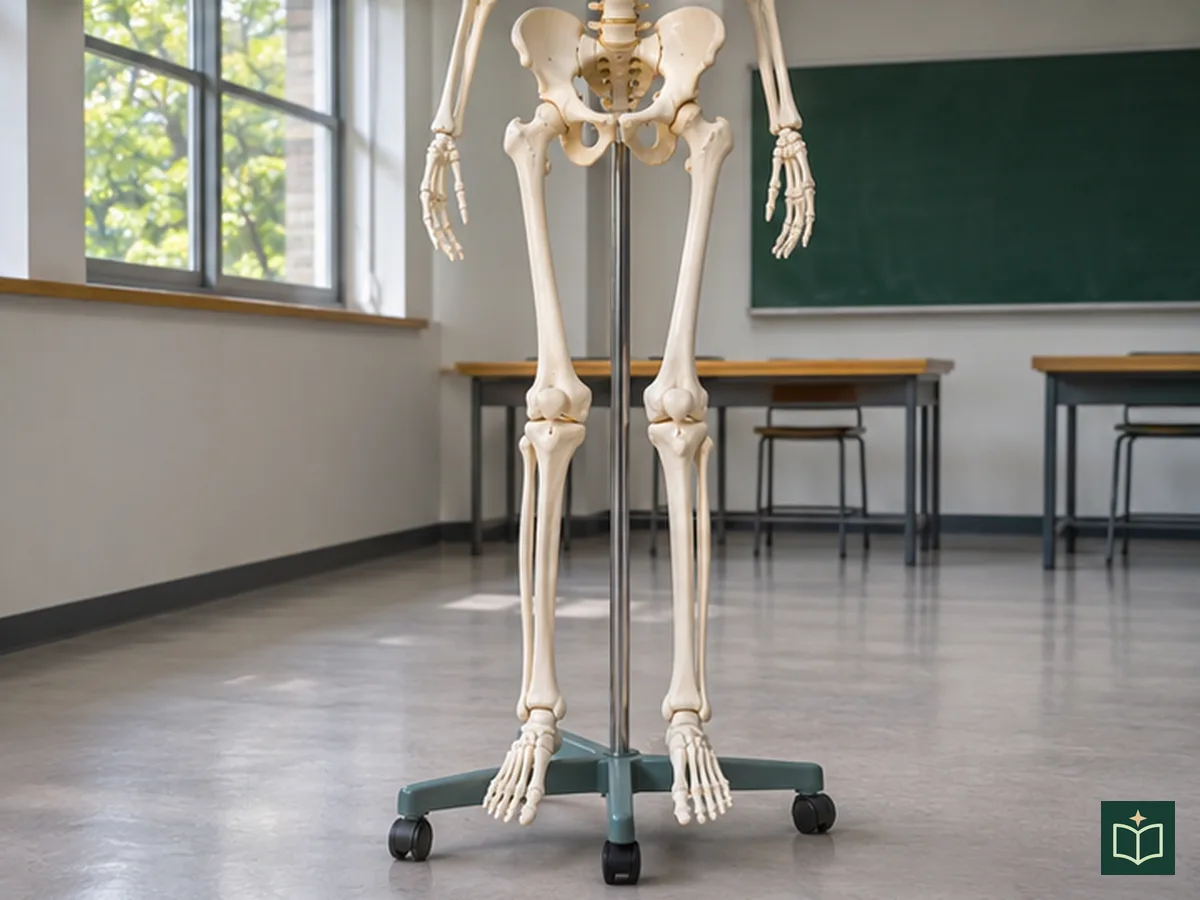
A skeleton of 206 bones
An adult skeleton usually contains 206 bones, from the tiny stapes in the middle ear, about three millimetres long, to the femur in the thigh. Anatomists group them by shape: long bones, short bones such as those in the wrist, flat bones such as the skull and ribs, and irregular bones such as the vertebrae. Long bones have a hollow shaft filled with marrow and wider ends that form joints. The values in this table are typical lengths for a tall adult man and are rounded. Women and shorter people have proportionally shorter bones, but the order of the list stays much the same.
The femur
The femur is the longest, heaviest and strongest bone in the body. It runs from the hip to the knee and carries the weight of the upper body when standing, walking and running. During running, the forces on it can reach several times body weight. Its length is closely tied to height, at roughly a quarter of a person’s stature, which is why forensic scientists and archaeologists can estimate how tall someone was from a single thigh bone. For a person 175 centimetres tall, a quarter-based estimate gives a femur of about 45 centimetres. The neck of the femur, near the hip, is a common site of fractures in older people.
The lower leg
Below the knee, two bones run side by side. The tibia, or shinbone, is the larger and carries most of the body’s weight down to the ankle. Its front edge lies just under the skin, which is why knocks to the shin are so painful. The fibula, running along the outside of the leg, is almost as long but much thinner. It carries only a small share of the load and mainly anchors muscles and helps steady the ankle. Because it is less essential for bearing weight, surgeons sometimes take part of the fibula to rebuild bone elsewhere in the body, such as the jaw.
The arm
The arm repeats the pattern of the leg on a smaller scale. The humerus runs from the shoulder to the elbow. A nerve that passes close to its lower end is the cause of the tingling felt when people hit their so-called funny bone. The forearm has two bones. The ulna, on the little-finger side, is slightly longer and forms the hinge of the elbow. The radius, on the thumb side, is shorter but wider at the wrist, and it can rotate around the ulna, which allows the palm to turn up or down. A fall onto an outstretched hand often breaks the radius just above the wrist.
Ribs, hips and breastbone
Ribs are curved, flat bones, and their length increases from the first rib at the top of the chest to about the seventh, then decreases again. The seventh and eighth ribs are the longest when measured end to end, with the curve adding further length. Each hip bone forms from three bones, the ilium, ischium and pubis, which fuse during the teenage years into a single broad structure that supports the spine and holds the hip joint. The sternum, or breastbone, joins most of the ribs at the front through flexible cartilage, allowing the chest to expand with every breath.
Growing and keeping strong bones
Long bones grow in length at growth plates near their ends, layers of cartilage that are gradually replaced by bone until they close in the late teens or early twenties, when adult height is reached. Bone is living tissue that is constantly broken down and rebuilt, and it needs calcium, vitamin D and regular weight-bearing exercise to stay strong. Vitamin D deficiency is surprisingly common in the Gulf despite the strong sun, partly because people spend much of the hot day indoors and keep skin covered. Anyone concerned about bone health or vitamin levels should seek advice from a doctor, who can arrange simple tests.
Sources & further reading
Figures are rounded and widely published; check the linked organisations for the latest editions. These organisations do not endorse this website.