Who decides a record
Weather records are only as good as the measurements behind them. The World Meteorological Organization keeps a Weather and Climate Extremes Archive, and when a new extreme is reported it appoints a panel of experts to investigate. They check the thermometer and its calibration, the shelter it sat in, the site around it and whether the weather that day could produce such a reading. Official temperatures are measured in shade, inside a ventilated screen about 1.5 metres above the ground. This table lists the highest readings accepted for each continent or region, plus the Arctic and Antarctic, ranked from hottest to coolest.
Death Valley and its doubts
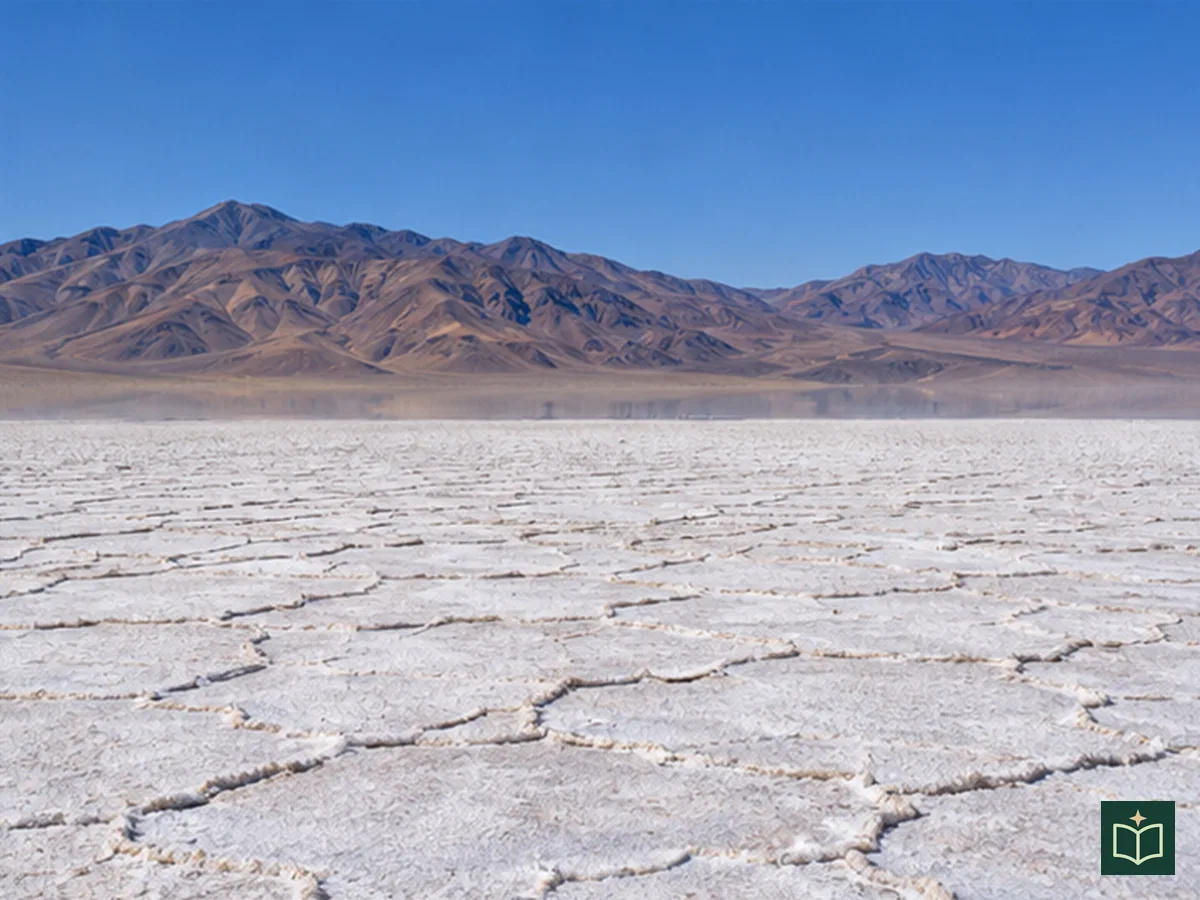
The world record of 56.7°C was logged at Greenland Ranch, now Furnace Creek, in California’s Death Valley on 10 July 1913. Death Valley lies below sea level in a deep, narrow basin surrounded by mountains, so sinking air warms as it descends and heat builds up over the bare ground. Some meteorologists doubt the 1913 reading, pointing to inconsistencies with nearby stations at the time, but it remains on the official list. More recent readings of about 54.4°C at Furnace Creek, in 2020 and 2021, are regarded by many experts as among the most reliable very high temperatures ever measured.
Struck off the list
For ninety years the world record belonged to Al Aziziyah in Libya, which reported 58.0°C in 1922. In 2012 a WMO panel rejected it after finding that the observer was probably inexperienced, the instrument was unsuitable and the reading was out of line with others in the region. The decision handed the title back to Death Valley. Tunisia’s 55.0°C at Kebili in 1931 is now Africa’s accepted record, although it too has been questioned. Investigations like these show that a famous number is not necessarily a reliable one, and the archive is updated when new evidence emerges. Libya’s figure had stood unchallenged in textbooks for decades.
Asia’s hottest readings
In 2019 the WMO confirmed two readings as the highest reliably measured in Asia: 53.9°C at Mitribah in Kuwait on 21 July 2016, and 53.7°C at Turbat in southern Pakistan on 28 May 2017. They are listed as the third and fourth highest accepted temperatures on Earth. A higher reading of 54.0°C from Tirat Zvi, in the Jordan Valley, dates from 1942 and is listed under the WMO’s region that includes Europe and the Middle East. Gulf summers routinely bring temperatures above 50°C in Kuwait, Iraq, Iran, Oman and the inland deserts of the UAE, so the region is closely watched for new records.
Every continent
The lower half of the table shows how widely heat records vary. Australia’s highest accepted reading is 50.7°C at Oodnadatta in 1960, and South America’s is 48.9°C at Rivadavia in Argentina in 1905. Europe’s continental record of 48.8°C was set near Siracusa in Sicily in August 2021, after a WMO review. In June 2020 the Siberian town of Verkhoyansk, better known for extreme cold, reached 38.0°C, the highest accepted temperature inside the Arctic Circle. In February 2020 Argentina’s Esperanza Base on the Antarctic Peninsula recorded 18.3°C, a record for the Antarctic continent. Such polar records draw attention because the Arctic is warming several times faster than the global average.
Air versus ground
These figures are air temperatures, and they are far lower than the temperature of the ground itself. Satellites measuring land surface temperature have recorded readings around 70°C in the Lut Desert of Iran and in other dark, sun-baked deserts. Those readings are not comparable with weather station records, which aim to measure the air people breathe. Climate change is raising the odds of new heat records, but it is the long-term rise in average temperatures, not any single extreme, that scientists use to track warming. Each new claim still has to pass the same careful checks before it enters the archive.
Sources & further reading
- WMO · Weather and Climate Extremes Archive ↗
- WMO · Verification of 3rd and 4th hottest temperatures ↗
Figures are rounded and widely published; check the linked organisations for the latest editions. These organisations do not endorse this website.