What an amphitheatre was
The Roman amphitheatre was a distinctive building: an oval arena surrounded on all sides by rising tiers of seats, so that every spectator faced the action. Unlike a theatre, which was semicircular and used for plays, the amphitheatre was built for gladiator combat, wild animal hunts and public executions. The earliest stone examples appeared in southern Italy in the first century BC, and hundreds were eventually built across the empire, from Britain to Syria and North Africa. Their size reflected a city’s population, wealth and the generosity of local patrons. Seating was arranged by social rank, with senators and officials closest to the arena and women and slaves highest up.
Ranking the arenas
This table ranks amphitheatres by estimated capacity, using figures from the Nîmes Arenas’ online guide to Roman amphitheatres, itself one of the best-preserved examples. Capacity is calculated from the length of seating that survives or can be reconstructed, allowing a fixed width of bench for each person, so the numbers are estimates and differ between sources. Rankings by outer size broadly agree at the top: the Colosseum measures about 188 by 156 metres, Capua about 170 by 140, Italica about 157 by 134 and El Jem about 148 by 122. Some large arenas, such as those at Carthage and Milan, survive only as foundations, so their capacities are uncertain and they are left out.
The Colosseum
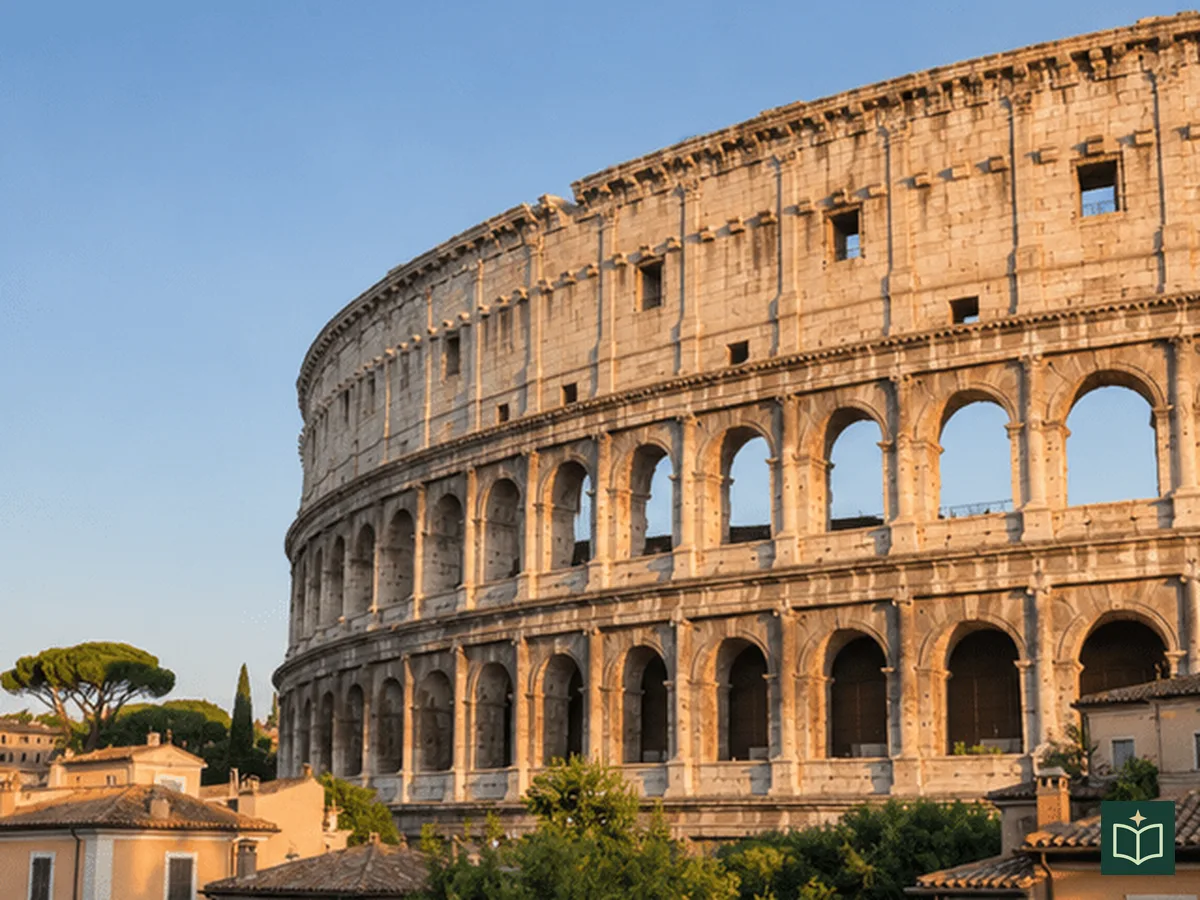
The Flavian Amphitheatre, known today as the Colosseum, was begun by the emperor Vespasian around AD 70 and inaugurated by his son Titus in AD 80 with games said to have lasted a hundred days. It held about 50,000 people, entering through 80 numbered arches that allowed the crowd to fill and empty quickly. A huge canvas awning, the velarium, could shade spectators, worked by sailors from the imperial fleet. Beneath the arena floor, a network of tunnels and lifts, the hypogeum, raised animals and scenery into view. Its ruined state is largely due to earthquakes and centuries of stone being taken for other buildings.
Capua and Italica
The amphitheatre at Capua, near Naples, was second only to the Colosseum. The city was famous for its gladiator schools, and it was from one of them that Spartacus led his revolt in 73 BC, although the surviving arena was built later. Italica, near Seville in southern Spain, was the birthplace of the emperors Trajan and Hadrian, and its amphitheatre was enlarged as the city gained imperial favour. Both arenas are now partly ruined, their upper tiers lost, but their size remains impressive. Their place near the top of the list shows how wealthy provincial and Italian cities competed to stage spectacles on a scale approaching that of Rome.
Verona and El Jem
Verona’s arena, in northern Italy, is among the best-preserved amphitheatres and still hosts a summer opera festival, a tradition begun in 1913. The amphitheatre at El Jem, ancient Thysdrus in Tunisia, was built in the third century AD in a town enriched by the olive-oil trade. It stands almost complete, rising above the surrounding houses, and is a UNESCO World Heritage Site. Further down the list, the amphitheatres of Nîmes and Arles in southern France and Pula in Croatia also survive remarkably intact. Nîmes and Arles still stage events, and their stonework gives visitors a vivid sense of how such buildings worked.
Why they still matter
Roman amphitheatres influenced the design of modern stadiums, from the oval shape to numbered entrances and tiered seating by price. Their scale is still striking: the Colosseum’s capacity is comparable with many modern football grounds, and the Roman world had no amplified sound or electric light. Arenas also tell a darker story about entertainment based on violence and death. Many have become major tourist sites, and the Colosseum draws millions of visitors a year. In the Middle East, Roman arenas are rarer than theatres, though the hippodrome at Jerash in Jordan, built for chariot races, and the many theatres of the region show that public spectacle reached the empire’s eastern provinces too.
Sources & further reading
Figures are rounded and widely published; check the linked organisations for the latest editions. These organisations do not endorse this website.