The Sentinel Range
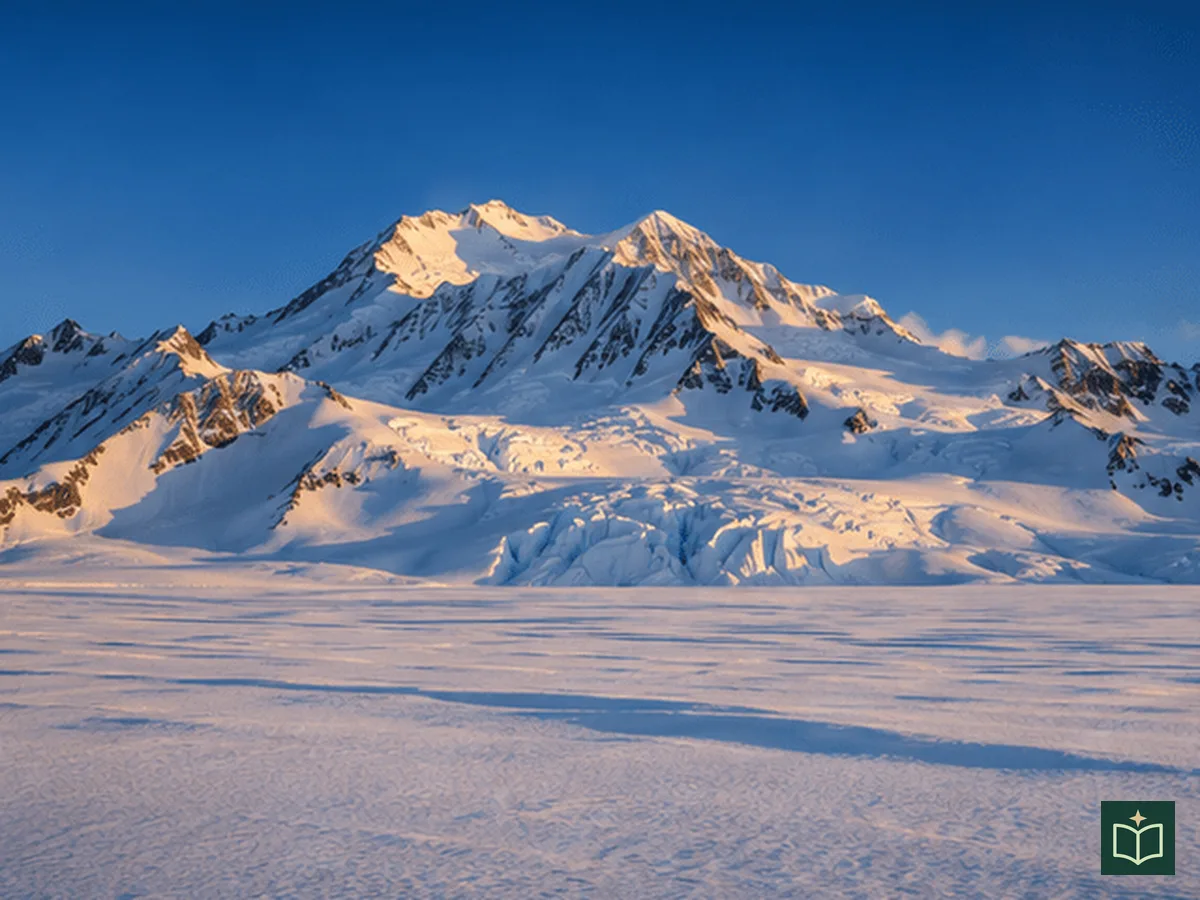
Antarctica’s highest ground lies not near the South Pole but in the Ellsworth Mountains, a range about 350 kilometres long near the base of the Antarctic Peninsula. Its northern part, the Sentinel Range, holds seven of the ten summits in this table, including the top four. The range rises abruptly from the West Antarctic ice sheet, with steep faces and long glaciers on its flanks. It was first seen from the air in 1935 by the American explorer Lincoln Ellsworth, after whom it is named, but its highest peaks were not identified and mapped until United States Navy flights in the late 1950s. Many peaks are named after people from that era of exploration.
Mount Vinson
Mount Vinson, the summit of the Vinson Massif, is about 4,892 metres high, a figure set by a satellite survey in 2004 that replaced older, higher estimates. It was first climbed in December 1966 by an American expedition, and it has since become one of the Seven Summits, the highest peaks on each continent. Climbers typically fly from Punta Arenas in Chile to a blue-ice runway at Union Glacier, then to a base camp on the mountain. Its routes are not especially technical, but the cold, wind and isolation make it serious: summer temperatures near the summit often fall below minus 30°C, and rescue is far away.
Tyree and its neighbours
Mount Tyree, about 4,852 metres, is only some 40 metres lower than Vinson but far harder to climb, with steep rock and ice on every side. It was first climbed in 1967 and has seen very few ascents since. Mount Shinn and Mount Gardner complete the Sentinel Range’s top four, followed further down by Epperly, Rutford and Craddock. Mount Epperly remained unclimbed until 1994, when the Swiss mountaineer Erhard Loretan reached its summit alone. Because these peaks are so remote, heights for several of them have been revised as better survey data became available, and the gaps between some lower places are only a few metres.
The Transantarctic peaks
Three summits in the table stand far away in the Transantarctic Mountains, which cross the continent for more than 3,000 kilometres and divide East from West Antarctica. Mount Kirkpatrick, about 4,528 metres, is famous among geologists as well as climbers: in the early 1990s, researchers found the fossil of a crested meat-eating dinosaur, named Cryolophosaurus, on its slopes, evidence that Antarctica once had a warmer climate and forests. Mount Elizabeth stands nearby in the same Queen Alexandra Range. Mount Markham, about 4,350 metres, was sighted in 1902 during Robert Falcon Scott’s first Antarctic expedition and named after one of its main supporters.
Ice that hides the land
Antarctica is the highest continent on average, mainly because its ice sheet is about two kilometres thick in many places. Under that ice lie mountain ranges and deep basins; in places the bedrock dips more than 2,000 metres below sea level. The summits in the table are measured above sea level to the top of their snow and ice, as for mountains elsewhere. Volcanoes form a separate group: Mount Erebus, at about 3,794 metres, is an active volcano with a lava lake, and Mount Sidley, about 4,285 metres, is the continent’s highest volcano. Neither reaches the top ten, which is formed by uplifted blocks of ancient rock.
Climbing and protection
Only a few hundred people climb in Antarctica each season, almost all supported by specialist operators flying from Chile. Under the Antarctic Treaty system, expeditions must follow strict environmental rules, including removing their waste and avoiding damage to fragile sites. Even so, interest in Vinson has grown steadily, including among climbers from the Gulf, as part of attempts on the Seven Summits. Scientists also visit the region to study how the West Antarctic ice sheet is changing, because its loss could raise global sea levels by several metres over centuries. The high peaks provide fixed points for measuring how fast the surrounding ice is thinning and flowing.
Sources & further reading
Figures are rounded and widely published; check the linked organisations for the latest editions. These organisations do not endorse this website.