What counts as a peninsula
A peninsula is a piece of land surrounded by water on most sides but connected to a larger landmass. The word comes from the Latin for almost an island. Small examples, such as Qatar or Musandam, are easy to define, but for the largest peninsulas the boundary with the mainland is a matter of convention. Geographers may draw it along a mountain range, a river or a line between two gulfs. Because of this, published areas differ, sometimes by hundreds of thousands of square kilometres, and some lists include regions others do not. The figures here are rounded and follow commonly used estimates, so the closer places should be read as approximate.
Arabia first
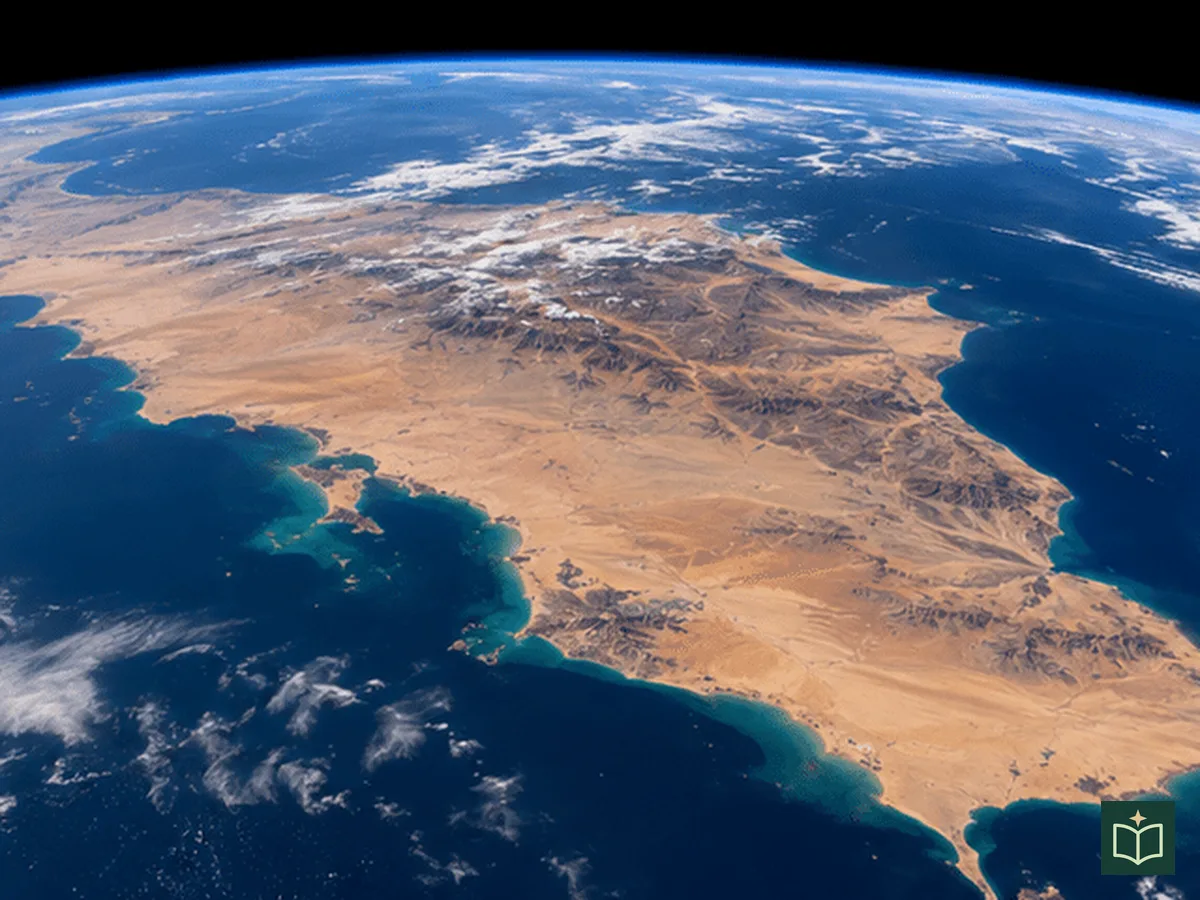
The Arabian Peninsula covers about 3.1 million square kilometres, bounded by the Red Sea to the west, the Gulf of Aden and Arabian Sea to the south, and the Gulf of Oman and Arabian Gulf to the east. Its northern edge, where it meets the Syrian Desert and Mesopotamia, has no clear natural line, which is why estimates vary. Saudi Arabia covers roughly two thirds of the peninsula, with Yemen, Oman, the UAE, Qatar, Kuwait and Bahrain sharing the rest. Comparing the extremes in the table, Arabia is about five times the size of the Iberian Peninsula, and larger than India’s Deccan by more than a million square kilometres.
A peninsula on its own plate
Arabia is more than a geographical shape; it sits on its own tectonic plate. About 25 to 30 million years ago, the Arabian plate began to split from Africa, opening the Red Sea and the Gulf of Aden. It is still moving north-east into Eurasia at a few centimetres a year, a collision that raised the Zagros Mountains of Iran and helped form the shallow basin of the Arabian Gulf. The same geology trapped the oil and gas reserves that transformed the region’s economies. The plate tilts gently, with high mountains in the west, in Yemen and the Sarawat range, and lower land sloping towards the Gulf coast.
Asia’s other giants
Second and third places belong to southern Asia. The Indochinese Peninsula, about 2 million square kilometres, includes Myanmar, Thailand, Laos, Cambodia, Vietnam and peninsular Malaysia, bounded by the Bay of Bengal and the South China Sea. India’s Deccan, the triangular southern part of the subcontinent, covers about 1.9 million square kilometres, depending on where its northern edge is drawn. In Africa, the Somali Peninsula, or Horn of Africa, is almost exactly the same size and lies directly across the Gulf of Aden from Yemen. North America’s largest is the Labrador Peninsula in eastern Canada, a vast region of forest, lakes and tundra shared by Quebec and Newfoundland and Labrador.
Europe and Antarctica
Europe is itself sometimes described as a peninsula of Asia, and it has several large peninsulas of its own. Anatolia, which forms most of Türkiye, and the Scandinavian Peninsula, shared by Norway and Sweden with a small part of Finland, are almost identical in size at about three quarters of a million square kilometres. The Balkan Peninsula follows, though its northern boundary is especially uncertain. The Iberian Peninsula, home to Spain and Portugal, covers about 580,000 square kilometres. The Antarctic Peninsula, stretching towards South America, closes the list. Smaller but famous examples, such as Italy, Korea and Florida, are well below the threshold for the top ten.
Why peninsulas matter
Peninsulas have shaped history because they combine long coastlines with protected interiors. Sea access encouraged trade and seafaring, from the Phoenicians of the Levant to the navigators of Portugal and the pearl divers and merchants of the Gulf. Their narrow necks made them easier to defend, and their position between seas often turned them into crossroads, as with Anatolia between Europe and Asia. Arabia’s location between Africa, Asia and Europe placed it on ancient incense and spice routes, and today on major shipping lanes through the Strait of Hormuz and Bab el-Mandeb. Its long coastline also explains the importance of ports from Jeddah to Dubai.
Sources & further reading
Figures are rounded and widely published; check the linked organisations for the latest editions. These organisations do not endorse this website.