The wandering albatross
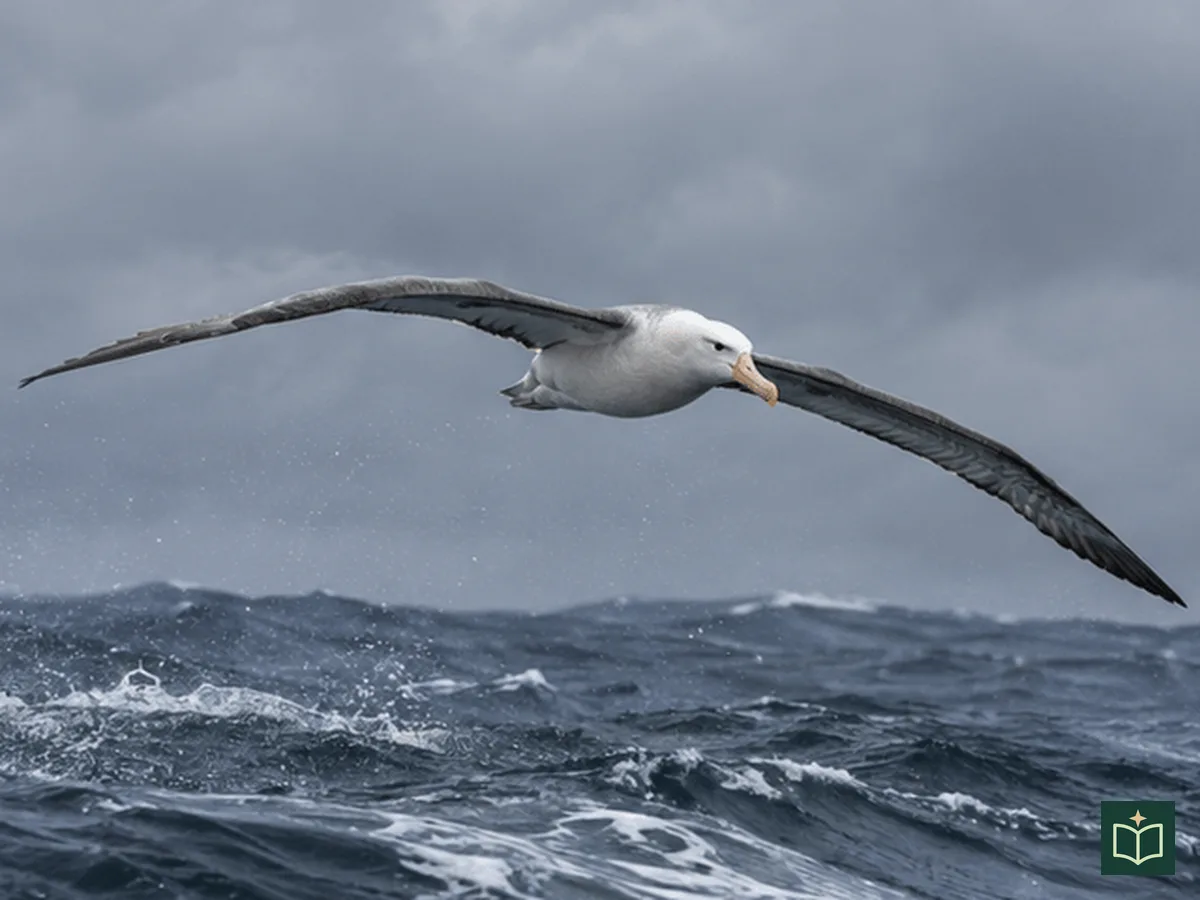
The wandering albatross of the Southern Ocean holds the record for the longest wings of any living bird. Most adults measure about 3.1 metres from tip to tip, and the largest reliably measured individuals reach about 3.5 metres or slightly more. The bird itself weighs only around 8 to 12 kilograms, so its wings are extremely long relative to its body. It breeds on remote sub-Antarctic islands, such as South Georgia and the Crozet Islands, raising a single chick over most of a year. Between breeding seasons it may spend years at sea, circling the globe in the band of strong westerly winds that blows around Antarctica.
Flying without flapping
Albatrosses fly using a technique called dynamic soaring. Wind near the sea surface is slowed by friction with the waves, while wind a few metres higher blows faster. By repeatedly climbing into the faster air, turning, and diving back down, the bird gains energy from the difference, much as a sailor tacks across the wind. A locking tendon in the shoulder holds the wings out without constant muscle effort. As a result, albatrosses can travel hundreds of kilometres a day while barely flapping, and studies of tagged birds show their heart rate in flight is close to its resting level. Calm days, by contrast, can leave them sitting on the water.
Pelicans and condors
Behind the albatrosses come very different birds. The great white pelican and the Dalmatian pelican, among the heaviest flying birds, have broad wings of more than three metres and soar in flocks on rising warm air, or thermals, during migration. The Dalmatian pelican winters in parts of the Middle East and is occasionally recorded in the Gulf. The Andean condor, with wings of up to about 3.2 metres, soars over mountains and coasts in South America. A study published in 2020 found that one condor flew more than 170 kilometres over about five hours without flapping, and that the birds spent only about one per cent of their flying time beating their wings.
Vultures, storks and swans
The lower places are tightly bunched, with several species reaching about three metres. The Himalayan and cinereous vultures, which ride thermals over the mountains and steppes of Asia, are among the largest birds of prey. The marabou stork of Africa is sometimes credited with the largest wingspan of all, but such claims have not been reliably confirmed. The trumpeter swan of North America is one of the heaviest flying birds as well as one of the widest. In Arabia, the lappet-faced vulture, found in the UAE, Saudi Arabia and Oman, spans up to about 2.9 metres, just outside the table. Wingspans vary between individuals, so the order of the last places shifts between sources.
Lost giants of the air
Some extinct birds had far larger wings. Pelagornis sandersi, a seabird that lived around 25 million years ago, is estimated from fossils found in South Carolina to have had a wingspan of roughly six to seven metres, about twice that of today’s albatrosses. Argentavis, a condor-like bird from South America that lived about six million years ago, may have had a similar span. Calculations suggest such giants could only have flown by soaring, using winds and thermals to stay aloft, because their muscles could not have powered sustained flapping flight. Their fossils help scientists understand the physical limits that govern how large a flying animal can become.
Threats and protection
Long wings make albatrosses superb travellers but expose them to danger at sea. Many are caught on baited hooks set by longline fishing boats, drowning as the lines sink. Several albatross species are listed as threatened, and the wandering albatross is classed as vulnerable. An international agreement, the Agreement on the Conservation of Albatrosses and Petrels, encourages fleets to use simple measures such as weighted lines, night setting and bird-scaring streamers. Vultures face different threats, including poisoning and collisions with power lines. In the Gulf, conservation programmes for the lappet-faced vulture include monitoring nests and reducing the risk from power infrastructure.
Sources & further reading
- Britannica · Albatross ↗
- Agreement on the Conservation of Albatrosses and Petrels ↗
- Britannica · Andean condor ↗
Figures are rounded and widely published; check the linked organisations for the latest editions. These organisations do not endorse this website.