What counts as an industrial robot
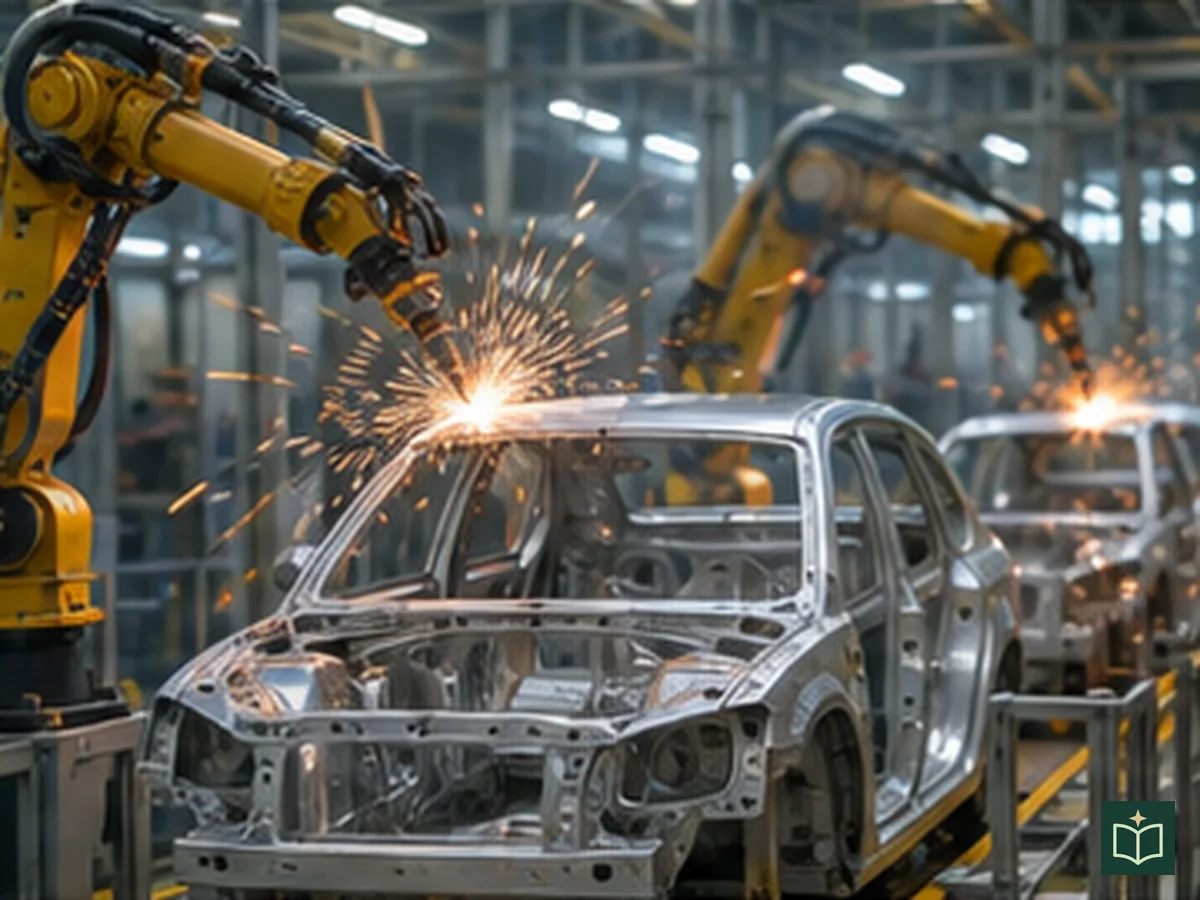
In a modern car plant, rows of orange or yellow arms swing in unison, welding body panels in showers of sparks. These are industrial robots: automatically controlled, reprogrammable machines that can move a tool along several axes. The most common type is the articulated arm, loosely modelled on a human arm with a shoulder, elbow and wrist. Others include fast, four-axis SCARA robots used to place electronic components, spider-like delta robots that pick items from conveyor belts in a blur, and gantry systems moving along overhead rails. What unites them is flexibility. Unlike single-purpose machines, the same robot can be reprogrammed for a new product or task.
Inside the arm
A typical articulated robot has six joints, each turned by an electric servo motor through a precise reduction gearbox that trades speed for strength. Six axes allow the tool at the end to reach a point in space and to approach it at any angle, as your hand can. Each joint has an encoder that measures its exact angle many times a second, feeding back to a controller, a cabinet of electronics that calculates how every motor must move to follow the desired path smoothly. The tool at the end, called the end effector, is swapped to suit the job: a gripper, a welding torch, a paint gun, suction cups or a screwdriver.
Precision and repeatability
Robot specifications distinguish two qualities. Accuracy is how closely the arm reaches a position defined in software; repeatability is how consistently it returns to the same point time after time. Industrial arms are typically far better at repeating than at absolute accuracy. A small assembly robot may repeat a position to within about 0.02 millimetres, less than the width of a human hair, which is roughly 0.07 millimetres. Large arms carrying hundreds of kilograms are less precise but still consistent to a fraction of a millimetre. Calibration, temperature changes and wear all affect performance, so factories schedule regular checks, and many add cameras so robots can correct for parts that are slightly out of place.
Teaching a robot
Robots do nothing until programmed. The traditional method uses a teach pendant, a handheld controller with which a technician jogs the arm to each key position and records it, building up a sequence of moves. That is precise but takes the robot out of production. Increasingly, engineers use offline programming: they build a digital model of the work cell, plan and test the motions in simulation, check for collisions and then download the program. Vision systems let robots locate parts that arrive in random positions. Some collaborative models can be taught by hand, an operator simply guiding the arm through the motions while it records them, which makes small production runs practical.
Keeping people safe
A large robot arm moves with enough force to cause serious injury, and it gives no warning before it starts. Traditional installations therefore keep people out entirely, using fences, interlocked gates and light curtains that stop the robot instantly if a beam is broken. International safety standards, notably ISO 10218, set requirements for design and installation. A newer class of collaborative robots, often called cobots, is designed to work alongside people. They move more slowly, have rounded shapes and sense unexpected contact, stopping when they bump into something. Even so, every application needs a risk assessment, because a harmless arm holding a sharp blade or a heavy part may still be dangerous.
Where robots work, and where they do not
The first industrial robot, Unimate, began work at a General Motors plant in 1961, handling hot metal castings. Carmaking and electronics remain the largest users, followed by metals, plastics, food and logistics. According to the International Federation of Robotics, more than four million industrial robots now operate worldwide, with China installing the most each year and South Korea having the highest density relative to its factory workforce. Robots suit tasks that are repetitive, precise, heavy, hot or hazardous. They still struggle with variety: handling soft, tangled or unfamiliar objects remains difficult. Advances in vision and artificial intelligence are slowly widening what robots can do, but human dexterity remains hard to match.
Sources & further reading
Figures are rounded and widely published; check the linked organisations for the latest editions. These organisations do not endorse this website.