The highest, coldest continent
Antarctica covers about 14 million square kilometres, larger than Europe and almost twice the size of Australia. Unlike the Arctic, which is a frozen ocean surrounded by land, Antarctica is a continent surrounded by ocean. Almost all of it lies under ice averaging around two kilometres thick, which makes it the highest continent on average. Height, latitude and a bright surface that reflects most sunlight combine to make it the coldest place on Earth. The lowest temperature measured at a weather station, −89.2°C, was recorded at Vostok in 1983. Even in summer, temperatures on the high plateau stay far below freezing.
A frozen desert
Despite its ice, Antarctica is the driest continent. Cold air holds very little moisture, so the interior receives only a few centimetres of snowfall, measured as water, each year, comparable to the driest parts of the Sahara or Arabia. The ice sheet exists not because much snow falls, but because almost none of it melts. Over hundreds of thousands of years, thin layers have built up and compressed into ice. The McMurdo Dry Valleys, near the Ross Sea, are almost free of ice and snow, kept bare by dry winds, and are among the closest analogues on Earth to the surface of Mars.
Where the world’s fresh water is stored
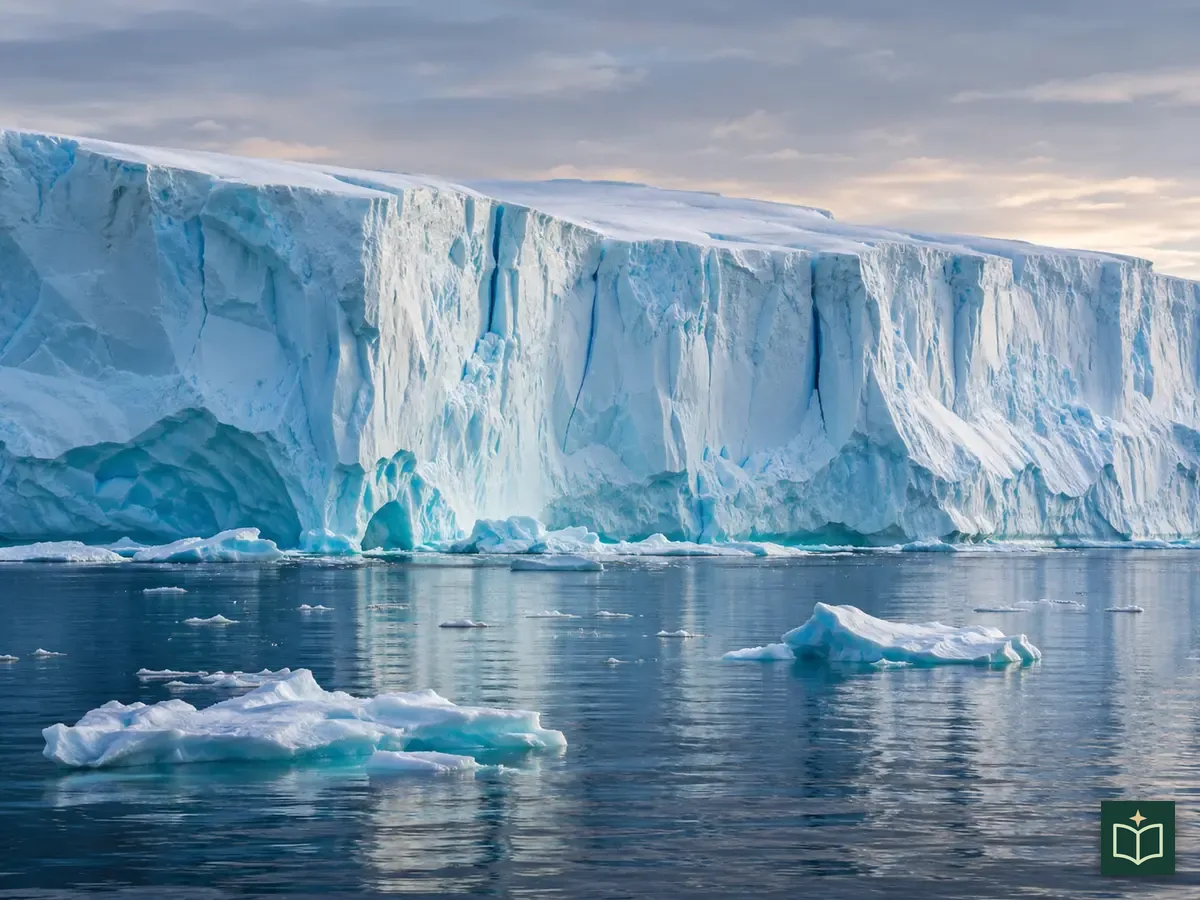
The Antarctic ice sheet holds roughly 90 percent of the ice on Earth and around 70 percent of its fresh water. If all of it melted, global sea level would rise by about 58 metres, although that would take many thousands of years. The ice is not static: it flows slowly from the interior towards the coast, speeding up in fast-moving ice streams and glaciers. Where it reaches the sea, it often spreads out as floating ice shelves, such as the Ross and Ronne shelves, which act as buttresses holding back the ice behind them. Icebergs break off their edges in a process called calving.
Winds and a ring of ocean
Cold, dense air pours downhill from the high interior towards the coast, creating katabatic winds that can exceed 200 km/h in places such as Commonwealth Bay. Around the continent, the Antarctic Circumpolar Current, the largest ocean current on Earth by volume, flows eastward unbroken by land. It helps isolate Antarctica from warmer waters and links the Atlantic, Indian and Pacific oceans. Each winter, sea ice around the continent expands to cover an area larger than Antarctica itself, before shrinking back in summer. Salt expelled as that sea ice forms helps create the dense bottom water that spreads through the world’s oceans.
A continent set aside
Antarctica has no permanent population and no government of its own. Several countries made territorial claims in the first half of the twentieth century, some of them overlapping. The Antarctic Treaty, signed in 1959 by twelve countries and in force since 1961, set those claims aside, banned military activity and nuclear testing, and reserved the continent for peaceful purposes and scientific cooperation. An environmental protocol agreed in 1991 prohibits mineral resource activities other than scientific research. More than 50 countries are now parties to the treaty. A few thousand people live at research stations in summer, and far fewer through the dark winter.
Ice cores and rising seas
Antarctic ice is also an archive. Scientists drill cores containing bubbles of ancient air, allowing them to measure past concentrations of carbon dioxide and methane. Cores from sites such as Dome C have extended the record back about 800,000 years, showing how greenhouse gases and temperature rose and fell together through ice-age cycles. Today researchers focus on how warming oceans are melting ice shelves from below, particularly in West Antarctica, where glaciers such as Thwaites rest on bedrock below sea level. How quickly this ice responds is one of the largest uncertainties in projections of sea-level rise for coastal cities worldwide.
Sources & further reading
Figures are rounded and widely published; check the linked organisations for the latest editions. These organisations do not endorse this website.