Three families
Geologists classify rocks by origin. Igneous rocks form when molten rock, called magma underground and lava at the surface, cools and solidifies. Sedimentary rocks form when particles of other rocks, shells or minerals settle in layers, usually in water, and are compacted and cemented over time. Metamorphic rocks begin as any type of rock and are transformed by high temperature, pressure or chemically active fluids, without melting completely. Each family has distinctive textures. Igneous rocks are made of interlocking crystals or glass, sedimentary rocks of grains and layers, and metamorphic rocks often of aligned or banded minerals. Those textures let a trained eye read a rock's history.
How each forms
Igneous rocks come in two styles. Intrusive rocks such as granite cool slowly underground, giving crystals time to grow large. Extrusive rocks such as basalt cool quickly at the surface, so their crystals are tiny or absent, as in volcanic glass. Sedimentary rocks include sandstone from cemented sand, shale from mud and limestone, often built from the shells and skeletons of marine organisms. Many contain fossils. Metamorphic rocks form deep in mountain belts or near hot magma. Limestone can become marble, shale can become slate, then schist, and sandstone can become quartzite. The original rock is called the protolith, and its chemistry shapes the result.
Rocks of the UAE
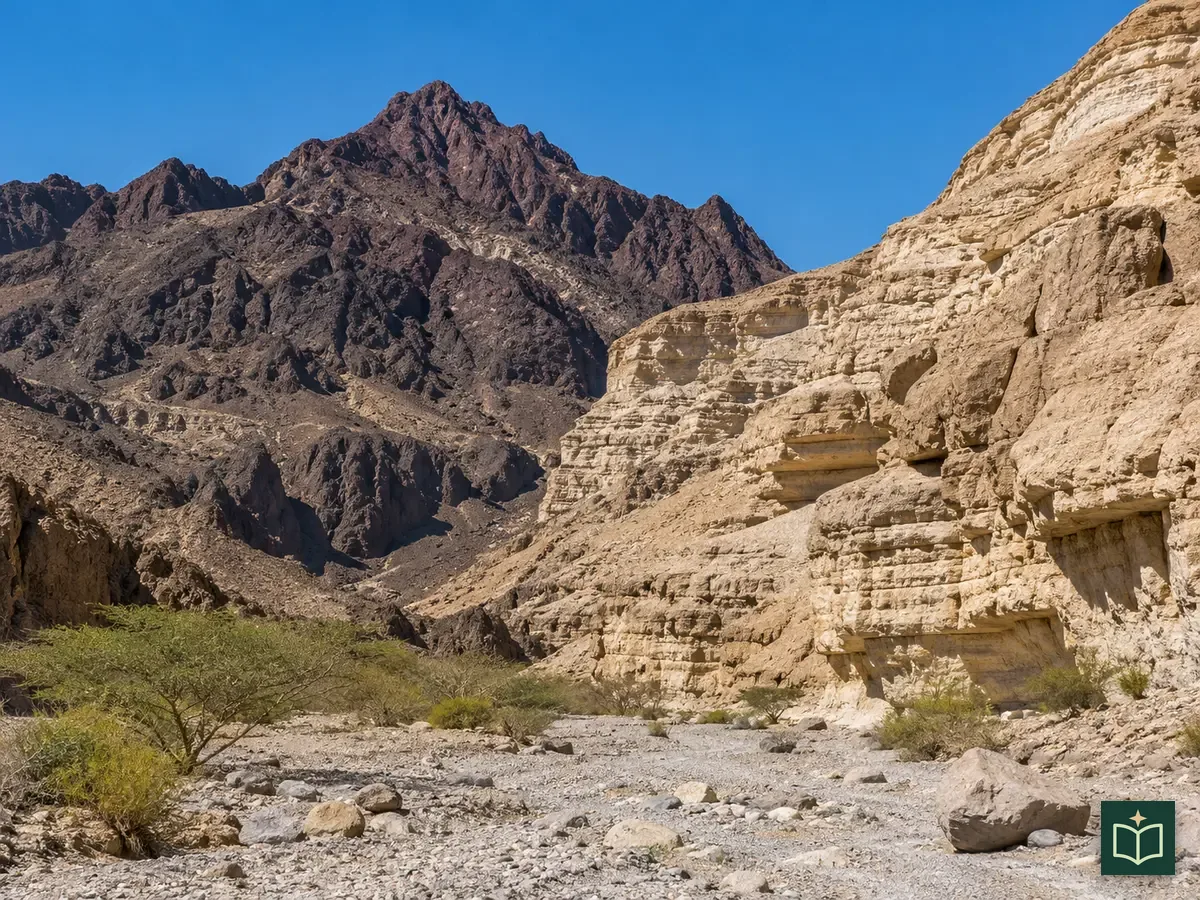
The UAE offers a striking illustration of all three. The Hajar Mountains, shared with Oman, contain one of the world's best-exposed ophiolites, a slab of ancient oceanic crust and upper mantle pushed onto the continent around 95 to 70 million years ago. Its dark igneous rocks, such as gabbro and peridotite, give the mountains their brown and black hues. Jebel Hafeet, near Al Ain, is a fold of sedimentary limestone rich in fossils. Along the coast, young sedimentary rocks and the salt flats called sabkhas continue to form today. Metamorphic rocks occur in places such as the Bani Hamid area, where intense heat altered rocks beneath the ophiolite.
Where they are similar
All three families are made of minerals, naturally occurring crystalline substances such as quartz, feldspar, calcite and mica. Many of the same minerals appear in each family; quartz, for example, is common in granite, sandstone and quartzite. All three can be broken down by weathering into sediment, and all can be buried, heated or melted. All are used as building materials, from granite worktops to limestone blocks and marble floors. Most importantly, they are connected through the rock cycle, so each family is a temporary stage in a continuous process rather than a fixed category. Given enough time, any rock can become any other kind.
The rock cycle and misconceptions
The rock cycle describes how rocks change over millions of years. Magma cools into igneous rock, which is uplifted, weathered and eroded into sediment. The sediment becomes sedimentary rock, which may be buried and turned into metamorphic rock, and if it melts it becomes magma again. Plate tectonics drives the cycle. A common misconception is that rocks are permanent; on geological timescales they are constantly being recycled. Another is that metamorphic rocks have melted. They change in the solid state; once melting occurs, the result is igneous. People also assume that all crystals indicate igneous rock, but metamorphic rocks can be highly crystalline too.
Why it matters
Knowing how rocks form helps people find resources. Oil and gas are mostly found in sedimentary basins, including those beneath the Gulf, because sediments trapped the organic material that became hydrocarbons and also provide porous reservoir rocks. Many metal ores are associated with igneous and metamorphic processes, including the copper once mined in the Hajar Mountains thousands of years ago. Rock types also influence groundwater, soil fertility, landscape shapes and engineering decisions, such as tunnel and foundation design. Above all, rocks are archives. Their three families record volcanoes, ancient seas and colliding plates, allowing geologists to reconstruct billions of years of Earth's history.
Sources & further reading
Figures are rounded and widely published; check the linked organisations for the latest editions. These organisations do not endorse this website.