Edison's revenge
In the 1880s alternating current beat direct current for power grids because transformers made it easy to raise and lower AC voltage. But over very long distances, AC lines lose more energy and need extra equipment to stay stable. Modern power electronics now let engineers convert huge amounts of power between AC and DC efficiently.
How a link works
At each end of an HVDC link sits a converter station packed with high-power semiconductor valves. The sending station turns AC into DC at hundreds of thousands of volts; the receiving station turns it back. Between them, the line needs only two conductors, or even one with a ground or sea return, and narrower corridors.
Where HVDC shines
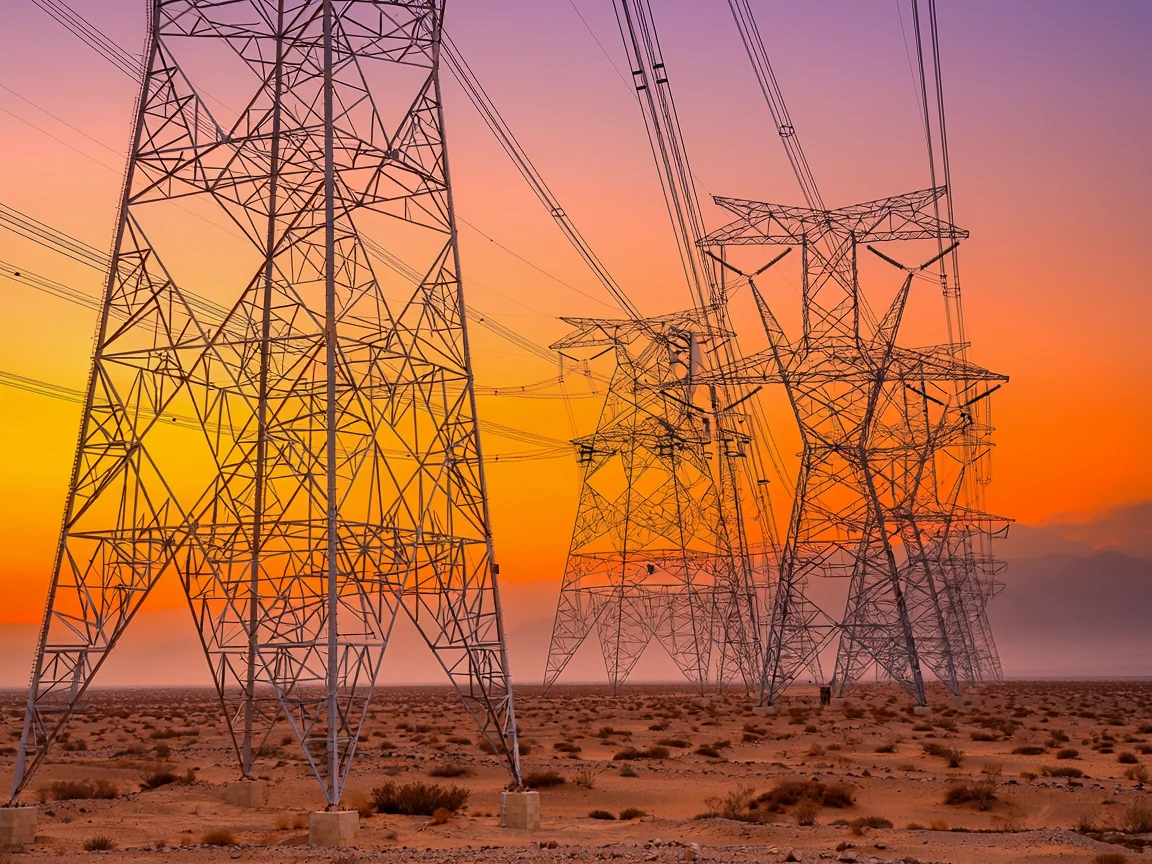
It is the best choice for long overhead lines from remote hydro, wind or solar plants to cities, and for undersea cables, where AC cables lose too much energy over a few dozen kilometres. HVDC also links grids that run at different frequencies or are not synchronised, such as those of neighbouring countries.
Building the supergrid
China operates the world's most powerful lines, including a ±1,100 kV link stretching about 3,300 km. Europe uses HVDC cables to connect offshore wind farms and to trade power between countries under the North Sea. As renewables grow, long-distance links help move electricity from where it is cheapest to generate to where it is needed.
Sources & further reading
Loss figures are indicative ranges, not values for a specific line. Photograph: original AI-generated illustration (Adobe Firefly). Reference organisations do not endorse this website.