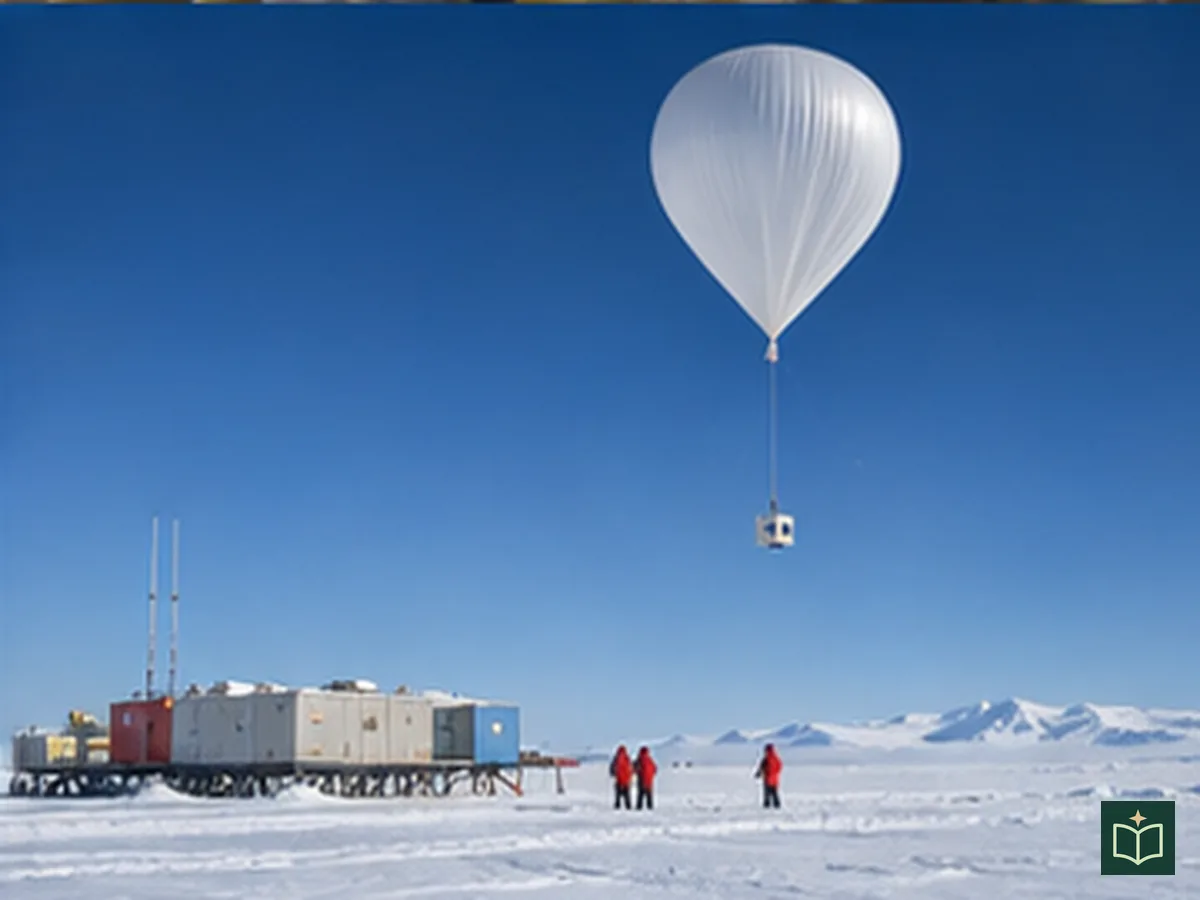
Ozone high and low
Ozone is a form of oxygen made of three atoms rather than the usual two. Near the ground it is a pollutant, a main ingredient of summer smog that irritates the lungs. High above, it is essential. About 90 per cent of Earth's ozone sits in the stratosphere, mostly between about 15 and 35 kilometres up, in what is called the ozone layer. Despite the name, it is extremely thin. If all the ozone above a spot were brought down to sea-level pressure, it would form a layer only about 3 millimetres thick. Scientists measure it in Dobson units, where 300 units equals that 3-millimetre layer. Yet this sliver of gas shields life from harsh ultraviolet.
A cycle powered by sunlight
The ozone layer is constantly made and unmade by sunlight. In the stratosphere, energetic ultraviolet light splits ordinary oxygen molecules into single atoms. Each free atom quickly attaches to an intact oxygen molecule, forming ozone. Ozone, in turn, absorbs ultraviolet light, which splits it back into a molecule and an atom, and the cycle repeats. Each time, the energy of the absorbed light becomes heat, which is why temperatures rise with height through the stratosphere. The process blocks essentially all of the most dangerous UV-C and most UV-B, the radiation that causes sunburn and damages DNA. Without it, life on land as we know it would be impossible.
The CFC problem
In the twentieth century, industry adopted chlorofluorocarbons, or CFCs, as near-perfect chemicals for refrigerators, air conditioners, aerosol sprays and foams. They were non-toxic, non-flammable and extremely stable. That stability was the problem. CFCs drift unchanged into the stratosphere, where strong ultraviolet light finally breaks them apart and frees chlorine atoms. A single chlorine atom acts as a catalyst, destroying ozone molecules one after another without being used up, and can break down many thousands before it is removed. In 1974 the chemists Mario Molina and Sherwood Rowland warned of this danger, work for which they shared the 1995 Nobel Prize in Chemistry with Paul Crutzen.
The hole over Antarctica
In 1985, scientists from the British Antarctic Survey reported a startling drop in springtime ozone over Antarctica, and satellite data soon confirmed a vast region of depletion: the ozone hole. It forms every southern spring because of extreme cold. In the polar winter, the stratosphere becomes cold enough to form thin clouds of ice and acid. Reactions on the surfaces of these clouds convert chlorine into forms that, when sunlight returns in September, destroy ozone rapidly. At its worst, ozone over parts of Antarctica has fallen by more than half. The hole is not a literal gap but a severe thinning, and a weaker version sometimes appears over the Arctic.
A treaty that worked
The response was swift by international standards. The Montreal Protocol, agreed in 1987, committed countries to phase out CFCs, halons and other ozone-depleting substances, and it was strengthened several times as the science became clearer. It became the first UN treaty ratified by every country in the world. Industry developed substitutes, and atmospheric levels of ozone-depleting chlorine have been falling since the late 1990s. Scientific assessments supported by the UN Environment Programme project that the ozone layer should return to its 1980 condition around 2040 over most of the world, around 2045 over the Arctic and around 2066 over Antarctica, though it varies from year to year.
Lessons and loose ends
The ozone story is often cited as the most successful environmental agreement ever reached, and it brought an unexpected bonus. Many CFCs are powerful greenhouse gases, so phasing them out also slowed global warming. Some replacements, the hydrofluorocarbons, or HFCs, do not harm ozone but trap heat strongly, so the Kigali Amendment, agreed in 2016, set a schedule to cut them too. Vigilance is still needed: unexpected emissions of a banned CFC were detected in the late 2010s, traced and then reduced. For people in sunny regions such as the Gulf, where the UV index is often extreme, the recovering layer matters directly, though sun protection remains essential.
Sources & further reading
Figures are rounded and widely published; check the linked organisations for the latest editions. These organisations do not endorse this website.