Why it matters
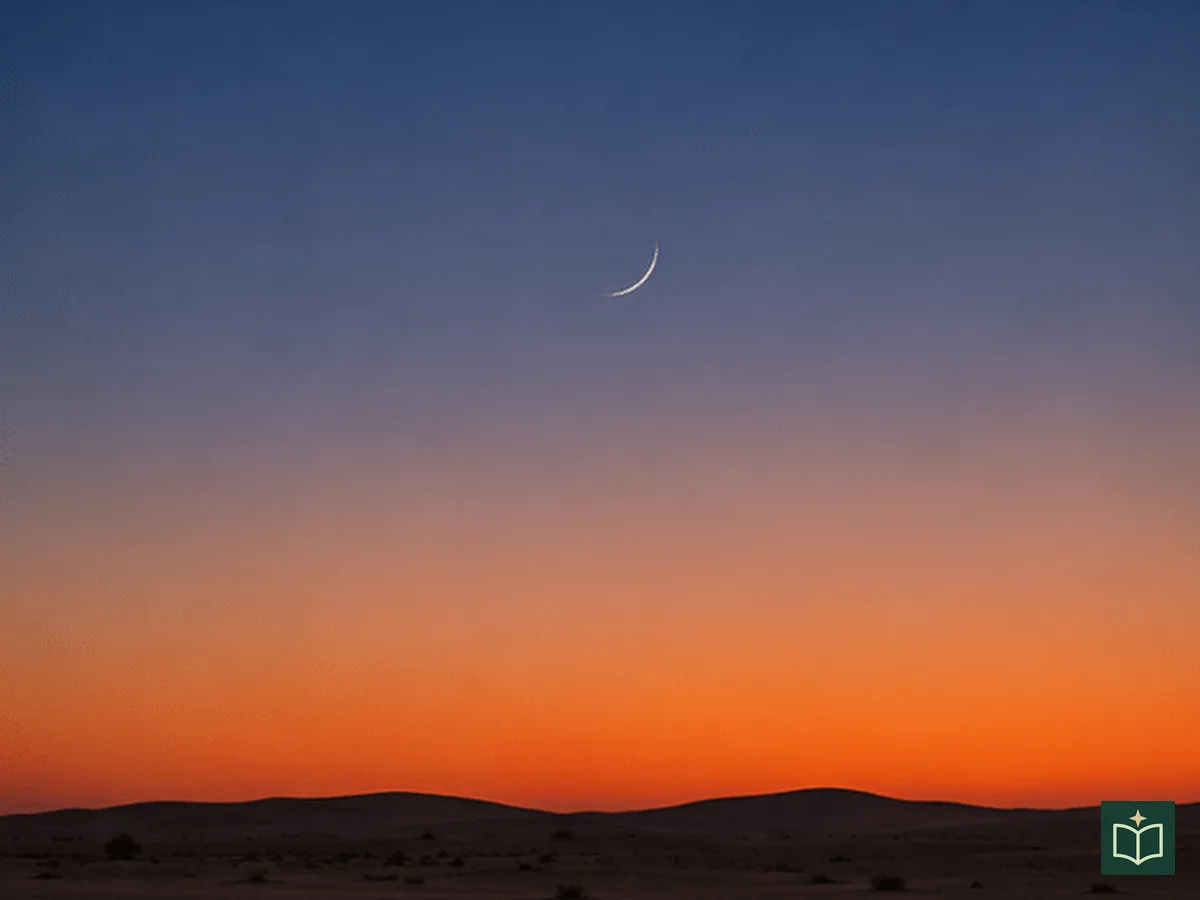
The Islamic calendar is lunar: each month traditionally begins when the new crescent, the hilal, is first seen in the evening sky. Because a lunar cycle lasts about 29.5 days, a month has either 29 or 30 days, depending on whether the crescent is seen on the evening of the 29th. The beginning of Ramadan and the dates of Eid al-Fitr and Eid al-Adha follow this rule, which is why committees in the UAE, Saudi Arabia and other countries gather to look for the Moon. The difficulty is real. On the decisive evening the crescent can be extremely faint, low on the horizon and visible for only a few minutes before it sets.
From new moon to crescent
At new moon, or conjunction, the Moon passes roughly between Earth and the Sun. Its sunlit side faces away and the side towards us is dark, so it cannot be seen. As the Moon continues its orbit it moves eastward relative to the Sun by about 12 degrees a day, roughly half a degree an hour. A thin edge of its sunlit half gradually turns towards Earth. The angle between Moon and Sun, called the elongation, is the key quantity: the larger it is, the wider and brighter the crescent. A day after conjunction the elongation is about 12 degrees, and the crescent is still a hair-thin arc.
The conditions for a sighting
Several factors must line up. The Moon must have moved far enough from the Sun, and it must set long enough after sunset to be seen against a darkening sky; this gap is known as the lag time. The Moon sets on average about 49 minutes later each day, but the angle of its path to the horizon varies with season and latitude, so Moons of the same age can give very different lag times. Below an elongation of about seven degrees, known as the Danjon limit, the crescent appears too fragmentary for the eye to see. Haze, dust and humidity near the horizon can hide even a favourable crescent.
How astronomers predict it
Modern astronomers combine precise calculations of the Moon's position with records of thousands of past sighting attempts to build visibility criteria. Systems developed by researchers such as Bernard Yallop in Britain and Mohammad Odeh, who founded the International Astronomical Center in Abu Dhabi, estimate for each place whether the crescent should be visible to the naked eye, only with optical aid, or not at all. These forecasts are usually drawn as maps with curves sweeping across the globe. Because the Moon moves on through the night, the crescent is generally easier to see farther west, so on a given evening it may be visible from the Americas but not from the Gulf.
Calculation and observation
Countries apply these tools in different ways. Some rely on direct sighting by trained observers, increasingly supported by telescopes and sensitive cameras that can capture a crescent invisible to the eye. Others use calculated criteria to accept or reject reported sightings, or to fix dates in advance. Saudi Arabia uses the calculated Umm al-Qura calendar for civil purposes while confirming the start of key months by sighting. The UAE has used imaging equipment and drones in its moon-sighting work. These differences, together with the geography of visibility, explain why the start of Ramadan or the date of Eid sometimes differs by a day between countries.
Why the record is hard to break
Astronomers keep records of the youngest crescents ever seen. Naked-eye sightings of a Moon less than about 15 hours after conjunction are exceptional, and most successful sightings involve an older, wider crescent. Telescopes and cameras have pushed the limits further, even imaging the Moon in daylight at the moment of conjunction, though that is not an evening crescent. For ordinary observers, the best advice is simple: know where the Sun has set, look a little to its left or right and slightly above the horizon, and scan with binoculars only after the Sun is fully below the horizon to protect your eyes.
Sources & further reading
Figures are rounded and widely published; check the linked organisations for the latest editions. These organisations do not endorse this website.