A white antelope of the sands
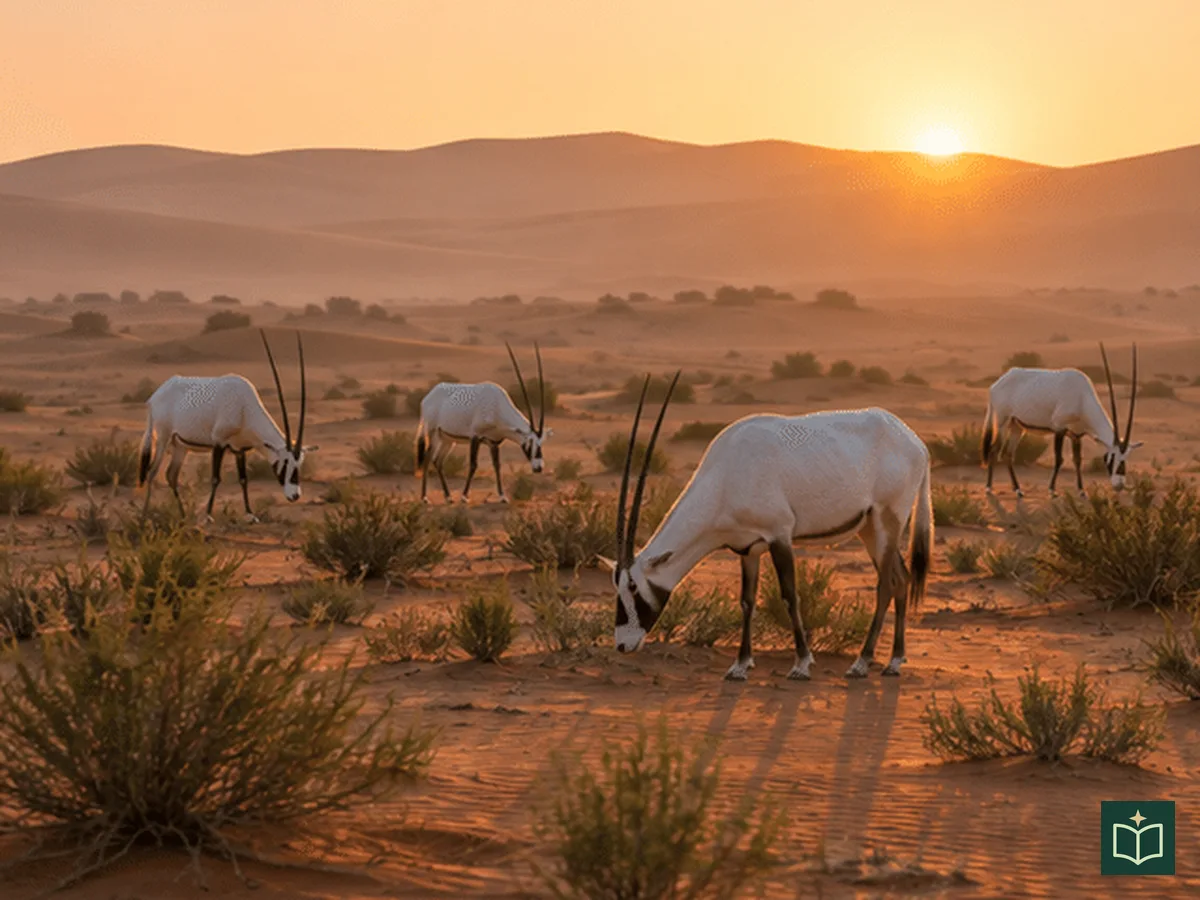
The Arabian oryx is a medium-sized antelope, standing about a metre at the shoulder and weighing around 70 kilograms, with long, nearly straight horns and a brilliant white coat. It is the smallest of the oryx species and the only one native to the Arabian Peninsula, where it once roamed from Syria and Iraq to Oman and Yemen. The pale coat is not just striking: it reflects much of the fierce sunlight, while darker skin beneath helps block ultraviolet rays. In winter the hair can lift slightly to trap warmth on cold desert nights. Broad, splayed hooves spread its weight, helping it walk on soft sand and gravel plains.
Drinking without drinking
Wild oryx can go for weeks, and in some conditions months, without drinking free water. Most of what they need comes from food. They feed mainly at night and around dawn, when grasses and shrubs are cooler and have absorbed moisture from the humid night air or dew, so each mouthful carries more water than it would at midday. Roots and succulent plants add to the supply. During the hottest part of the day oryx rest in the shade of trees and shrubs, often scraping shallow hollows in the cooler ground beneath. Moving as little as possible in the heat reduces the water that would otherwise be lost through breathing and evaporation.
A body that spends little
Inside the body, the oryx is a careful accountant of water. Its kidneys produce concentrated urine and its dung is notably dry. Studies of reintroduced oryx in Saudi Arabia found that in summer the animals lowered their metabolic rate and water turnover, making their reserves last longer. Like camels, oryx can let their body temperature rise by several degrees during the day instead of sweating to hold it steady, then shed that heat into the cooler night air. This strategy, known as adaptive heterothermy, saves water that would be spent on evaporative cooling. The combination lets a herd survive in places where no surface water exists for most of the year.
Sensing distant rain
Rain in the Arabian interior is rare and patchy, but it transforms the land within days as dormant seeds sprout and shrubs regrow. Oryx are reported to move towards areas where rain has fallen, sometimes travelling long distances. Herders and researchers have long noted that the animals seem to detect storms far away, perhaps by seeing distant clouds and lightning or by smelling moist air carried on the wind. The exact cues are not fully understood. What is clear is that oryx herds roam over very large home ranges, which allows them to track scattered pulses of fresh grazing across a landscape that offers little in any single place.
Lost and brought back
Hunting, increasingly with vehicles and firearms in the twentieth century, drove the oryx into rapid decline. The last known wild animals were shot in Oman in 1972, and the species was declared extinct in the wild. A few years earlier, conservationists had launched Operation Oryx, capturing some of the last animals and gathering others from private collections into a breeding herd in the United States. Rulers and zoos in the Gulf kept further animals. From 1982 captive-bred oryx were released in Oman, followed by Saudi Arabia, Israel, the UAE and Jordan. In 2011 the International Union for Conservation of Nature moved the species to Vulnerable, the first animal to recover that far after extinction in the wild.
A symbol with a future to secure
Today wild and semi-wild populations number in the low thousands across protected areas, including large reserves in Abu Dhabi and Saudi Arabia, with many more in managed herds. The oryx has become an emblem of the region; it is Qatar's national animal and appears widely in art and design. Its future still depends on protection. Poaching, fences, drought and overgrazing by livestock all pose risks, and small populations can suffer from limited genetic diversity. Rising temperatures may also test the limits of its water-saving strategies. The story of the oryx shows both how finely an animal can be tuned to a harsh environment and how quickly people can undo that work.
Sources & further reading
Figures are rounded and widely published; check the linked organisations for the latest editions. These organisations do not endorse this website.