The tree of the sands
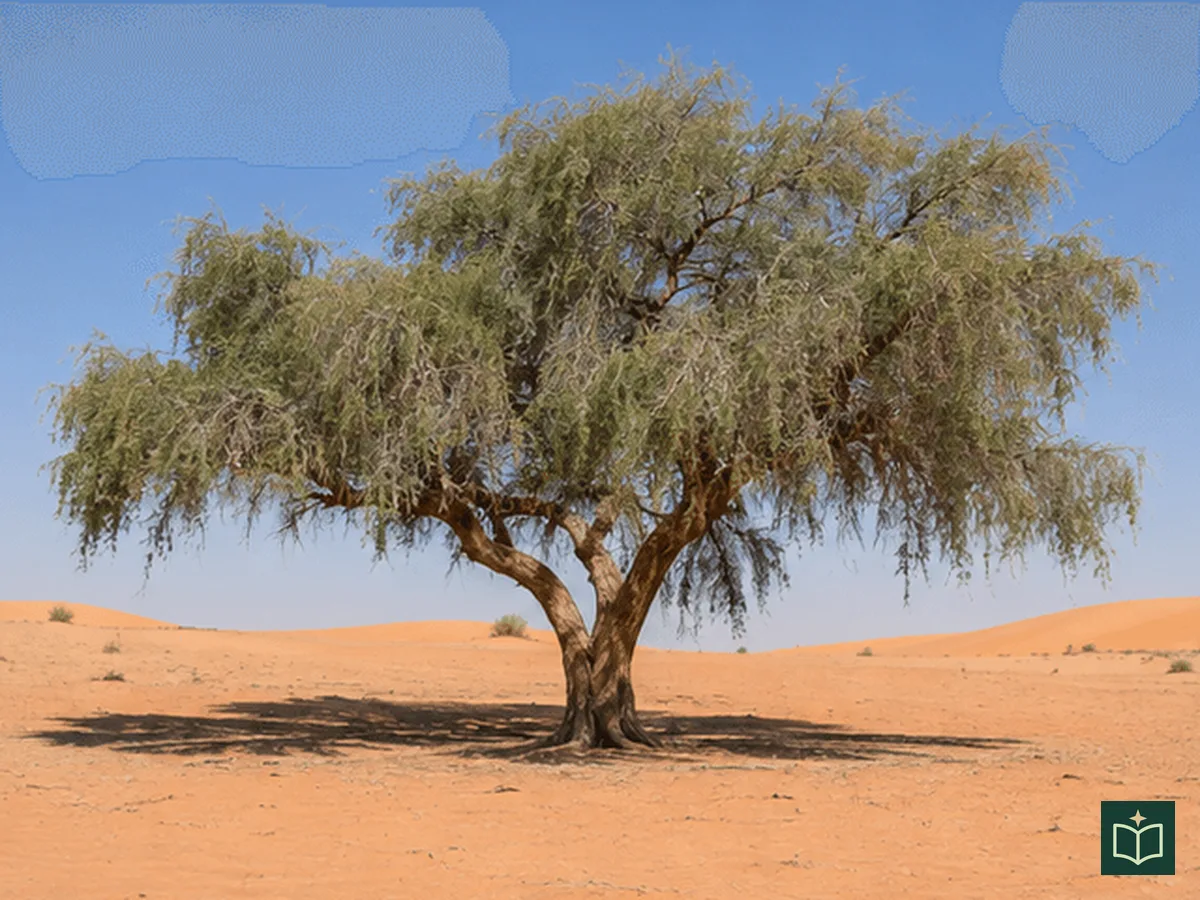
The ghaf, Prosopis cineraria, is a slow-growing evergreen tree of the pea family, found from Arabia across Iran and Pakistan to India. In the UAE it grows on sandy plains and between dunes, often standing alone with a broad, drooping canopy that offers rare shade. It was declared the UAE's national tree in 2008 and was chosen as the emblem of the Year of Tolerance in 2019. For centuries Bedouin communities relied on it: camels and goats browse its leaves and pods, travellers rested beneath it, and its wood served for fuel and building. Cutting a ghaf in the UAE is now restricted by law, reflecting its value in the landscape.
Roots that go deep
Most of the ghaf's success lies underground. Young trees put early growth into a taproot that drives straight down through sand, and in mature trees this root is commonly reported to reach about 30 metres, sometimes more, where the water table is deep. Once it reaches permanently moist layers, the tree has a reliable supply that does not depend on the weather. A second system of shallower lateral roots spreads widely near the surface, ready to absorb water from the occasional winter downpour. This two-level design lets the ghaf draw on both rare rainfall and steady groundwater, a strategy botanists call phreatophytic, meaning a plant that taps the water table.
Green when everything else is not
Because it reaches groundwater, the ghaf can stay green and even flower during the hottest months, when temperatures can exceed 50°C and most other plants have shed leaves or died back. Its small, finely divided leaves limit water loss, and the tree can close the pores on its leaves during the fiercest hours. Flowers appear in the spring and long, slender pods follow; these pods, eaten raw or cooked, have long been part of local diets in parts of the tree's range. A single mature ghaf becomes a hub of desert life, sheltering insects, reptiles, birds and small mammals that depend on its shade and food.
Holding the desert together
The ghaf also shapes its surroundings. Its network of roots binds loose sand and helps slow the movement of dunes, while its canopy breaks the wind at ground level. Like many members of the pea family, it hosts bacteria in its roots that capture nitrogen from the air, and fallen leaves enrich the poor sandy soil around it. Seedlings of other plants often grow more easily in its shade. For these reasons ghaf trees are planted along roadsides and in afforestation projects in the UAE, and conservation groups encourage residents to plant native species like it rather than thirsty imported trees that need constant irrigation.
A tree with a long history
In India, where the same species is called khejri or shami, it is equally revered. In 1730, according to tradition, more than 360 members of the Bishnoi community in Rajasthan gave their lives trying to stop soldiers felling khejri trees, an episode later cited as an early example of environmental protest. In Bahrain, a solitary Prosopis cineraria known as the Tree of Life has stood in open desert for around four centuries, puzzling visitors about where it finds water. Its survival is usually explained by the same deep roots that sustain ghaf trees in the UAE, tapping water that lies far beneath the dry surface.
Pressures on an old survivor
Deep roots are not a guarantee of safety. Where heavy pumping for farms and towns lowers the water table faster than a ghaf's roots can follow, trees can weaken and die. Urban development, overgrazing and the clearing of land have reduced numbers in some areas. Another threat is the introduced mesquite, Prosopis juliflora, a fast-growing relative brought to the region for greening projects, which competes aggressively for water and space and has spread widely. Protecting the ghaf therefore means protecting the hidden groundwater it relies on. In a region where water is precious, the tree is a living gauge of what lies beneath the sand.
Sources & further reading
- UAE Ministry of Climate Change and Environment ↗
- Kew · Plants of the World Online ↗
- Emirates Nature–WWF ↗
Figures are rounded and widely published; check the linked organisations for the latest editions. These organisations do not endorse this website.