The problem with sand
A skyscraper is extremely heavy, and its weight must reach the ground without the building sinking or tilting. In cities such as New York, engineers can often rest towers on hard bedrock near the surface. Much of the Gulf coast offers no such luxury. Beneath Dubai lie layers of sand, silt and weak sedimentary rocks such as calcareous sandstone and siltstone, with salty groundwater only a few metres down. Solid bedrock, if it exists at all, is far too deep to reach economically. Engineers therefore design foundations that work with these weaker materials, spreading the load widely and deeply enough that the ground can carry it safely.
Piles that grip the ground
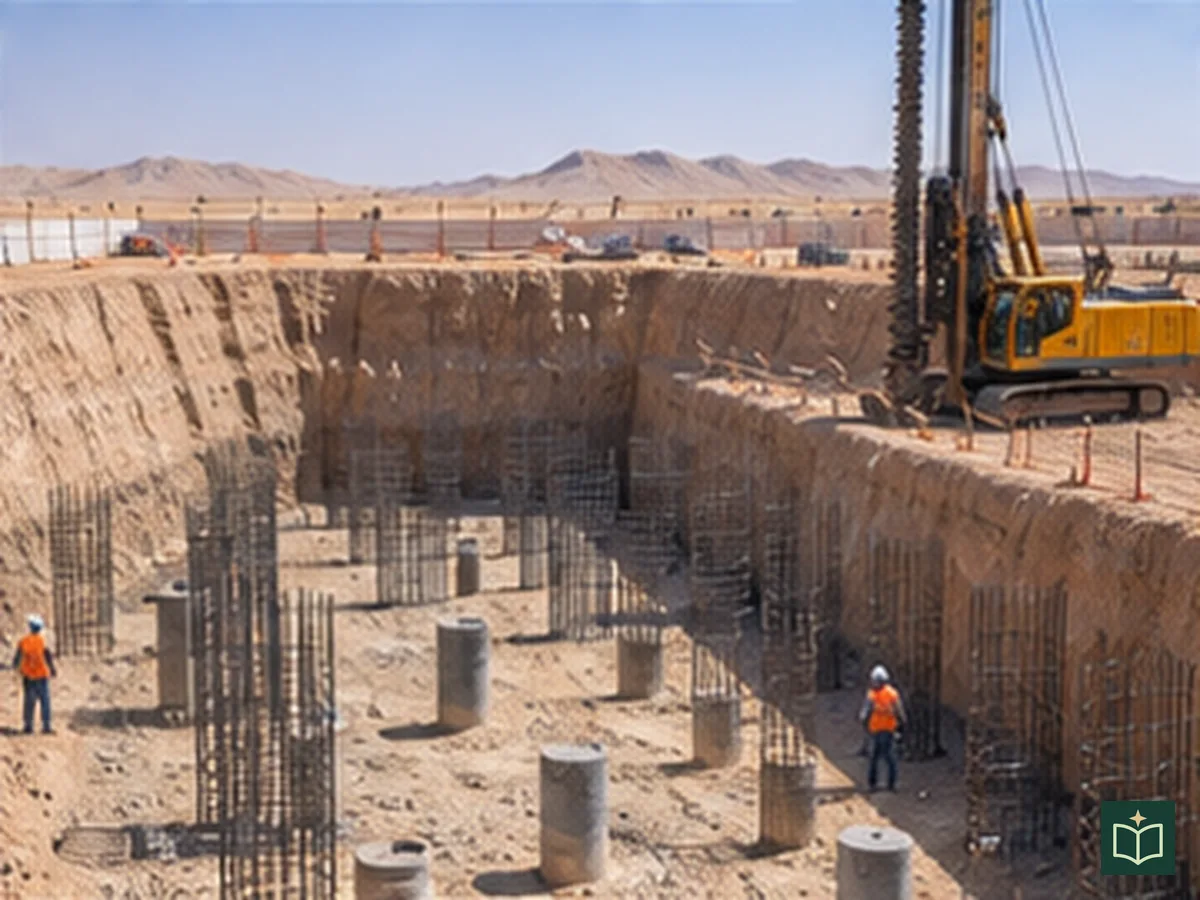
The solution is the pile: a long column of reinforced concrete cast in a drilled hole. Some piles bear on a hard layer at their tip, like a table leg on a floor. In the Gulf, most of a tall tower's piles work mainly by friction, often called skin friction. The surface of each pile grips the surrounding soil and rock along its whole length, so the deeper and wider it is, the more load it can carry. A pile 1.5 metres across and 45 metres long has a side area of about 212 square metres. Hundreds of such surfaces, working together, can hold up hundreds of thousands of tonnes.
The raft that ties it together
Piles alone would act independently, and each might settle a slightly different amount. A thick concrete raft caps them, tying their heads together and spreading the building's load among them. The raft also carries some load directly into the ground beneath it, which is why engineers call the combination a piled raft. Under Burj Khalifa, the raft is about 3.7 metres thick and rests on 192 bored piles, each around 1.5 metres in diameter and roughly 50 metres deep. Pouring such a raft requires thousands of cubic metres of concrete placed continuously, often at night in the Gulf so that heat does not weaken it as it sets.
Testing before building
Foundation design begins long before construction. Engineers drill dozens of boreholes, recover rock cores and run laboratory tests to measure strength and stiffness. They also load test piles in the field, pushing on them with hydraulic jacks to many times their working load while measuring how much they move. Computer models then predict how the whole foundation will settle as the tower rises. Some settlement is expected and acceptable; what matters is that it is small and even. Monitoring continues during construction, with instruments tracking movement as each floor is added, so engineers can compare reality with prediction and adjust if necessary.
Fighting salty groundwater
Gulf groundwater is rich in chlorides and sulphates, which attack concrete and corrode steel reinforcement. A foundation must last as long as the tower above it, and it cannot be inspected or repaired easily once buried. Engineers use dense, low-permeability concrete with additives such as silica fume and ground slag, extra concrete cover over the steel, and waterproof membranes. At Burj Khalifa, the designers also installed cathodic protection, a system that applies a small electric current to the reinforcement to prevent it rusting. Drilling under the water table is done with polymer or bentonite fluids that hold the borehole open until concrete is placed.
Misconceptions and limits
It is tempting to imagine skyscrapers balanced on a fragile layer of sand, or anchored to some hidden bedrock. Neither is quite right. A well-designed friction foundation is a robust, proven system used worldwide, from Shanghai to Dubai, where ground conditions are soft. Its limits come from ground knowledge rather than height alone: poor investigation, unexpected cavities or changes in groundwater can cause problems. Taller buildings also face wind and earthquake forces that try to tip them, so foundations must resist uplift and overturning as well as weight. The result is a structure designed for its precise patch of ground, as unique as the tower above it.
Sources & further reading
Figures are rounded and widely published; check the linked organisations for the latest editions. These organisations do not endorse this website.