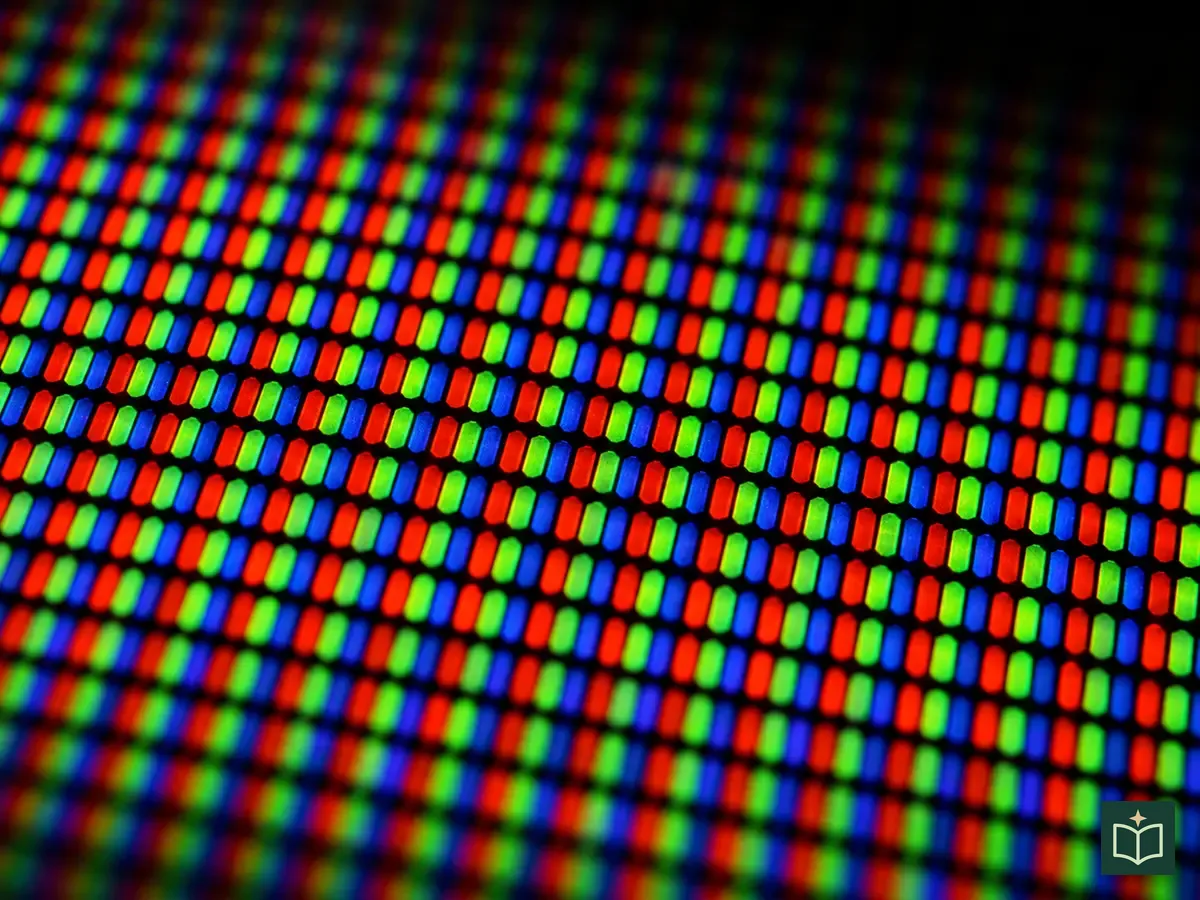
Additive colour
A painter mixes pigments, which absorb light, so mixing many colours tends towards brown or black. A screen works the opposite way, by adding light. Red, green and blue are the additive primaries because they roughly match the three types of colour-sensitive cone cell in the human eye. Light all three fully and you see white; red and green together appear yellow; nothing at all is black. Each pixel on a screen contains separate red, green and blue elements, called subpixels. They are so small that, from normal viewing distance, the eye cannot separate them and blends their light into one colour. A magnifying glass reveals the trick.
How an LCD works
Liquid crystal displays, common in laptops, monitors and many televisions, do not generate light at each pixel. A backlight, today made of LEDs, shines white light through a sandwich of layers. Two polarising filters are set at angles to each other, with a thin layer of liquid crystal between them. Liquid crystals are molecules that flow like a liquid but line up like a crystal, and an electric field can twist them. Depending on the voltage, they rotate the light so more or less of it passes the second filter. Finally, a colour filter over each subpixel tints the light red, green or blue.
How OLED works
Organic light-emitting diode displays, now common in phones and premium televisions, take a different approach. Each subpixel contains thin layers of carbon-based compounds that glow when an electric current passes through them, so there is no backlight. A pixel showing black is simply switched off. That gives deep blacks, high contrast and good viewing angles, and it allows very thin and even flexible or foldable screens. OLEDs can also save power when displaying dark content. Their weaknesses are that the organic materials gradually age, with blue typically fading fastest, and that static images displayed for very long periods may leave faint permanent ghosts, called burn-in.
Sharpness and smoothness
Resolution describes how many pixels a screen has; pixel density, measured in pixels per inch, describes how tightly they are packed. Phones commonly exceed 300 pixels per inch, beyond which most people cannot see individual pixels at arm's length. Refresh rate is how many times a second the image is redrawn. Traditional screens refresh 60 times a second; many phones now offer 120, which makes scrolling look smoother. Some vary the rate automatically, dropping very low for a still image to save battery. Brightness, measured in units called nits, matters greatly outdoors, especially in strong sunlight such as a Gulf summer afternoon.
Newer variations
Manufacturers keep refining both approaches. Mini-LED televisions use thousands of tiny backlight zones that can dim independently, giving LCDs much better contrast. Quantum dots, minute semiconductor crystals that emit very pure colours, are used to widen the range of colours a screen can show. MicroLED, in which each subpixel is its own tiny inorganic LED, promises OLED-like contrast with greater durability, but is hard to manufacture cheaply. Marketing names abound, but most displays still fall into two families: screens that filter a backlight and screens whose pixels emit their own light. Knowing which you are buying helps make sense of the claims.
Myths and good habits
A common worry is that screens emit harmful radiation; the visible light they give off is ordinary light, far dimmer than daylight. Evidence that screen blue light damages eyes is limited, though bright screens late at night may affect sleep, which is why night modes shift colours warmer. Eye strain usually comes from long sessions without breaks, so the familiar advice of regularly looking at something distant is sensible; persistent symptoms deserve a professional eye examination. To extend an OLED's life, avoid leaving static images at full brightness for hours. And remember that colours differ between devices, so a photo may look slightly different on every screen.
Sources & further reading
Figures are rounded and widely published; check the linked organisations for the latest editions. These organisations do not endorse this website.