The carrier wave
Sound itself cannot travel far through the air as an electrical signal, so a radio station needs a carrier. The transmitter generates a radio wave at a precise frequency, the number shown on the dial, and feeds it to an antenna that radiates it outward at the speed of light. On its own the carrier is a steady, featureless hum of energy. To carry a programme, the station changes it in step with the audio, a process called modulation. A receiver tuned to that frequency ignores every other station, picks up the varying carrier and reverses the process, recovering the original sound to send to a speaker or headphones.
AM: changing the strength
Amplitude modulation, the method behind the first public broadcasts around 1920, varies the strength of the carrier. Loud sounds make the wave's peaks taller; quiet ones make them smaller, while the frequency stays fixed. AM stations use the medium-wave band, roughly 0.5 to 1.6 megahertz, and long-wave in some countries. The receiver simply follows the changing strength, which made early radios cheap to build. The drawback is noise. Lightning, electric motors and other interference also change signal strength, so they are heard as crackle. AM channels are also narrow, limiting sound quality, which is why AM is now used mostly for speech, news and talk.
FM: changing the frequency
Frequency modulation, developed by the American engineer Edwin Armstrong in the 1930s, keeps the carrier's strength constant and varies its frequency slightly up and down with the audio. Because the receiver listens for changes in frequency, not strength, most electrical noise is ignored. FM channels are also wider, allowing better fidelity, and a stereo signal can be added using a pilot tone. FM uses a much higher band, about 88 to 108 megahertz. One side effect is the capture effect: when two stations share a frequency, the receiver locks onto the stronger rather than mixing them, so FM fades abruptly instead of gradually at the edge of its range.
Why range differs
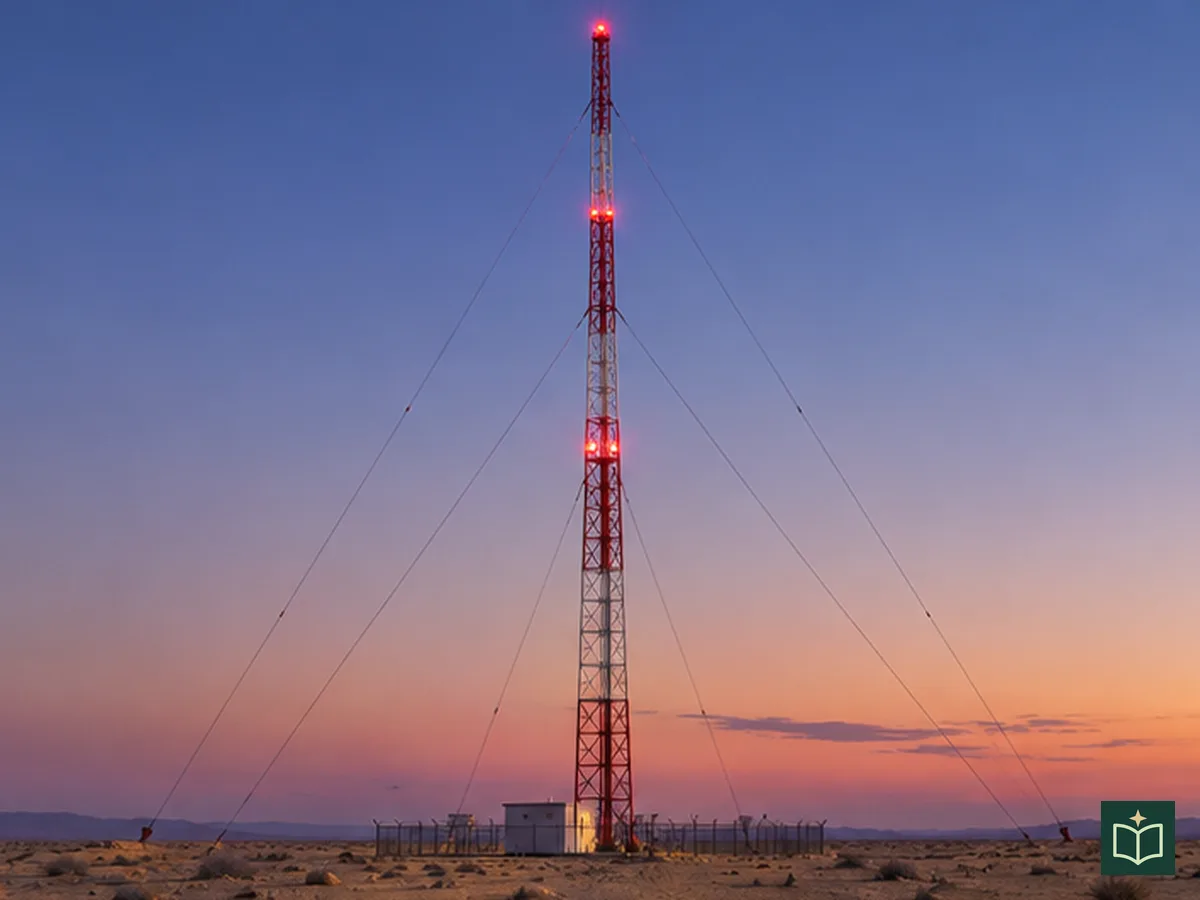
The two systems behave differently mainly because of their frequencies. A wave's length equals the speed of light divided by its frequency. At 100 megahertz, an FM wave is about 3 metres long; at 1 megahertz, an AM wave is about 300 metres. Long medium waves follow the curve of the Earth as ground waves, and at night they reflect off the upper atmosphere, letting powerful AM stations be heard hundreds or thousands of kilometres away. Short FM waves travel mostly in straight lines and stop at the horizon, so an FM station typically covers a city and its surroundings, which is why transmitters sit on tall masts and hilltops.
Digital radio
Digital radio converts audio into compressed data, as a music file does, and transmits the numbers rather than a continuous wave shape. Systems such as DAB and its upgraded version DAB+, widely used in Europe and Australia, bundle many stations into a single block of spectrum called a multiplex. The receiver uses error correction to rebuild the data, so reception is either clean or lost, without the gradual hiss of analogue. Digital radio can also carry text such as song titles and news. Other systems exist too: HD Radio in North America adds digital signals alongside existing AM and FM channels, while DRM is designed for longer-range bands.
Still on the air
Streaming has given listeners endless choice, yet broadcast radio remains widely used, particularly in cars. One transmitter reaches every receiver in range at no cost per listener and without a data connection, which matters in emergencies when mobile networks may be congested or down. Many countries keep at least some AM and FM services for this reason. In the Gulf, FM remains the main platform for local stations in Arabic, English and South Asian languages. The basic physics has not changed in a century: a station still shapes a wave, and a receiver still reads that shape back into sound, whether as a smooth curve or as digital data.
Sources & further reading
Figures are rounded and widely published; check the linked organisations for the latest editions. These organisations do not endorse this website.