Barrels, tonnes and litres
Spill sizes appear in several units. The oil industry counts in barrels, each about 159 litres. Shipping and international spill statistics use tonnes, and because crude oils differ in density, one tonne corresponds to roughly seven barrels. American reports sometimes use gallons. These conversions explain why the same spill can appear in very different numbers across news reports. The International Tanker Owners Pollution Federation, ITOPF, which collects global tanker spill data, uses three size classes: small spills of under 7 tonnes, medium spills of 7 to 700 tonnes and large spills of more than 700 tonnes. Large tanker spills have become far less frequent since the 1970s.
Estimating at the source
When a tanker or storage tank is damaged, the starting point is accounting: how much oil was on board, and how much remains in undamaged tanks. That can be calculated from loading records and soundings, though wrecks are difficult to survey. A leaking well is harder, because the flow is continuous and often deep underwater. During the Deepwater Horizon disaster in the Gulf of Mexico in 2010, early official estimates of around 1,000 and then 5,000 barrels a day were later replaced. A government-led team using video analysis, pressure readings and other methods concluded that the flow had been far higher, putting the total released at about 4.9 million barrels.
Reading a slick from above
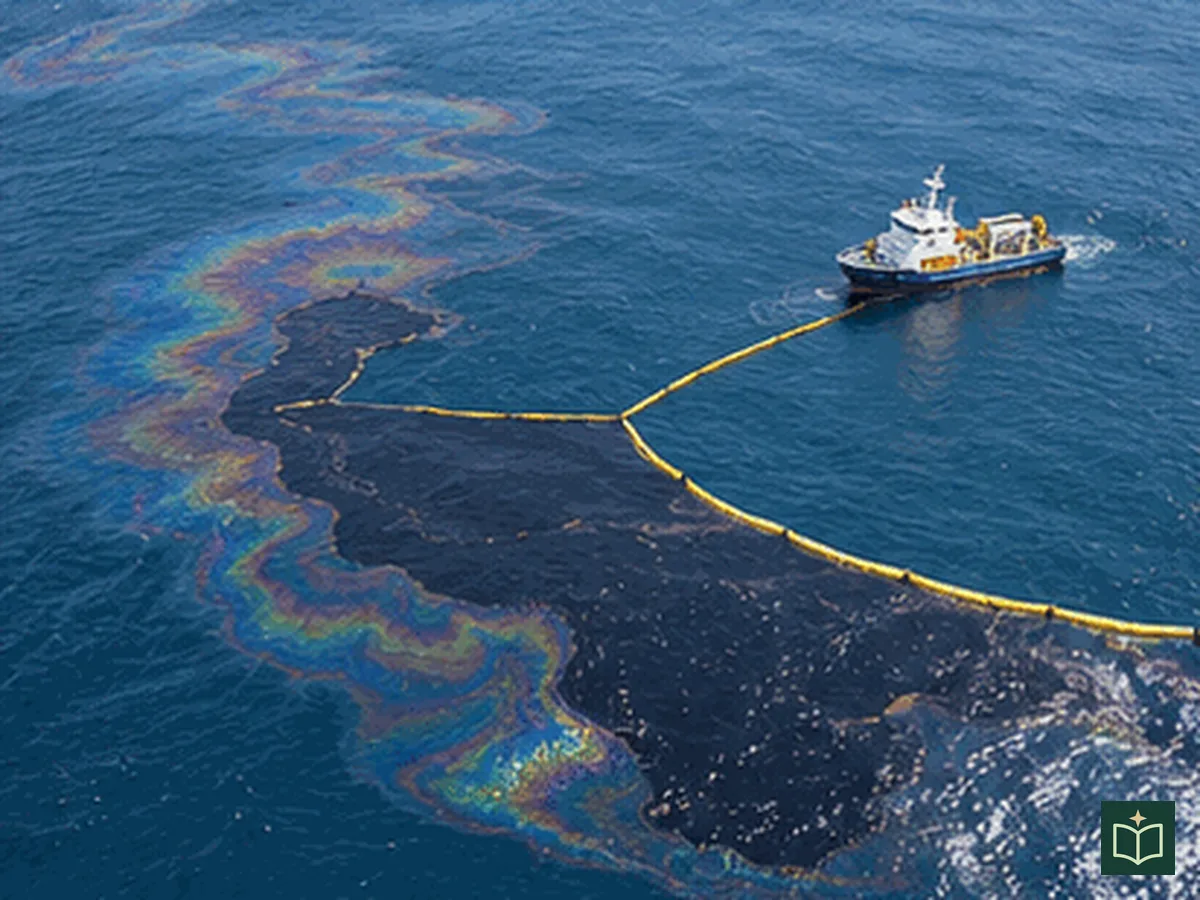
Responders also estimate how much oil is on the water, using aircraft, drones and satellites. Radar satellites detect slicks because oil dampens small waves, leaving a smoother, darker patch. Thickness is judged by appearance. Under a widely used scheme, the Bonn Agreement Oil Appearance Code, a silvery sheen indicates a layer well under one micrometre thick, rainbow colours a few micrometres and dark, true-coloured oil much more. Volume equals area multiplied by thickness. A thin sheen of 0.1 micrometres covering ten square kilometres contains only about one cubic metre of oil, or roughly six barrels. A small area of thick oil can contain far more than a vast sheen.
Why the numbers change
Early figures change for several reasons. Initial reports are often based on what operators know or are willing to say before surveys are complete. Slicks spread, break up and drift, so aerial observations capture only part of the oil at any moment. Oil also weathers: lighter compounds evaporate within hours or days, some oil disperses into the water, and some sinks or strands on beaches. The amount on the surface is therefore always smaller than the amount spilled. Investigations and legal proceedings, which can take years, produce the final estimates. The largest spill in history, during the 1991 Gulf War, still has a wide range of published estimates.
The Gulf's shipping lanes
The waters around the Arabian Peninsula carry an exceptional volume of oil. A large share of the world's seaborne crude passes through the Strait of Hormuz, and Fujairah, on the UAE's east coast, is one of the world's biggest bunkering hubs, where ships take on fuel. The Gulf is shallow and semi-enclosed, with high evaporation and slow water exchange, so oil can persist near coasts, mangroves and desalination plant intakes. Regional states cooperate on spill response through the Regional Organization for the Protection of the Marine Environment. In the region, spill reports often describe threats to drinking water supplies as well as wildlife and beaches, because so much water comes from the sea.
Reading a spill report
When a spill is reported, check the unit and convert if needed: tonnes and barrels differ roughly sevenfold. Find out whether the figure is the amount spilled, the amount on the water or the maximum possible, such as a tanker's entire cargo. Look at what type of oil is involved, since light fuels evaporate quickly while heavy fuel oil persists and is hard to clean. Note the location and weather, which decide where the oil will go. Be cautious with early totals, especially for leaking wells. Finally, remember that size is only one measure of harm: a small spill near a sensitive coast can do more damage than a large one far offshore.
Sources & further reading
Figures are rounded and widely published; check the linked organisations for the latest editions. These organisations do not endorse this website.