Thrust measured in grams
A chemical rocket burns fuel violently and produces huge thrust for a few minutes. An ion engine does the opposite. NASA likened the push of the engine on its Deep Space 1 probe, launched in 1998, to the weight of a sheet of paper resting on your hand: less than a tenth of a newton. It could never lift anything off the ground. But in the near-frictionless environment of space, that tiny push can be kept up for months or years, adding up to large changes in speed. Electric propulsion of this kind now moves deep-space probes, keeps communications satellites in position and raises thousands of small satellites to their working orbits.
How the engine works
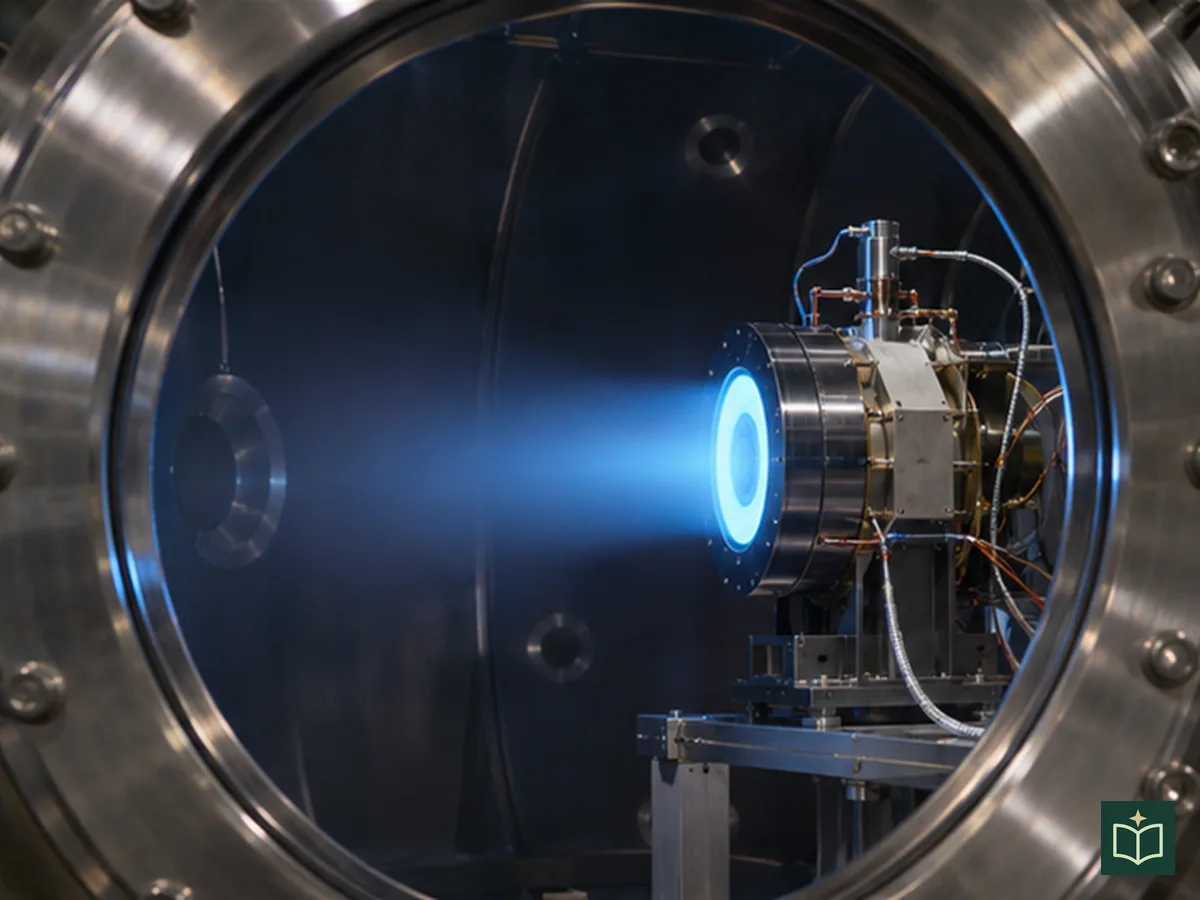
A gridded ion engine starts with a gas, usually xenon, which is heavy, inert and easy to store. Inside a chamber, electrons strike the xenon atoms and knock off some of their own electrons, leaving positively charged ions. At the back of the chamber sit two or three closely spaced metal grids with thousands of aligned holes, held at a high voltage difference. The electric field pulls the ions through the holes and accelerates them to around 30 kilometres per second or more. A separate device sprays electrons into the departing beam, so it leaves electrically neutral and the spacecraft does not become charged and drag its own exhaust back.
Why exhaust speed matters
A rocket gains speed by throwing mass backwards, and the faster that mass leaves, the more speed each kilogram of propellant buys. This relationship is captured by the rocket equation. Chemical rockets are limited by the energy stored in their fuel, giving exhaust speeds of up to about 4.5 kilometres per second. Ion engines are limited instead by electrical power, so they can reach exhaust speeds many times higher. Consider a 1,000-kilogram probe carrying 300 kilograms of propellant. Using exhaust at 30 kilometres per second, it can change its speed by about 10.7 kilometres per second. With exhaust at 3 kilometres per second, the same propellant gives only about 1.1.
The patience problem
The catch is acceleration. A thrust of 0.09 newtons on a one-tonne spacecraft produces an acceleration of 0.00009 metres per second squared, so imperceptible that it adds only about 7.8 metres per second in a full day. Gaining one kilometre per second takes roughly 129 days of continuous firing. That rules out ion engines for launches or quick manoeuvres, but suits long cruises. The thrusters also need plenty of electricity, usually from large solar panels, which limits them further from the Sun. Engines must be built to run for tens of thousands of hours, because the ion beam slowly erodes the grids, and that wear is a main limit on their life.
Missions that relied on it
Deep Space 1 proved the technology on a deep-space mission, flying past an asteroid and a comet. NASA’s Dawn spacecraft then used three ion engines to visit Vesta and Ceres, the two largest bodies in the asteroid belt, becoming the first probe to orbit two different destinations beyond Earth. Over its mission, Dawn changed its own speed by about 11 kilometres per second, more than any spacecraft had achieved with its own propulsion. Japan’s Hayabusa probes used ion engines to return asteroid samples, and the European-Japanese BepiColombo uses them on its long journey to Mercury. Many communications satellites now use electric thrusters to save mass.
Hall thrusters and the future
A close cousin, the Hall-effect thruster, uses a magnetic field to trap electrons and create the electric field that accelerates ions, without fragile grids. It gives more thrust per unit of power but a somewhat slower exhaust, and it has become common on commercial satellites; some large constellations use cheaper krypton or argon instead of scarce xenon. Researchers are developing higher-power electric engines that could one day move heavy cargo to the Moon or Mars more efficiently than chemical rockets. None will replace chemical engines for leaving Earth’s surface. But once in space, the quiet glow of an ion beam is increasingly how spacecraft get around.
Sources & further reading
Figures are rounded and widely published; check the linked organisations for the latest editions. These organisations do not endorse this website.