Four rotors, no moving parts
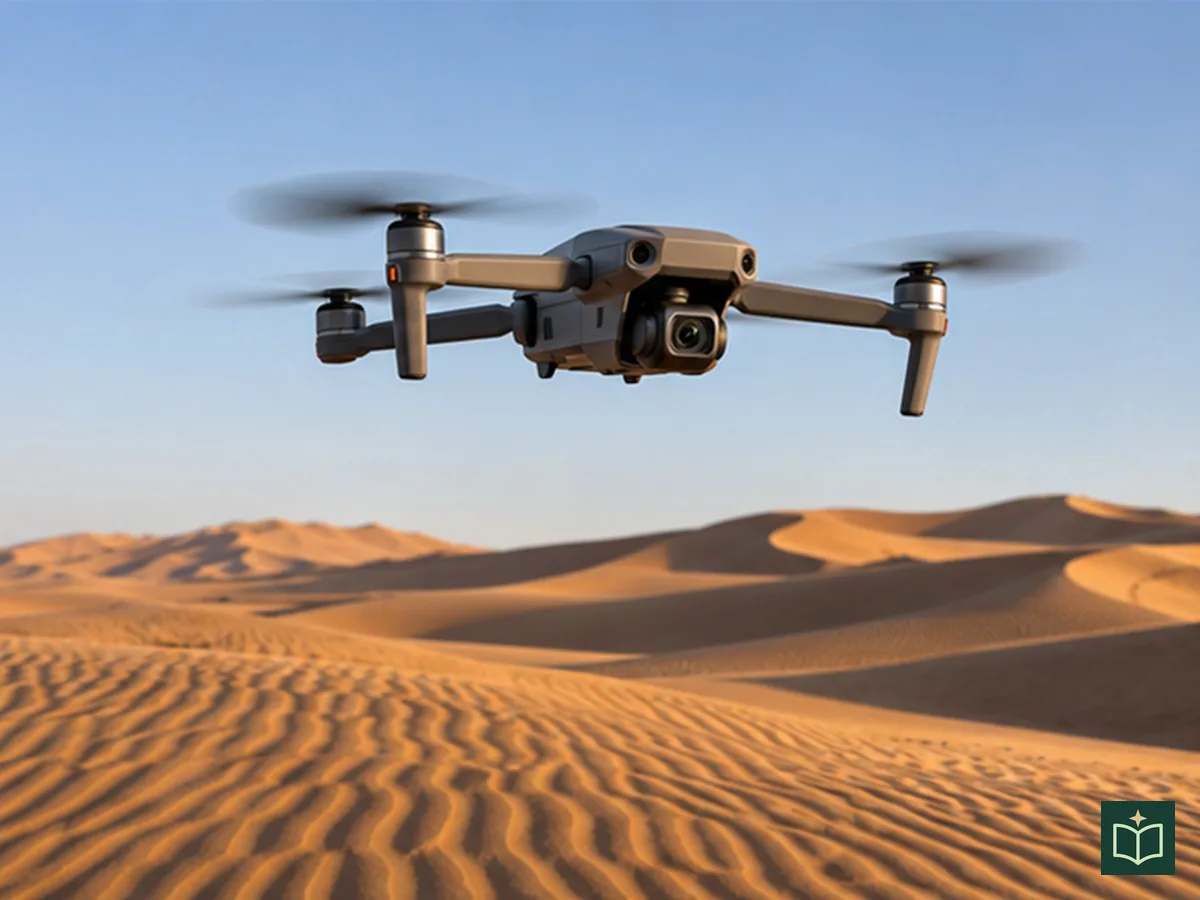
A helicopter steers by changing the angle of its rotor blades through a complex mechanical linkage. A typical consumer quadcopter has no such mechanism. Its four propellers are fixed to four electric motors, and the only thing that changes is how fast each one spins. That simplicity is why small drones became cheap and reliable from the 2010s, as tiny motion sensors from smartphones, light lithium batteries and efficient brushless motors became widely available. The same design, sometimes with six or eight rotors for extra lift and redundancy, is used for aerial photography, surveying, crop spraying, building inspection, deliveries and search and rescue around the world.
Cancelling the twist
A spinning propeller pushes air down and also tries to twist the drone the opposite way, the same reaction that would spin a helicopter without a tail rotor. Quadcopters cancel this by spinning two diagonally opposite rotors clockwise and the other two anticlockwise. To climb, all four speed up together. To tilt and move forward, the rear pair speeds up slightly and the front pair slows, so the drone leans and some of its thrust pushes it ahead. To turn on the spot, the clockwise pair speeds up while the anticlockwise pair slows, or the reverse, so the twisting forces no longer cancel and the drone rotates while total lift stays the same.
Inherently unstable
Left alone, a quadcopter would not stay level for more than a moment. Tiny differences between motors, a gust of wind or a shift in weight start it tilting, and once tilted it slides sideways and tilts further. Stability comes entirely from the flight controller, a small computer that reads an inertial measurement unit. This contains gyroscopes measuring how fast the drone is rotating and accelerometers measuring which way gravity points. The controller compares the drone’s actual attitude with the desired one and calculates corrections. At 1,000 updates a second, a drone flying at 10 metres per second moves just one centimetre between corrections, so errors are caught before they grow.
The feedback loop
Most flight controllers use a type of feedback calculation known as PID control. The proportional part reacts to the current error: the further the drone has tilted, the harder it pushes back. The integral part corrects persistent errors, such as a constant breeze or an unbalanced load. The derivative part reacts to how fast the error is changing, damping the correction so the drone does not overshoot and wobble. Tuning these three settings is a craft in itself. Racing drones are tuned to respond violently fast, while camera drones are tuned for smooth, gentle movement. Several loops are stacked, controlling rotation, angle, speed and position in turn.
Holding a position
Staying level is not the same as staying in place. To hover over one spot, camera drones combine satellite positioning, which gives location to within a few metres, with a barometer for height and downward-facing cameras that track the texture of the ground, a technique called optical flow. Forward-facing sensors detect obstacles. Software blends all these imperfect measurements into one best estimate of position. This is why drones can drift over water or featureless sand, where cameras find little texture, and why strong, gusty winds remain a challenge. Battery capacity limits most consumer drones to roughly 20 to 45 minutes in the air, and less when it is hot or windy.
Rules and responsibilities
Because drones are easy to fly, aviation authorities regulate them closely. Most countries, including the UAE, require many drones to be registered and restrict flights near airports, crowds and sensitive sites, often with no-fly zones built into the drone’s own software. Pilots are responsible for keeping drones within sight, respecting privacy and checking local rules before flying, especially when travelling with one. Regulators are gradually allowing longer-range operations, such as deliveries and inspections beyond the pilot’s view, using remote identification systems that broadcast each drone’s identity and position. The underlying physics, though, stays the same: four spinning rotors and a computer that never stops making corrections.
Sources & further reading
- US Federal Aviation Administration · Unmanned aircraft systems ↗
- UAE General Civil Aviation Authority ↗
Figures are rounded and widely published; check the linked organisations for the latest editions. These organisations do not endorse this website.