The problem of flat glass
For centuries, making flat glass was difficult and expensive. Early window glass was blown into a cylinder or spun into a disc, then flattened, leaving ripples and uneven thickness. Later, glass was drawn upwards from a molten pool or rolled into plate, but high-quality plate had to be ground and polished on both sides, wasting material and time. In the 1950s, Alastair Pilkington and Kenneth Bickerstaff, working for the British glassmaker Pilkington, developed a radically simpler idea: pour molten glass onto a bath of molten tin. Announced in 1959, the float process spread worldwide through licensing and now makes the vast majority of flat glass for buildings and cars.
Melting the ingredients
Clear soda-lime glass starts as a precise recipe of raw materials. The main ingredient is silica sand, mixed with soda ash to lower its melting temperature, limestone and dolomite to make the glass durable, and small amounts of other minerals. Crushed recycled glass, called cullet, is added because it melts easily and saves energy. The batch is fed continuously into a huge furnace heated by gas burners to around 1,500 degrees Celsius. Bubbles rise and escape, and the melt becomes a uniform liquid. Float lines run nonstop, day and night, for many years between rebuilds, because cooling and restarting a furnace is costly and can damage its lining.
Floating on tin
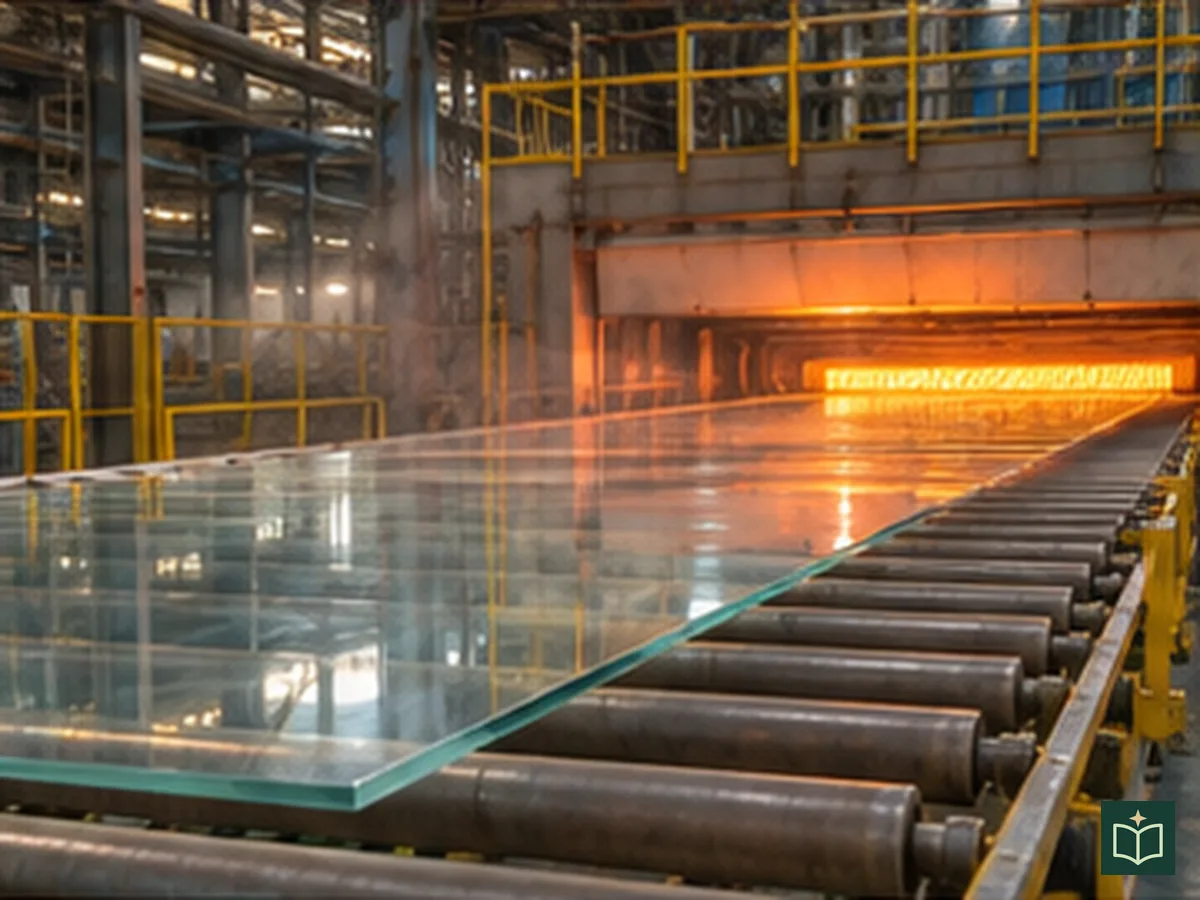
Molten glass at about 1,100 degrees flows onto a shallow bath of molten tin, enclosed in a chamber filled with nitrogen and hydrogen to stop the tin oxidising. Tin is ideal because it is much denser than glass, stays liquid over the right temperature range and has a perfectly flat surface. The glass floats and spreads until gravity and surface tension balance, which naturally gives a sheet about six millimetres thick. Toothed rollers at the edges pull or hold back the ribbon to make it thinner or thicker. As it travels along the bath, it cools until it is stiff enough, at around 600 degrees, to lift onto rollers.
Annealing and cutting
The ribbon then passes through a long annealing oven called a lehr, where its temperature falls slowly and evenly. Cooling too fast would trap stresses inside the glass and cause it to crack unexpectedly. At the end, automated scanners inspect the ribbon for bubbles, stones and distortion, marking faults to be cut out. Diamond or carbide wheels score the glass, and it snaps cleanly into sheets. Edges and waste are crushed back into cullet and returned to the furnace. A single float line can be hundreds of metres long and produce a continuous ribbon several metres wide, enough glass for thousands of windows each day.
Toughened, laminated and coated
Plain float glass is only the starting point. To make toughened, or tempered, glass, a cut sheet is heated to around 620 degrees and then blasted with cold air, so the surface hardens in compression while the core stays in tension. The result is several times stronger and breaks into small blunt pieces rather than dangerous shards. It cannot be cut afterwards. Laminated glass bonds two sheets with a plastic interlayer that holds fragments together, which is why car windscreens and many balconies use it. Thin metal oxide coatings can reflect heat while letting light through. In Gulf towers, solar-control and low-emissivity coatings greatly reduce air-conditioning demand.
Limits and what to watch
Glassmaking is energy-intensive. Furnaces burn large amounts of natural gas, and the carbonates in the recipe release carbon dioxide as they melt. Manufacturers are cutting emissions by using more cullet, testing hydrogen and electric heating, and recovering waste heat. Recycling flat glass is harder than recycling bottles, because windows come with frames, coatings and laminates that must be removed. One common misconception is that old windows are thicker at the bottom because glass flows over centuries. In fact, at room temperature glass flows far too slowly for that; older panes were simply uneven when made, and installers often placed the thicker edge at the bottom.
Sources & further reading
Figures are rounded and widely published; check the linked organisations for the latest editions. These organisations do not endorse this website.