Railways have always been signalled
Trains cannot steer around obstacles and need long distances to stop, so railways have relied on signalling since the nineteenth century. Traditional systems divide a line into fixed blocks, sections of track that only one train may occupy at a time, protected by signals at their entrances. A train may enter a block only when the one ahead has left it. This is safe but wasteful, because trains must stay at least a full block apart regardless of their actual speed. On busy urban lines, where trains run every couple of minutes, that spacing limits how many people the line can carry, particularly during morning and evening peaks.
Moving blocks and radio
Modern metros use communication-based train control, or CBTC. Each train determines its own position precisely using sensors on its wheels and beacons fixed between the rails, and reports its position and speed continuously by radio to computers beside the track. Those computers calculate a movement authority for every train, the point up to which it may safely travel, based on the position of the train ahead and the route ahead. Instead of fixed blocks, each train is surrounded by a protected zone that moves with it, known as a moving block. Trains can therefore run closer together safely, increasing capacity without building new tunnels or tracks.
Three layers of automation
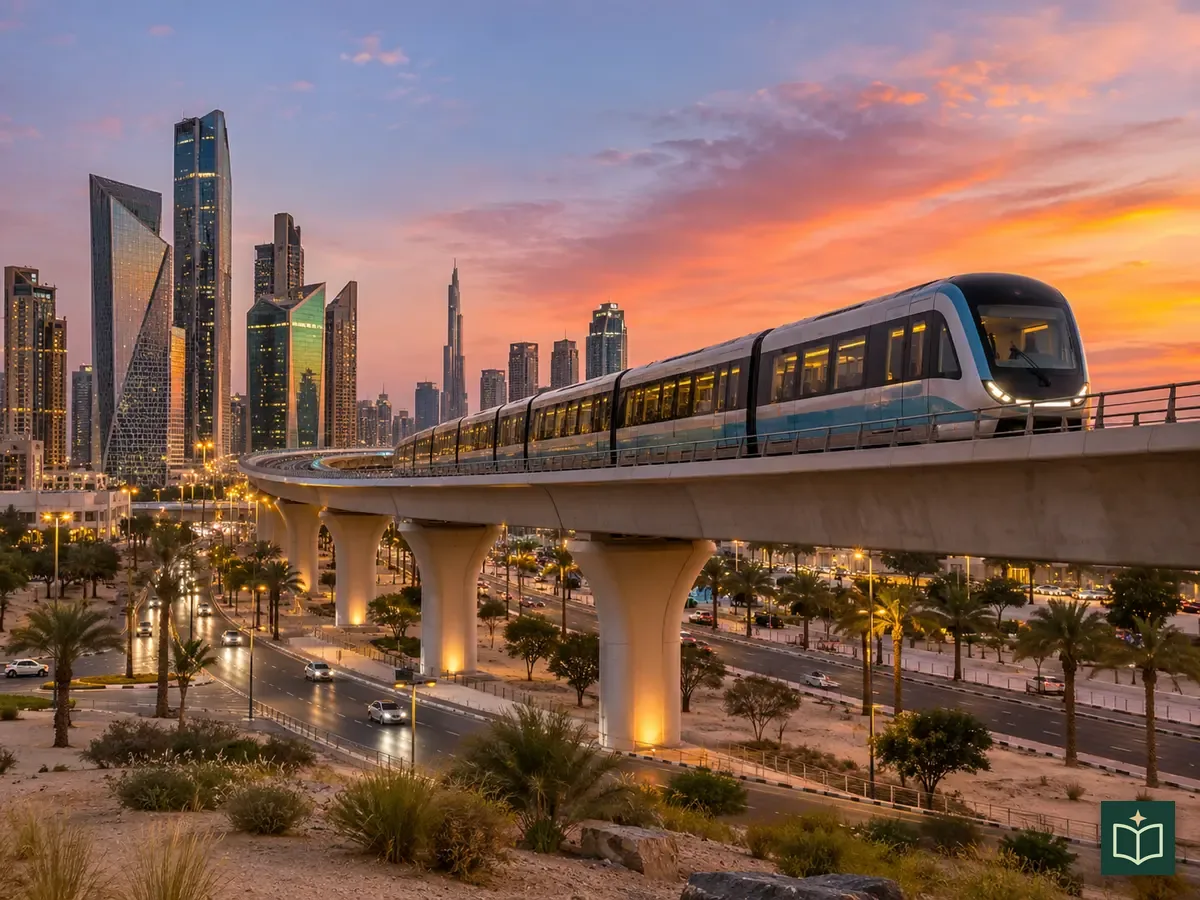
CBTC systems combine several functions. Automatic train protection enforces speed limits and movement authority, applying the brakes if a train would exceed them; this is the safety layer. Automatic train operation drives the train, accelerating, coasting and braking smoothly to stop with doors aligned to platform screen doors. Automatic train supervision, in a central control room, sets timetables, adjusts spacing and routes trains around problems. Railways describe their level of automation in grades. At Grade of Automation 4, the highest, there is no driver or attendant at all. Dubai Metro opened in 2009 as a fully driverless system, and its Red Line ranks among the longest of its kind.
When things go wrong
Driverless does not mean unattended. Control centre staff watch the entire network, communicate with passengers through intercoms and screens, and dispatch roving staff to deal with incidents. Platform screen doors keep people and objects off the track, removing one of the main risks that drivers traditionally watched for. Obstacle detectors on the front of trains and intrusion sensors provide further protection. If a train loses communication, it stops safely, and operators can restore service under restricted procedures. Every safety-critical function is designed to fail safe, meaning that a fault leads to the train stopping rather than continuing with uncertain information. Evacuation walkways and procedures are planned in detail.
Why cities choose it
Automation allows trains to run at short intervals with consistent performance, increasing capacity and reliability. It lets operators add trains quickly for events or late-night demand without scheduling extra drivers, and smooth automatic driving can reduce energy use. Many new metro lines worldwide, from Copenhagen and Paris to Singapore, Riyadh and Doha, have been built for driverless operation, and some older lines have been converted. The cost lies in complex systems, rigorous safety certification and integration with stations. Labour is redeployed to customer service, maintenance and control rather than eliminated. Studies by public transport associations have found that driverless lines generally achieve strong safety and punctuality records.
Misconceptions
Driverless metros are not the same as self-driving cars. A train runs on a fixed, enclosed path with no pedestrians, junctions with traffic or unpredictable steering, which makes full automation much simpler to achieve safely. The computers do not use artificial intelligence to make driving decisions; they follow deterministic rules that can be tested and certified. Nor are passengers alone: help is available at the push of a button. Front windows that once belonged to the driver now offer a view down the tunnel, a favourite spot for children. The quiet success of these systems is a reminder of how much safety engineering hides behind routine journeys.
Sources & further reading
Figures are rounded and widely published; check the linked organisations for the latest editions. These organisations do not endorse this website.