A standard box
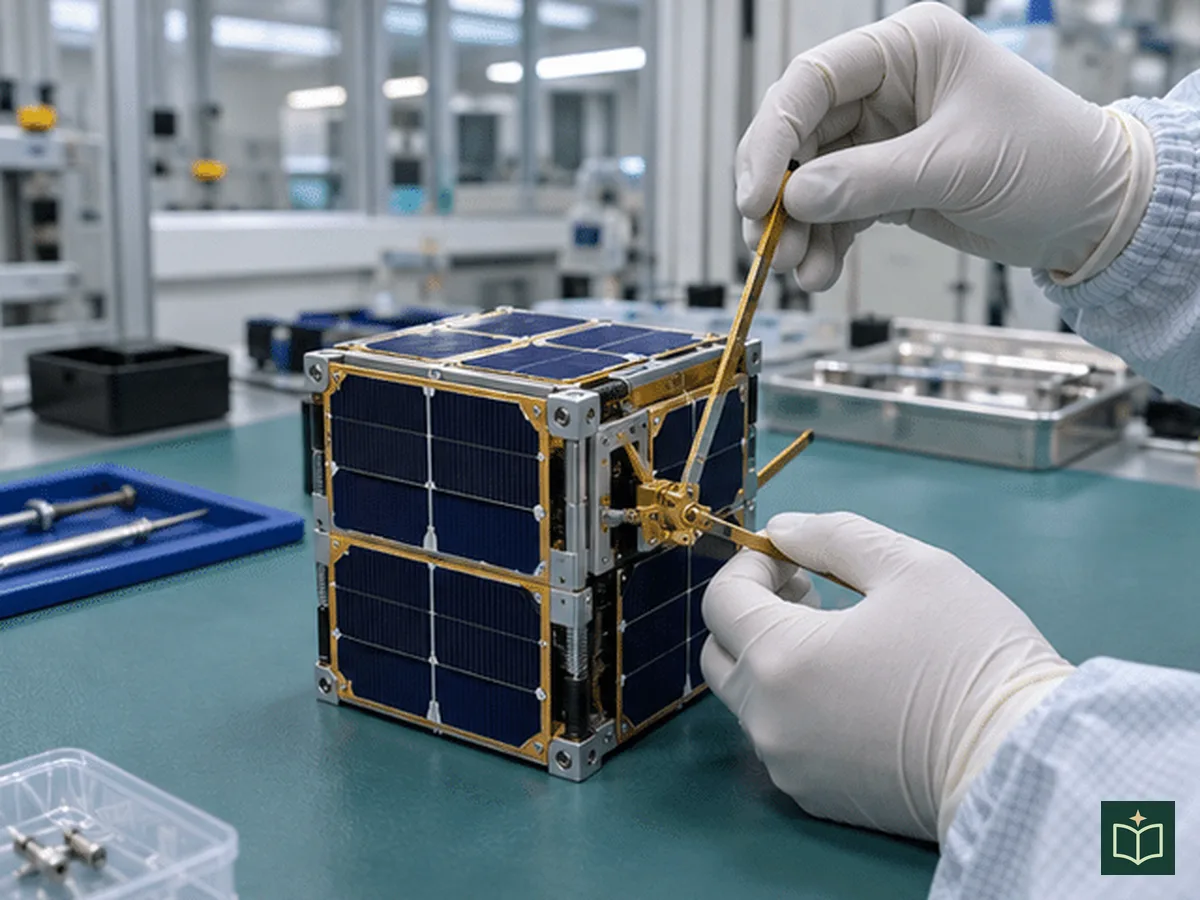
A CubeSat is a small satellite built to a shared standard. The basic unit, called 1U, is a cube 10 centimetres on each side, about one litre in volume and typically weighing one to two kilograms. Satellites can be made from several units stacked together: a 3U CubeSat is roughly the size of a loaf of bread, while 6U and 12U versions resemble a shoebox or small suitcase. Because every CubeSat fits the same dimensions, it can slot into standard launch dispensers and use parts made by many suppliers, such as solar panels, radios and computer boards. That standardisation, more than any single technology, is what made CubeSats transformative.
A university idea
The standard was created in 1999 by Jordi Puig-Suari of California Polytechnic State University and Bob Twiggs of Stanford University. Their goal was to let students design, build and fly a real spacecraft within the few years of a degree course. The first CubeSats reached orbit in 2003. Cal Poly also designed a spring-loaded deployer, a box that holds several CubeSats and pushes them out once the rocket reaches orbit, protecting the main payload from any malfunction. Space agencies quickly saw the value. NASA, the European Space Agency and others now run programmes offering free or subsidised launches to university and research teams, and thousands of CubeSats have since flown.
Why they are cheap
Traditional satellites can cost hundreds of millions of dollars and take a decade to build, with custom, radiation-hardened parts and exhaustive testing. CubeSats take a different approach. They often use commercial electronics similar to those in phones, accept a higher risk of failure and are designed in months or a couple of years. Launch costs fall sharply because CubeSats ride as secondary passengers on rockets carrying bigger satellites or supplies to the space station, sharing the cost. A 1U cube has a volume of 1,000 cubic centimetres, and a 3U design three times that, so many can fit into spare space on a single rocket. Whole missions can cost a small fraction of a conventional satellite.
What they do
Early CubeSats were mostly teaching projects that sent back simple signals. Today they do serious work. Companies operate constellations of hundreds of 3U CubeSats that photograph Earth's entire landmass almost every day, tracking crops, construction and disasters. Others monitor ships and aircraft, collect weather data or test new technologies cheaply before they are used on expensive missions. In 2018 two NASA CubeSats called MarCO flew all the way to Mars, relaying data as the InSight lander touched down, the first CubeSats to travel into deep space. Scientists also use them for astronomy, space weather and studies of Earth's upper atmosphere, often in coordinated groups rather than alone.
A route into space for the UAE
CubeSats have helped smaller and newer space nations build skills quickly. The UAE's first nanosatellite, Nayif-1, was built by students at the American University of Sharjah with guidance from engineers at the Mohammed Bin Rashid Space Centre and launched in 2017. It carried an amateur radio payload and, through its communications, introduced students to real mission operations. MeznSat, a 3U CubeSat developed by students at Khalifa University and the American University of Ras Al Khaimah, was launched in 2020 to study greenhouse gases over the region. Such projects train the engineers who later work on larger missions, a pattern repeated in many countries starting their space programmes.
Limits and responsibilities
Small size brings real constraints. CubeSats have little room for batteries, solar panels and antennas, which limits their power, data rates and instruments. Most have no propulsion or only very small thrusters, so they cannot easily dodge debris or adjust their orbits. Many fail early, especially student projects, though reliability has improved. In low orbits, thin atmospheric drag pulls them down within months to a few years, where they burn up, which helps limit clutter. But the sheer numbers being launched add to congestion and collision concerns. Operators must also secure radio frequency licences and comply with debris-mitigation rules, reminders that even tiny satellites carry big responsibilities.
Sources & further reading
Figures are rounded and widely published; check the linked organisations for the latest editions. These organisations do not endorse this website.