Four strokes, all at once
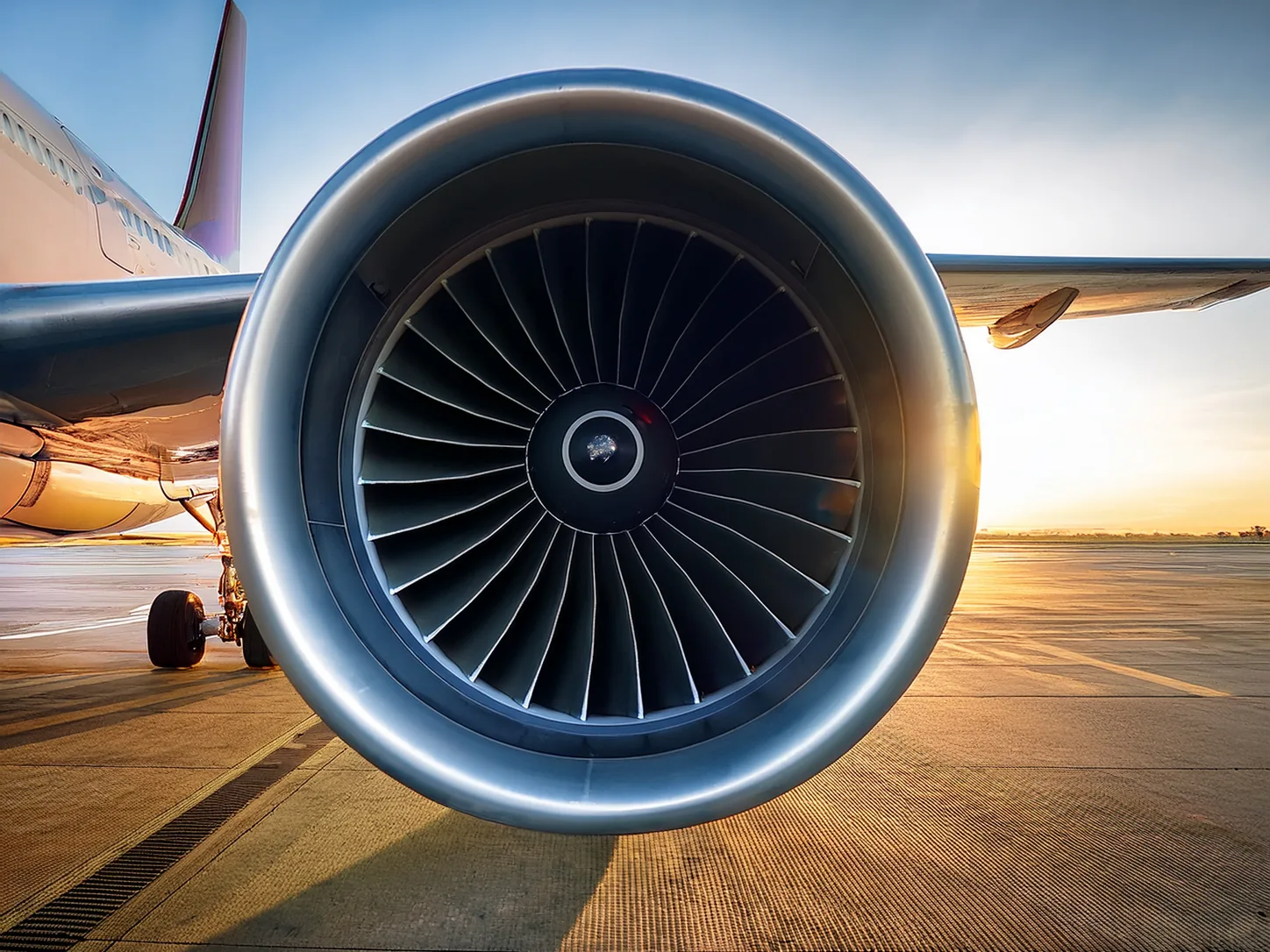
Engineers sum up the jet engine in four words: suck, squeeze, bang, blow. They are the same four stages as in a car engine, intake, compression, combustion and exhaust. The difference is that a piston engine performs them one after another inside the same cylinder, while a jet engine performs all four continuously, in separate sections arranged along its length. Air flows in at the front and out at the back without pause. The physics behind the result is Newton's third law. The engine throws a large mass of air backwards very fast, and the equal and opposite reaction pushes the engine, and the wing it hangs from, forwards.
Squeezing the air
At the front, rows of spinning blades form the compressor. Each row speeds the air up and each row of fixed vanes behind it slows it again, converting speed into pressure. A large airliner engine may have more than a dozen such stages, raising pressure to around forty times that of the outside air or more. Compression matters because fuel releases more useful energy when it burns in dense, high-pressure air. The blades are shaped like small wings and must be made with extreme precision. If airflow over them breaks down, the engine can surge, a violent reversal of flow that pilots and engineers work hard to avoid.
Burning and spinning
The squeezed air enters the combustor, where fuel is sprayed in and burns continuously, like a blowtorch that never goes out. Gas temperatures here can exceed the melting point of the metals around them, so parts are cooled by films of air and protected by ceramic coatings. The hot gas then rushes through the turbine, another set of bladed wheels. The turbine is not there to push the aircraft. Its job is to extract enough energy to spin the compressor and fan, which sit on the same shafts. Whatever energy remains leaves the exhaust nozzle as a fast jet, and in early engines that jet produced all of the thrust.
Why the fan does most of the work
Pushing a small amount of air very fast wastes energy and makes a great deal of noise. Pushing a large amount of air more gently gives the same thrust far more efficiently. Modern airliners therefore use turbofans, with a huge fan at the front driven by the core. Most of the air it moves never enters the core at all: it flows around it, through a duct, and out the back. In an engine with a bypass ratio of 10 to 1, ten parts of air bypass the core for every one part passing through it, so about 91 per cent of the airflow goes around. That bypass air produces most of the thrust.
From war to wide-bodies
Two engineers worked out the jet engine independently in the 1930s: Frank Whittle in Britain and Hans von Ohain in Germany. Von Ohain's engine flew first, powering the Heinkel He 178 in August 1939. Early jets were pure turbojets, fast but thirsty and very loud, suited to fighters. Airliners such as the de Havilland Comet and Boeing 707 brought jets to passengers in the 1950s. The real leap in economy came with high-bypass turbofans from around 1970, first on the Boeing 747. The wide-bodied jets that link Gulf hubs to every continent today depend on that design, which cut fuel use and noise dramatically.
Limits and what comes next
A common misconception is that jet engines work by pushing against the air behind the aircraft. They do not: thrust comes from accelerating air through the engine, which is why rockets, carrying their own oxidiser, work in a vacuum. Engines are already very efficient, so gains now come slowly, through lighter materials, hotter-running cores and ever larger fans. Fans cannot grow forever, because they must fit under the wing and their tips must not go too fast. Some designs add a gearbox so the fan can turn slower than the turbine. Others test open rotors without a duct. Each step aims at the same goal: moving more air, more gently.
Sources & further reading
Figures are rounded and widely published; check the linked organisations for the latest editions. These organisations do not endorse this website.