Why the second matters
It is easy to take for granted that your phone, laptop and bank all show the same time. But that agreement is essential. Security certificates that protect websites are valid only between certain dates, so a badly wrong clock can make secure sites refuse to load. The six-digit codes from authenticator apps are calculated from the current time and fail if a phone drifts too far. Logs from different servers must line up to reconstruct a cyberattack or a system crash. Financial markets timestamp trades to tiny fractions of a second, and mobile networks and power grids rely on precise timing to coordinate equipment across whole countries.
Every clock drifts
Inside most computers and phones is a quartz crystal that vibrates at a steady frequency, often 32,768 times a second, which the device counts to keep time. Quartz is good but not perfect, and its rate shifts with temperature and age. An error of 20 parts per million is typical for an inexpensive crystal. That sounds tiny, but a day contains 86,400 seconds, so the clock could gain or lose about 1.7 seconds a day, or close to a minute a month. Left alone, a fleet of computers would soon disagree by many seconds. So devices regularly compare themselves with a better source and quietly correct the difference.
Atomic time at the top
The ultimate reference is atomic time. Since 1967 the second has been defined by the radiation of caesium atoms: exactly 9,192,631,770 oscillations. National laboratories operate atomic clocks, and the International Bureau of Weights and Measures near Paris combines readings from hundreds of them around the world to produce Coordinated Universal Time, or UTC. Local time is UTC plus or minus an offset; the UAE uses UTC plus four hours, with no daylight saving changes. Navigation satellites also carry atomic clocks and broadcast precise time, which many time servers and mobile networks use as their reference. Phones often take time directly from the mobile network as well as from internet servers.
How a device asks the time
Most computers use the Network Time Protocol, NTP. Servers are arranged in layers called strata: stratum 1 servers connect directly to atomic or satellite references, stratum 2 servers synchronise with them, and so on. A device sends a request noting its own departure time. The server stamps when the request arrived and when its reply left, and the device notes when the reply returned. From those four timestamps it estimates the round-trip delay and its clock offset, assuming the journey took equally long in each direction. If the request took 30 milliseconds each way, the device subtracts that travel time rather than blindly copying the server's clock. Typical internet accuracy is within a few milliseconds.
The leap-second problem
Earth's rotation is slightly irregular and gradually slowing, so astronomical time drifts away from atomic time. Since 1972, timekeepers have occasionally added a leap second to UTC to keep the two within a second of each other; 27 have been added so far. Each one creates a minute with 61 seconds, an unusual event that software often handles badly. A leap second in 2012 contributed to outages at several websites and airline booking systems. Some large technology companies now 'smear' the extra second across many hours instead. In 2022 the international body that oversees measurement standards voted to stop adding leap seconds by 2035, letting the difference grow larger before any correction.
Beyond milliseconds
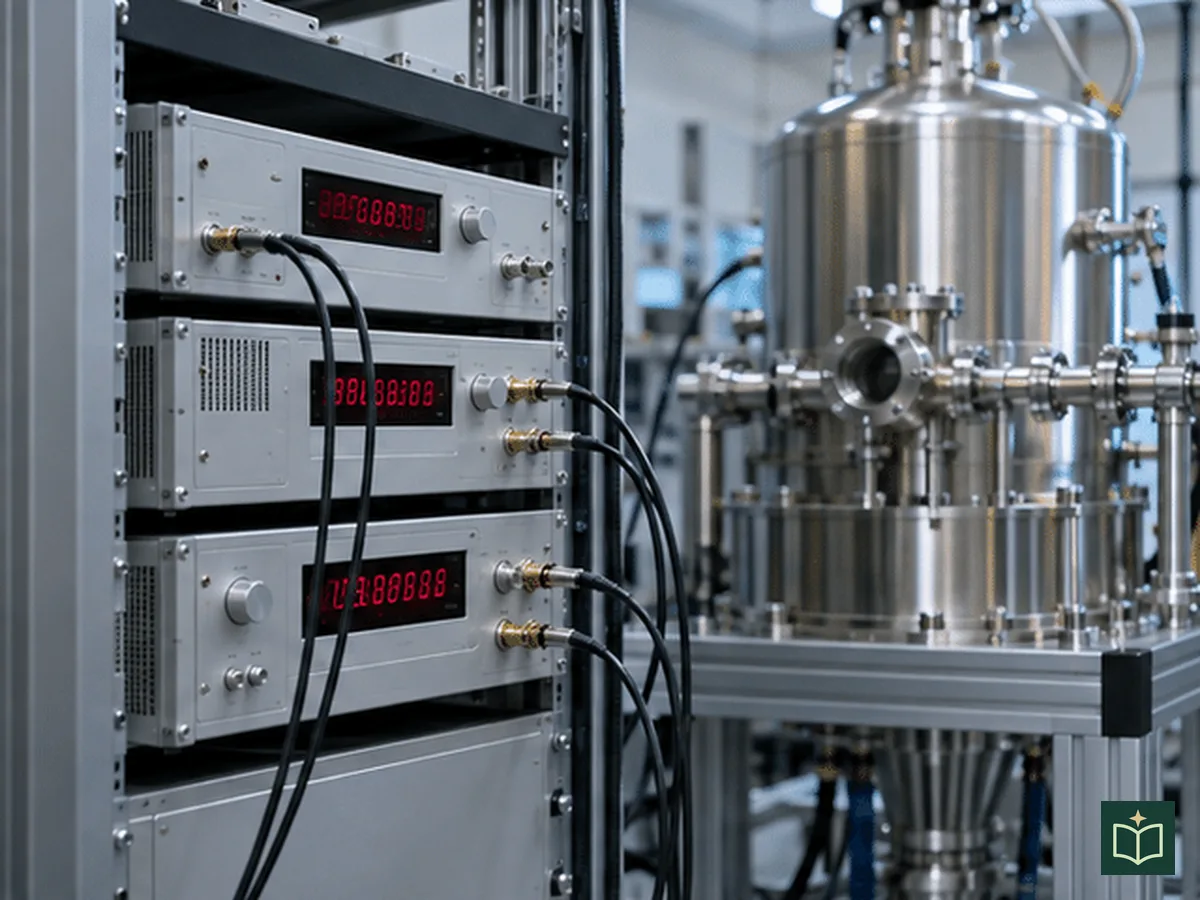
Some systems need more precision than NTP offers. Stock exchanges, telecom networks and power grids use the Precision Time Protocol, which relies on special network hardware to stamp messages as they pass and can achieve accuracy of under a microsecond within a local network. Data centres increasingly install their own atomic or satellite-disciplined clocks. Reliance on satellite timing creates a vulnerability, since signals can be jammed or spoofed, so critical industries keep backup sources. For ordinary users, the system works invisibly: when your phone switches on after a flight or a long time off, it quickly asks the network and servers for the time and corrects itself within moments.
Sources & further reading
Figures are rounded and widely published; check the linked organisations for the latest editions. These organisations do not endorse this website.