Nothing really wireless
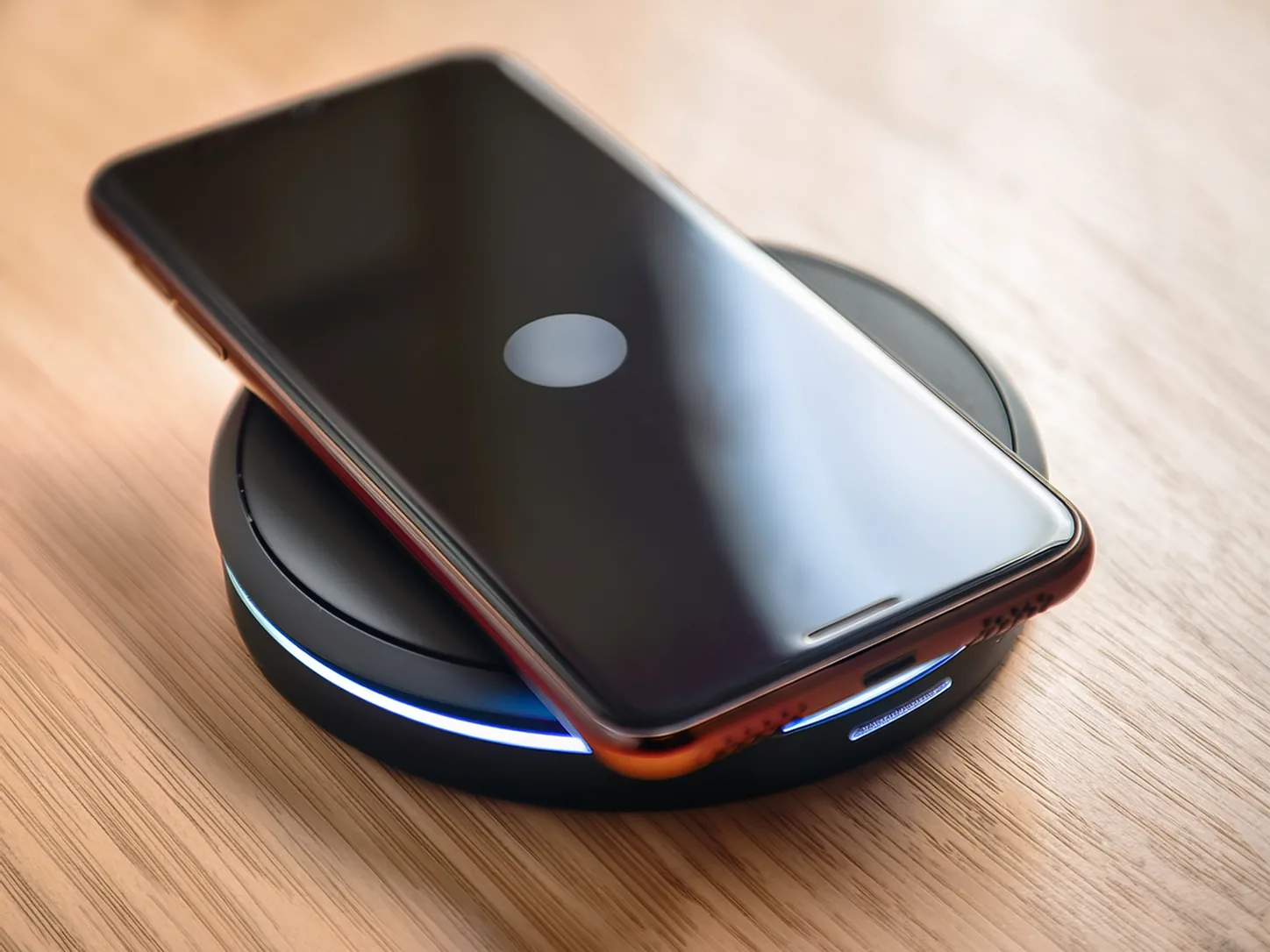
A wireless charging pad still plugs into the wall. What disappears is the cable between pad and phone. Inside the pad is a flat coil of copper wire, and inside the back of the phone is another. Placing the phone on the pad brings the two coils within a few millimetres of each other, and energy crosses that gap through a magnetic field. No electricity jumps through the air and no radio waves are beamed across the room. The same principle charges electric toothbrushes, smartwatches and wireless earbuds, and on a much larger scale it is being tested for charging buses and cars parked over pads in the road.
Faraday's old discovery
The physics was described by Michael Faraday in 1831. He found that a changing magnetic field passing through a loop of wire creates, or induces, an electric current in that loop. A steady field does nothing; it must change. So the pad drives alternating current through its coil, switching direction many thousands of times a second. That produces a magnetic field that constantly rises, collapses and reverses. Each change pushes current back and forth in the phone's coil. Circuits in the phone convert this alternating current into the steady direct current a lithium-ion battery needs, and its charging chip controls how fast it flows. The arrangement is essentially a transformer whose two halves have been pulled apart.
Why alignment matters
Magnetic fields weaken quickly with distance and spread out sideways. If the phone's coil sits directly over the pad's coil, most of the field passes through it. Shift the phone a little to one side, or add a thick case, and much of the field misses, so charging slows or stops. Early pads were fussy for exactly this reason. Some used several overlapping coils to widen the sweet spot. The Qi2 standard, announced in 2023, added a ring of magnets that snaps the phone into the correct position, an approach first popularised by one phone maker's magnetic system. Metal objects such as keys or coins left on a pad can also absorb the field and heat up.
Where the energy goes
Every conversion loses something, and wireless charging has more conversions than a cable. Energy is lost in the pad's electronics, in the coils' resistance, in the field that leaks past the phone and in the phone's own circuits. Much of it ends up as heat. As an illustration, if a pad delivers 15 watts to the phone at 75 per cent overall efficiency, it must draw 20 watts from the socket, and 5 watts become warmth. Real efficiency varies with the charger, the alignment and the phone, but wired charging is generally more efficient. Heat matters because lithium-ion batteries age faster when warm, so phones slow charging when they get hot.
From toothbrush to phone
Inductive charging is not new. Electric toothbrushes have used it for decades because a sealed handle with no metal contacts is safe in a wet bathroom. Phones adopted it more slowly. The Wireless Power Consortium, formed in 2008, published the first Qi specification in 2010, and competing standards were eventually outlasted. Wireless charging moved into the mainstream once major phone makers built Qi into flagship models from 2017. Today pads are common in cars, cafés, hotel rooms and furniture. On warm days in the Gulf, though, a phone left charging on a sunny dashboard can heat up quickly and pause charging until it cools.
Convenience versus loss
The main appeal is convenience: set the phone down and it charges, with no worn ports or fiddly plugs. The trade-offs are slower top speeds than the fastest cables, extra heat and a little wasted electricity. Across one phone, that waste is tiny. Across billions of devices charged every night, it adds up, which is one reason standards bodies keep pushing efficiency. A frequent misconception is that wireless charging damages batteries. Batteries age mainly through heat and full charge cycles, and a well-designed pad manages both. Leaving a phone in a thick case, or charging it under a pillow, is a bigger risk than the method itself.
Sources & further reading
Figures are rounded and widely published; check the linked organisations for the latest editions. These organisations do not endorse this website.