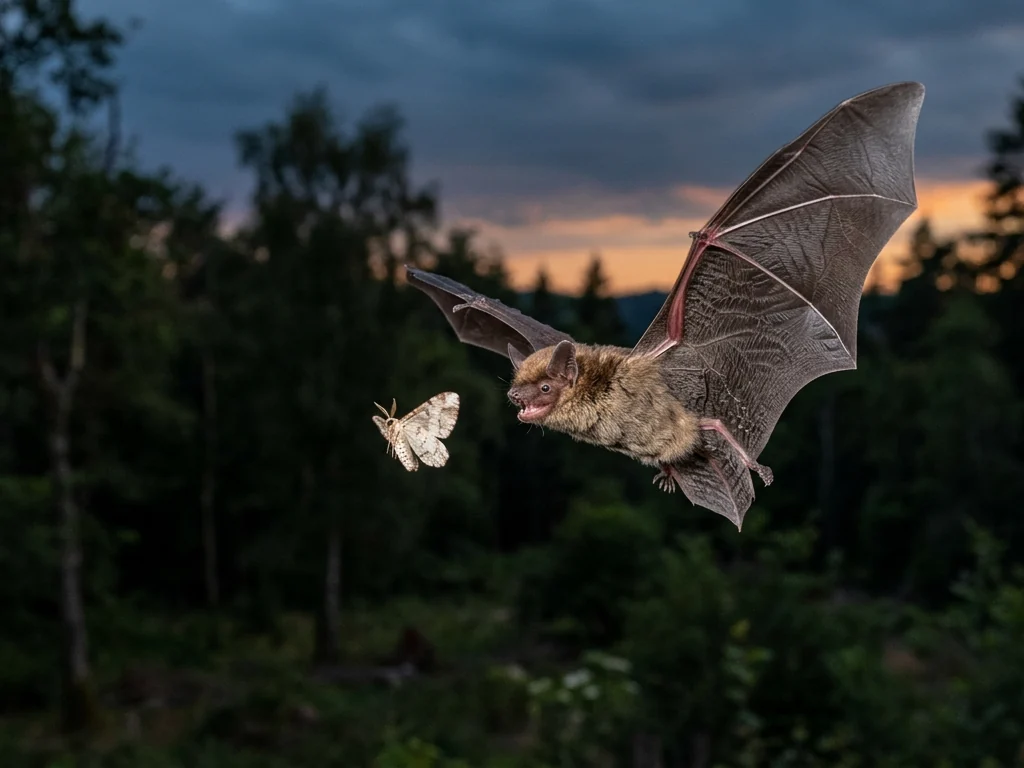
Sound as a flashlight
Bats are not blind, but darkness limits eyesight. Many species instead produce bursts of sound and listen for echoes. Because sound travels at roughly 343 metres per second in air, an echo that returns after a few thousandths of a second reveals that something is only a metre or so away.
Why ultrasound
Most echolocation calls are above about 20 kilohertz, beyond the upper limit of human hearing. Short wavelengths bounce off small objects such as moths and mosquitoes, giving the bat finer detail. The trade-off is that high-pitched sound fades quickly in air, so bats must be relatively close to their targets.
A fast feedback loop
When searching, a bat may call around ten times a second. As it closes in, the rate climbs to well over a hundred calls a second—the so-called feeding buzz. The brain compares each echo with the call that produced it, extracting distance, direction, speed and even the flutter of an insect’s wings.
An evolutionary arms race
Some moths have evolved ears that detect bat calls and trigger evasive dives. Others produce clicks that jam or warn. Dolphins, some whales and a few birds also echolocate, and people have borrowed the principle for sonar, ultrasound scanning and car parking sensors.
Sources & further reading
Call frequencies and rates vary widely between bat species; figures are typical, rounded values. Photograph: original AI-generated illustration (Adobe Firefly). Reference organisations do not endorse this website.