Why a plant would eat animals
Carnivorous plants still photosynthesise like any other green plant, using sunlight to make sugars. What they lack is nutrients. Most grow in bogs, wet heaths and sandy swamps where the soil is waterlogged, acidic and poor in nitrogen and phosphorus, the elements needed to build proteins and DNA. Catching insects and other small animals supplies those missing ingredients. Botanists have described several hundred carnivorous species, and the habit has evolved independently a number of times in unrelated plant families. Charles Darwin was fascinated by them and in 1875 published Insectivorous Plants, a detailed study that helped establish that these plants genuinely digest their prey.
The flytrap's snap
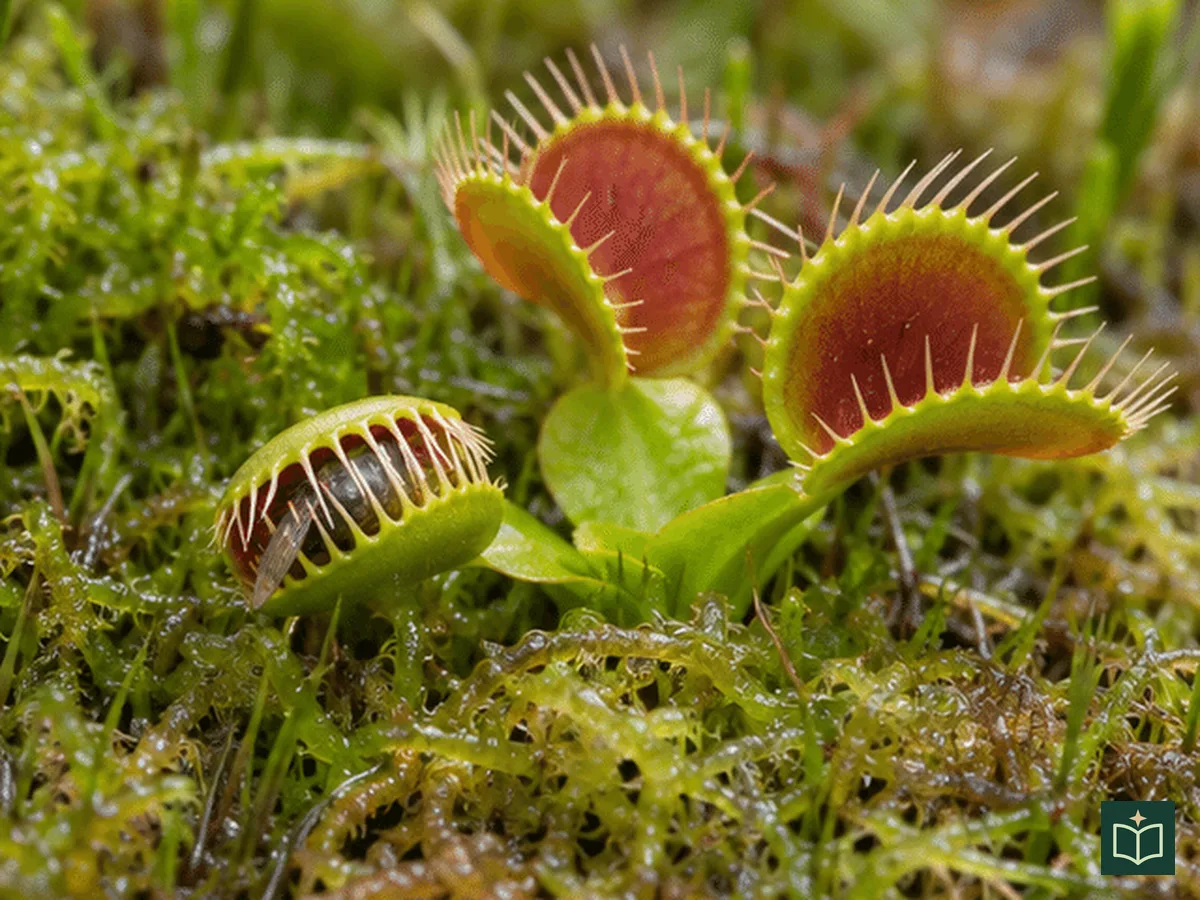
The Venus flytrap is native only to a small area of wetlands in North and South Carolina in the United States. Each trap is a leaf hinged into two lobes edged with stiff bristles. On the inner surface of each lobe sit usually three short trigger hairs. When an insect brushes one, it generates an electrical signal, much like a nerve impulse. A single touch does nothing, which saves the plant from wasting effort on raindrops or debris. A second touch within about 20 to 30 seconds triggers closure, and the lobes snap shut in a fraction of a second as they flip from curving outward to curving inward, like a popped contact lens.
A plant that counts
Research published in 2016 showed that the flytrap goes on counting after it shuts. A struggling insect keeps touching the trigger hairs, and each touch sends another electrical signal. After about three signals the trap seals tightly and begins activating digestive genes; by around five it is producing enzymes and the transporters that pull nutrients into its cells. An empty trap, or one that has caught a stone, receives no further signals and reopens within a day or so. Digestion of a fly takes roughly a week or more, after which the trap opens to leave a dry husk. Each trap can close only a limited number of times before it withers.
Pitfalls and pitchers
Pitcher plants use a passive trap: a leaf rolled into a deep cup filled with digestive fluid. Insects drawn by colour and nectar land on the rim, which in many tropical Nepenthes species becomes extremely slippery when wet, so visitors aquaplane and fall in. Waxy, downward-pointing surfaces inside prevent escape. North American Sarracenia pitchers stand upright in bogs, while Nepenthes, found from Madagascar to northern Australia, hang from vines. Some of the largest Nepenthes pitchers can hold more than a litre of fluid. A few species in Borneo have shifted diet, providing nectar to tree shrews that leave droppings in the pitcher, a nitrogen supply that does not involve catching anything.
Sticky and sucking traps
Sundews, of the genus Drosera, are found on every continent except Antarctica. Their leaves are covered in tentacles tipped with glistening drops of sticky mucilage that look like dew. An insect that lands becomes glued, and neighbouring tentacles slowly bend over it, sometimes with the whole leaf curling around. Bladderworts, which live in water or wet soil, use one of the fastest movements in the plant world. Their tiny bladders pump out water to create low pressure inside; when a small creature touches trigger hairs at the entrance, a trapdoor opens and the prey is sucked in within about a thousandth of a second, before the door closes again.
Fragile specialists
Their specialisation makes carnivorous plants vulnerable. Many depend on open, wet, nutrient-poor habitats that are easily drained for farming or building, or enriched with fertiliser run-off that lets ordinary plants outcompete them. Wild Venus flytraps survive in a limited area and are protected by law in North Carolina because of poaching for the plant trade. Fire suppression has also allowed shrubs to shade some bog habitats. For growers, the lesson is that these plants need rainwater or distilled water, since minerals in tap water can harm them, and they should not be fed meat from the kitchen, which can rot inside the trap. In the wild, insects provide all they need.
Sources & further reading
Figures are rounded and widely published; check the linked organisations for the latest editions. These organisations do not endorse this website.