An energy balance
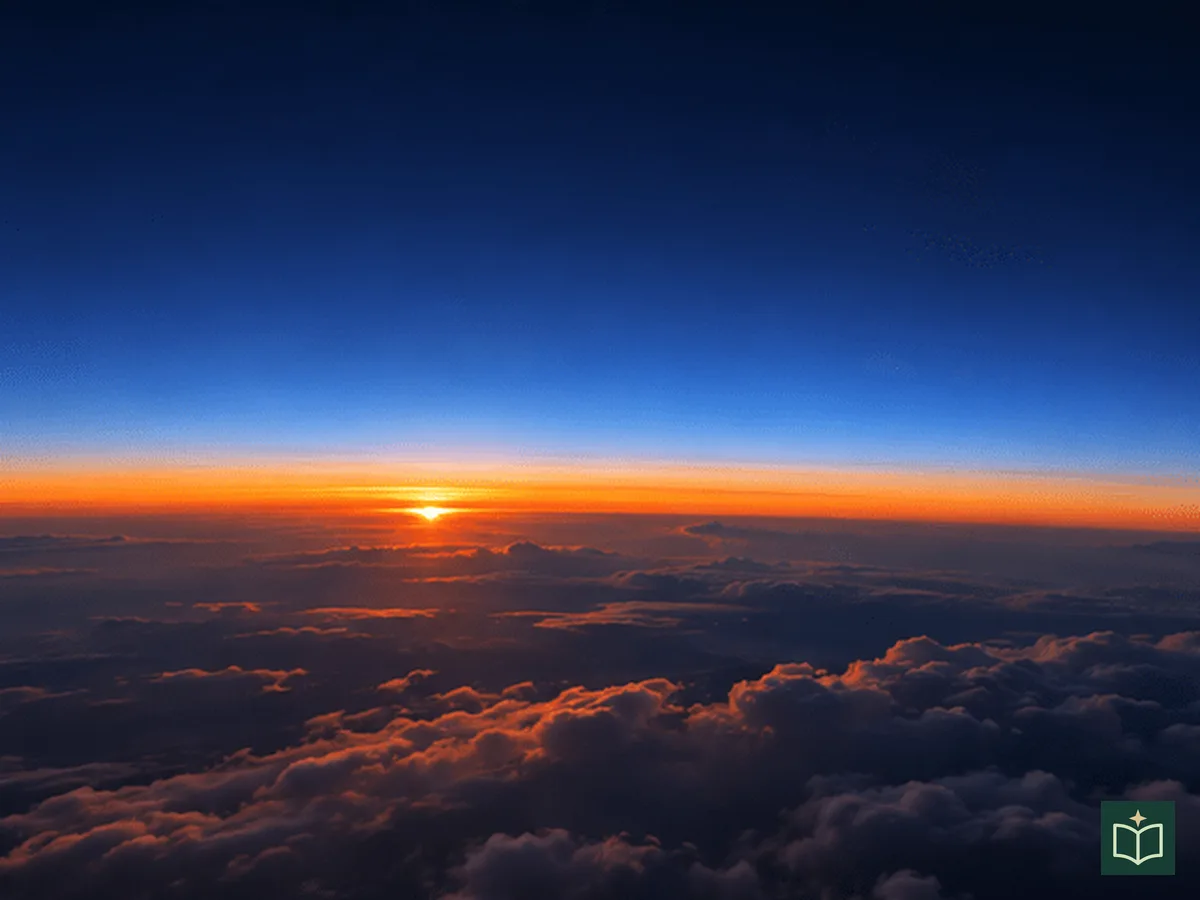
Earth's temperature depends on a balance between the energy it receives from the Sun and the energy it sends back to space. Sunlight arrives mostly as visible light, and about 30 per cent is reflected straight back by clouds, ice and bright surfaces. The rest is absorbed by land, oceans and air, warming them. Any warm object radiates energy, and Earth, being far cooler than the Sun, gives off its energy as infrared radiation, which our eyes cannot see. If that infrared escaped freely, calculations show the average surface would sit at about −18°C. The actual average is around 15°C. The difference, about 33 degrees, is the natural greenhouse effect.
Which gases do it
Nitrogen and oxygen make up about 99 per cent of dry air but barely absorb infrared, because their molecules consist of two identical atoms that cannot vibrate in the right way. Molecules with three or more atoms, or with uneven charge, can absorb infrared at particular wavelengths. Water vapour is the largest contributor to the natural effect, followed by carbon dioxide; methane, nitrous oxide and ozone add smaller shares. When these molecules absorb infrared they start vibrating, then re-emit energy in all directions, some back towards the surface. The air acts less like a lid than like a blanket, slowing the rate at which heat leaks to space.
Discovering the effect
The idea is old. In the 1820s the French mathematician Joseph Fourier reasoned that the atmosphere must keep Earth warmer than it would otherwise be. In 1856 the American scientist Eunice Foote showed that a glass cylinder of carbon dioxide heated more in sunlight than ordinary air. A few years later the Irish physicist John Tyndall measured precisely how water vapour and carbon dioxide absorb heat radiation. In 1896 the Swedish chemist Svante Arrhenius calculated that doubling carbon dioxide would warm the planet by several degrees, a figure broadly in line with modern estimates. The name greenhouse is a loose analogy; real greenhouses stay warm mainly because glass stops warm air rising away.
A thickening blanket
Before industrialisation, carbon dioxide made up about 280 parts per million of the atmosphere. Burning coal, oil and gas, together with deforestation and cement making, has pushed it above 420 parts per million, an increase of 50 per cent, measured continuously at Mauna Loa in Hawaii since 1958. Methane has more than doubled. Each additional molecule absorbs a little more outgoing infrared, so the planet must warm until it again radiates as much as it receives. The Intergovernmental Panel on Climate Change reported that the global surface in 2011–2020 was about 1.1°C warmer than in the late nineteenth century, and stated that human influence has unequivocally warmed the climate.
Feedbacks and water vapour
Water vapour behaves differently from carbon dioxide. It rains out within days, so its concentration is set mainly by temperature: warmer air can hold about 7 per cent more water vapour for each degree of warming. That makes water vapour an amplifier rather than a driver. A small warming from carbon dioxide raises water vapour, which adds more warming. Melting ice and snow expose darker ground and sea that absorb more sunlight, adding a further push. Clouds can work in both directions and remain the largest source of uncertainty. Methane, though shorter-lived than carbon dioxide, traps roughly 80 times as much heat per tonne over its first 20 years.
Why it matters here
Other planets show the effect's range. Mars, with a thin carbon dioxide atmosphere, has a weak greenhouse effect; Venus, with a dense one, has a scorching surface. On Earth, the strengthening effect shows up in hotter extremes, warming and rising seas and shifting rainfall. In the Gulf, where summer temperatures already exceed 45°C and humidity along the coasts adds to the strain, even modest warming affects health, water demand and energy use for cooling. Reducing emissions, the aim of the 2015 Paris Agreement and a central theme of the COP28 talks hosted in Dubai in 2023, is about slowing the thickening of a blanket the planet cannot do without.
Sources & further reading
Figures are rounded and widely published; check the linked organisations for the latest editions. These organisations do not endorse this website.