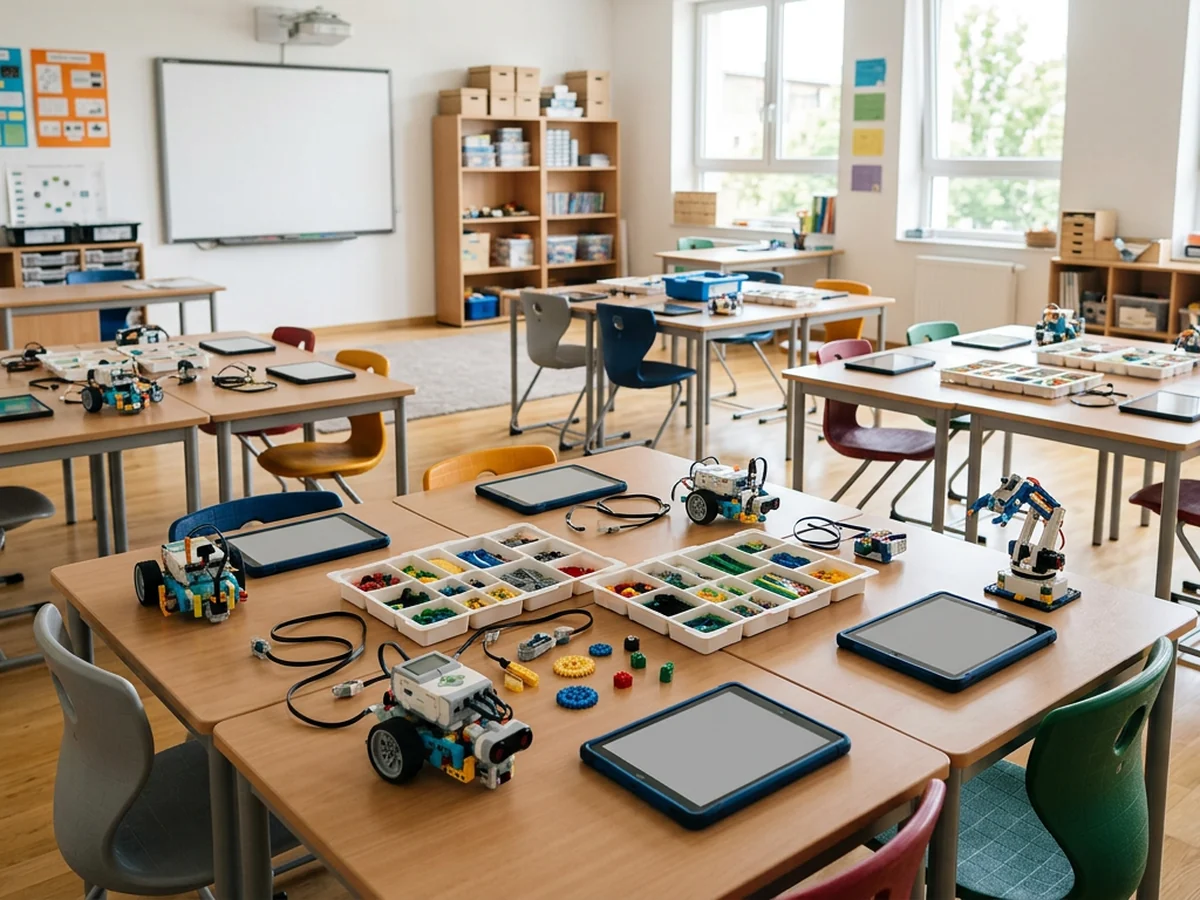
A national first
In May 2025 the UAE government announced that artificial intelligence would become a formal subject in all public schools, from kindergarten to grade 12, starting with the 2025–2026 academic year, which began on 25 August 2025. The Ministry of Education described it as a strategic step to prepare a generation that understands technology and its ethics. While several countries had added AI topics to computing lessons or run pilots, few had introduced a dedicated, mandatory subject running through every stage of school. The move fits a long-running national strategy that has made AI a priority across government, business and education.
What children learn
The curriculum is built around a set of core areas that include data and algorithms, software applications, awareness of ethics, real-world uses of AI, and the basic concepts behind how AI works. Content is tailored to each age. In kindergarten, children meet the idea of smart machines through stories, pictures and play. In primary years, they learn to spot AI in everyday life and to recognise patterns in data. In secondary school, students explore how models are trained, experiment with tools, build small projects and discuss questions of bias, privacy and responsibility.
How it is taught
According to the ministry, about 1,000 trained teachers were assigned to deliver the subject across public schools. AI is taught within the existing timetable, with class time allocated according to each grade. Officials said the subject would be assessed through school-based work rather than centralised exams, placing it among subjects that emphasise projects and practical understanding. Reports at launch put the number of students covered at close to one million, though public schools are only part of the UAE's school system, which also includes many private schools following international curricula.
Why the UAE is doing it
The UAE appointed the world's first minister for artificial intelligence in 2017 and has a National Strategy for Artificial Intelligence 2031 aiming to make the country a global leader. It has built a dedicated AI university, MBZUAI, attracted large AI investments and data centres, and by 2025 ranked first in the world for the share of working-age people using AI tools, according to Microsoft's AI diffusion research. Teaching AI from early childhood is meant to ensure that the next generation can build and govern these technologies, not just consume them.
Ethics at the centre
A distinctive feature of the curriculum is the emphasis on ethics. Students are taught that AI systems can be wrong, can reflect biases in their training data and can be misused, for example to create fake images or spread misinformation. They learn about privacy and why personal data should be protected. The ministry has stressed responsible use alongside technical skill, reflecting a wider debate about how schools should prepare young people for a world in which AI tools are everywhere and their outputs cannot always be trusted.
How it compares abroad
Other countries are moving in a similar direction at different speeds. China has required AI education in schools in Beijing from 2025, with a minimum number of hours each year. Estonia launched a national programme called AI Leap to give secondary students and teachers access to AI tools with training. South Korea, Singapore and the United Kingdom have integrated AI into computing and digital literacy lessons. The UAE stands out for covering every grade with a dedicated subject delivered across the entire public school system at once.
What comes next
Because the field moves month to month, the curriculum is built to be revised rather than fixed, and teacher training runs alongside it so staff stay ahead of the tools their students already use. The ministry has paired the subject with guidance on screen time, on data protection for children and on the sensible use of chatbots for homework. The measure of success will be whether students leave school able to think clearly about AI, use it productively and, for some, go on to build it themselves.
What it means for families
For parents, the change means children will come home talking about algorithms and datasets as naturally as earlier generations discussed computers. It also offers a chance to talk at home about sensible habits: using AI to explain and practise rather than to copy, checking facts, and protecting personal information. As AI becomes part of nearly every job, early, structured exposure may prove as important as learning to read charts or use the internet was for previous generations.
Sources & further reading
- WAM · Ministry of Education introduces AI curriculum in public schools ↗
- Gulf News · UAE schools to introduce AI curriculum without exams ↗
- Bloomberg · UAE rolls out AI for schoolkids (2025) ↗
Curriculum details are summarised from official announcements and may evolve. Photograph: original AI-generated illustration (Adobe Firefly). Reference organisations do not endorse this website.