One sea route. Millions of bills.
How disruption around the Strait of Hormuz travels through energy, transport and agricultural supply chains.
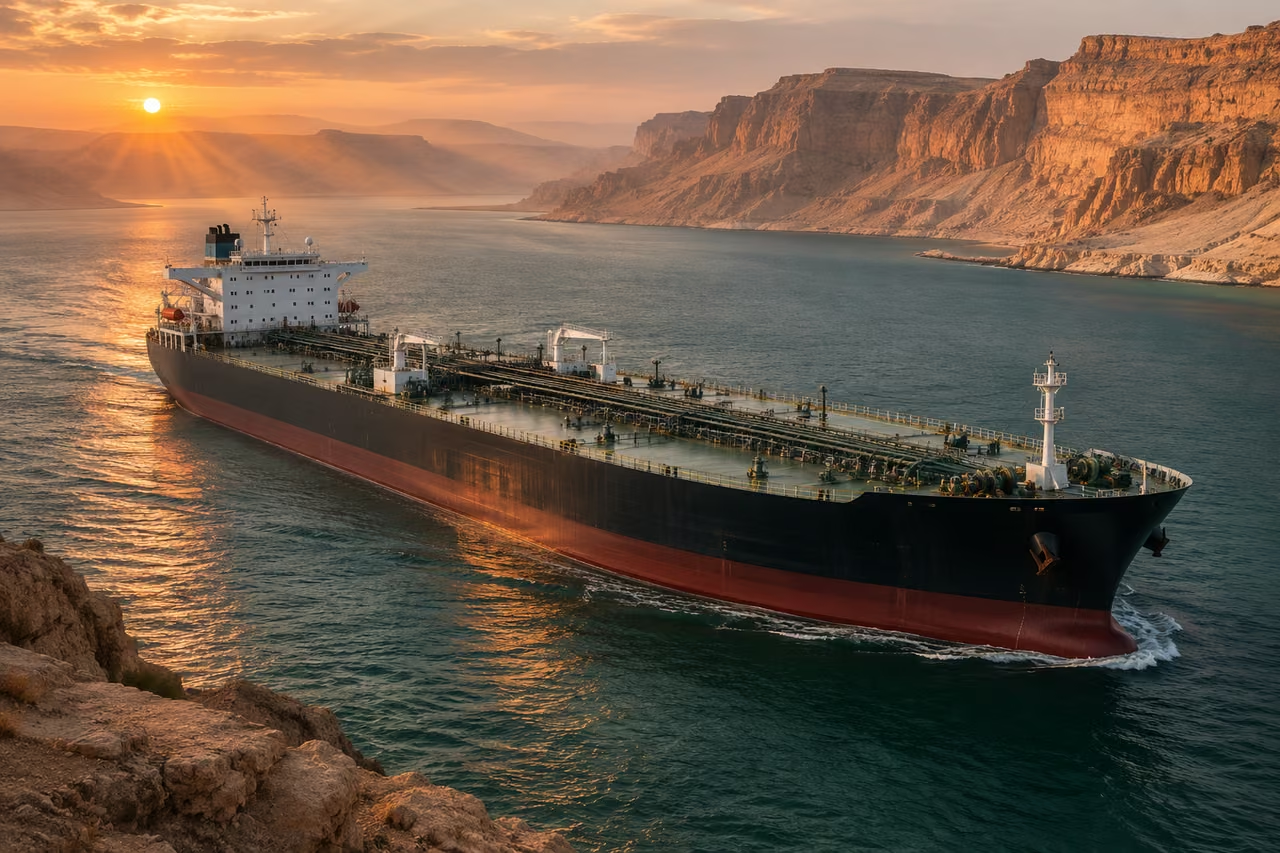
Conceptual AI illustration; not a documentary photograph.
Evidence: EIA release: 10 November 2026 · information cut-off: 5 November
The EIA’s November 2026 outlook reports that production disruptions have eased sharply from their May peak, while transport constraints continue. Partial recovery does not mean that every link has returned to normal.
- 01
The passage tightens
A maritime disruption can leave export cargoes unable to reach buyers on their usual schedule. Available production and deliverable supply are different things.
- 02
Costs travel outward
Freight, insurance, fuel and replacement supplies affect the delivered cost. A cargo’s price at origin is only one part of its journey.
- 03
Households feel the lag
Energy and agricultural inputs connect the shipping system to firms and consumers. The effect depends on inventories, contracts, exchange rates and domestic policy.
Estimated Middle East crude production shut-ins
- May 2026 · peak10.9million barrels per day
- October 20262.5million barrels per day
US EIA November 2026 STEO narrative estimates. Production shut-ins, not oil transit volumes. Rounded values; this is not a live flow tracker.
Evidence period: EIA release: 10 November 2026 · information cut-off: 5 November · Source details below
Read the recovery with the right denominator
EIA estimates Middle East crude production shut-ins at 2.5 million barrels a day in October 2026, down from a peak of 10.9 million in May. The chart measures production unavailable because of disruption; it does not measure oil moving through Hormuz. November’s outlook still describes constrained transport and alternative export arrangements. Its inputs were finalised on 5 November, so later developments are outside this snapshot.
An energy corridor is also a food-system corridor
UNCTAD’s March 2026 analysis highlights fertiliser as well as oil and gas exposure. Roughly one-third of global seaborne fertiliser trade passed through the strait in the baseline used by that report. Higher input and transport costs can therefore reach agriculture far from the Gulf. UNCTAD also stresses that heavily indebted, import-dependent developing economies have less fiscal room to absorb such shocks.
Follow the chain instead of one price
A useful reader’s method is to distinguish four signals: physical cargo movement, production shut-ins, shipping costs and consumer prices. They need not turn together. A vessel finding an alternative route does not instantly replenish a distant inventory; a lower market quotation does not immediately reset an existing delivery contract. This is an explanatory framework, not a forecast of oil prices or household inflation.
Better questions.
A clearer picture.
- Are physical export volumes recovering alongside production?
- Are freight and insurance costs easing across routes?
- How much inventory remains between delayed cargoes and end users?
Sources & dates.
- US EIA · November 2026 Short-Term Energy Outlook, pp. 3 and 5–6
Published: 10 November 2026
Evidence period: May and October 2026 estimates; forecast inputs through 5 November - UNCTAD · Strait of Hormuz disruptions: implications for global trade and development
Published: 10 March 2026
Evidence period: March 2026 assessment and its trade baselines - UNCTAD · Hormuz shipping disruptions: energy, fertilisers and vulnerable economies
Published: 10 March 2026
Evidence period: March 2026 rapid-analysis summary
Checked 15 November 2026. Conditions can change after publication. These organisations do not endorse Canvas of Knowledge.