How the list is built
Yemen’s highlands contain many summits above 3,000 metres, but most are poorly surveyed and their published heights vary. To give a reliable picture, this ranking lists the highest summit of each major mountain region and of each Gulf state, ordered by height. Jabal an-Nabi Shu’ayb, about 3,666 metres high and roughly 30 kilometres west of Sanaa, is the highest point of Yemen and of the whole peninsula. Some older references give it closer to 3,760 metres; modern satellite elevation data favour the lower figure. Its name honours the prophet Shu’ayb, and a small shrine stands on the summit. The bottom of the table shows how low the eastern side of Arabia is.
The Sarawat wall
The Sarawat mountains run for well over 1,000 kilometres parallel to the Red Sea, from Yemen through Saudi Arabia’s Asir and Hejaz regions. They formed as the Red Sea rift pulled Arabia away from Africa over the past 25 million years or so, lifting the peninsula’s western rim. The escarpment drops steeply to the narrow Tihamah coastal plain but slopes gently eastwards into the interior. Jabal Sawda, near Abha, is usually named as Saudi Arabia’s highest peak at about 3,000 metres, although some surveys place nearby Jabal Ferwa slightly higher. In the far north-west, Jabal al-Lawz near Tabuk sometimes receives snow in winter, which draws visitors from across the kingdom.
The Hajar, from the sea floor
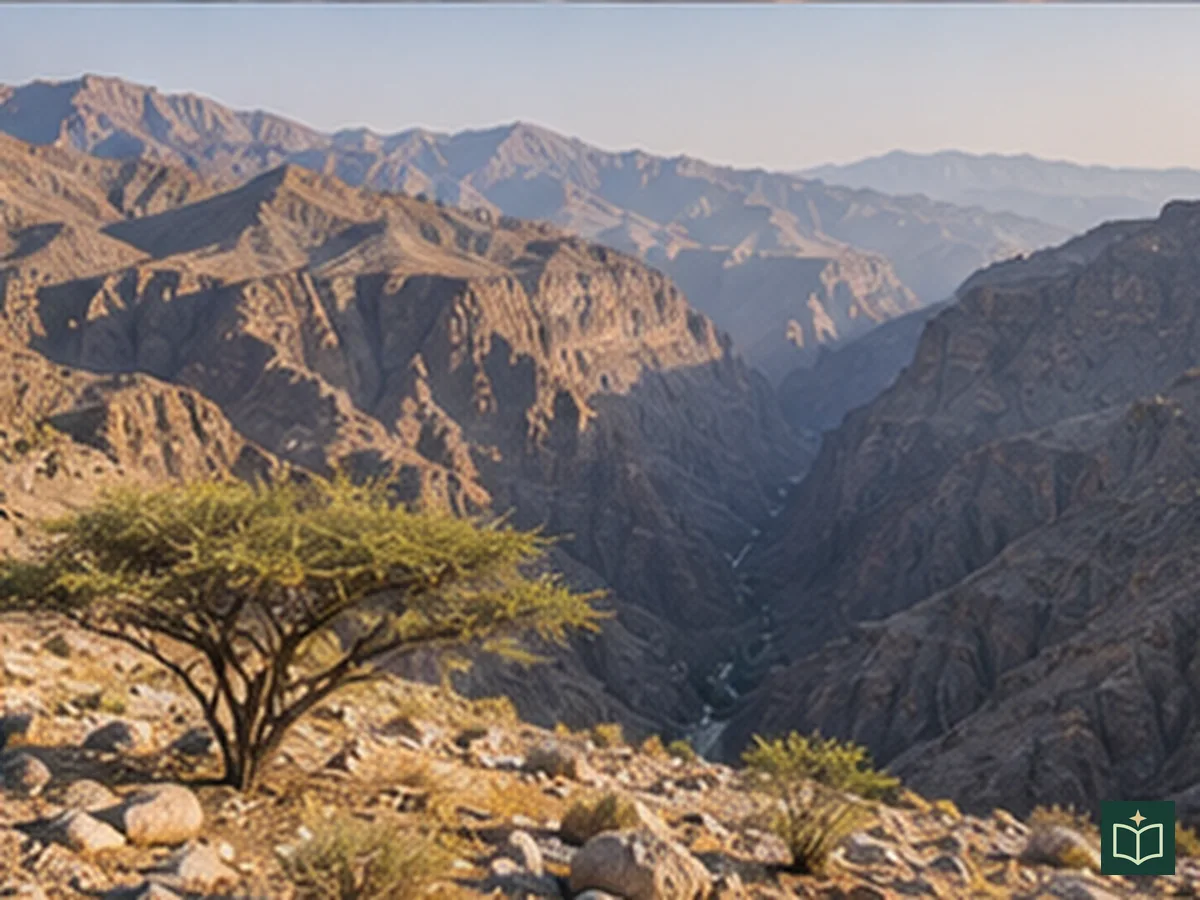
The Hajar mountains, about 700 kilometres long, arc through northern Oman and the eastern UAE. Their origin is unusual: much of the range consists of the Semail ophiolite, a slab of oceanic crust and upper mantle that was thrust onto the edge of Arabia around 70 to 95 million years ago. Geologists travel from around the world to see it, because it is one of the best-exposed sections of ocean floor on land. Jabal Shams, Oman’s highest peak at about 3,009 metres, overlooks Wadi Ghul, often called Oman’s Grand Canyon. Its summit area is restricted, so visitors walk the rim of the gorge instead.
The UAE’s high ground
At the northern end of the Hajar, Jebel Jais rises to about 1,934 metres. Its summit lies just across the border in Oman’s Musandam, so the UAE’s own highest point is a nearby ridge, Jabal ar-Rahrah, at about 1,892 metres in Ras Al Khaimah. Winter temperatures on Jebel Jais can fall close to freezing, and the mountain road, viewing decks and zipline attract large numbers of visitors from the coast. Jebel Hafeet, about 1,250 metres high, stands alone on the border near Al Ain. It is a limestone fold rather than part of the main ophiolite, and a winding road with dozens of bends leads almost to its top.
The low east
East of the mountains, the peninsula falls towards the Gulf. Kuwait’s highest ground, near its western border, reaches only about 300 metres. Bahrain’s Jabal ad-Dukhan, the Mountain of Smoke, is a limestone hill of about 135 metres in the middle of the main island, often hazy in summer. Qatar’s highest point is around 103 metres. These figures are a reminder that ‘mountain’ is a matter of local scale. For comparison, the Burj Khalifa in Dubai, at 828 metres, is more than six times taller than Bahrain’s highest ground and taller than every natural point in Kuwait, Qatar and Bahrain combined if they were stacked.
Why the heights matter
Arabia’s mountains have shaped its climate and settlement for thousands of years. The Sarawat and the Yemeni highlands catch monsoon and winter rain, which is why terraced farms, coffee, juniper woodlands and dense villages grew there while the interior stayed dry. In the Hajar, ancient aflaj channels carried spring water to oases. The ranges also hold endemic wildlife, such as the Arabian tahr in the Hajar. Today they are drawing new attention as cool retreats: Saudi Arabia and the UAE are investing in mountain tourism in Asir and on Jebel Jais. Heights in the table are rounded because surveys of these peaks still differ.
Sources & further reading
Figures are rounded and widely published; check the linked organisations for the latest editions. These organisations do not endorse this website.