How the list is drawn up
Africa’s highest ground is concentrated in the east of the continent, in a broad band of highlands linked to the East African Rift. This table ranks separate mountains rather than every individual summit. Kilimanjaro’s secondary volcanic peak, Mawenzi, is higher than Mount Stanley, for example, but is treated as part of the Kilimanjaro massif. The Rwenzori range, by contrast, contains six distinct mountains, each with its own cluster of summits, so several appear here. Heights come from national surveys and modern satellite measurements and are rounded; recent surveys have revised some figures by a few metres, and ice cover on the summits adds further uncertainty.
Kilimanjaro
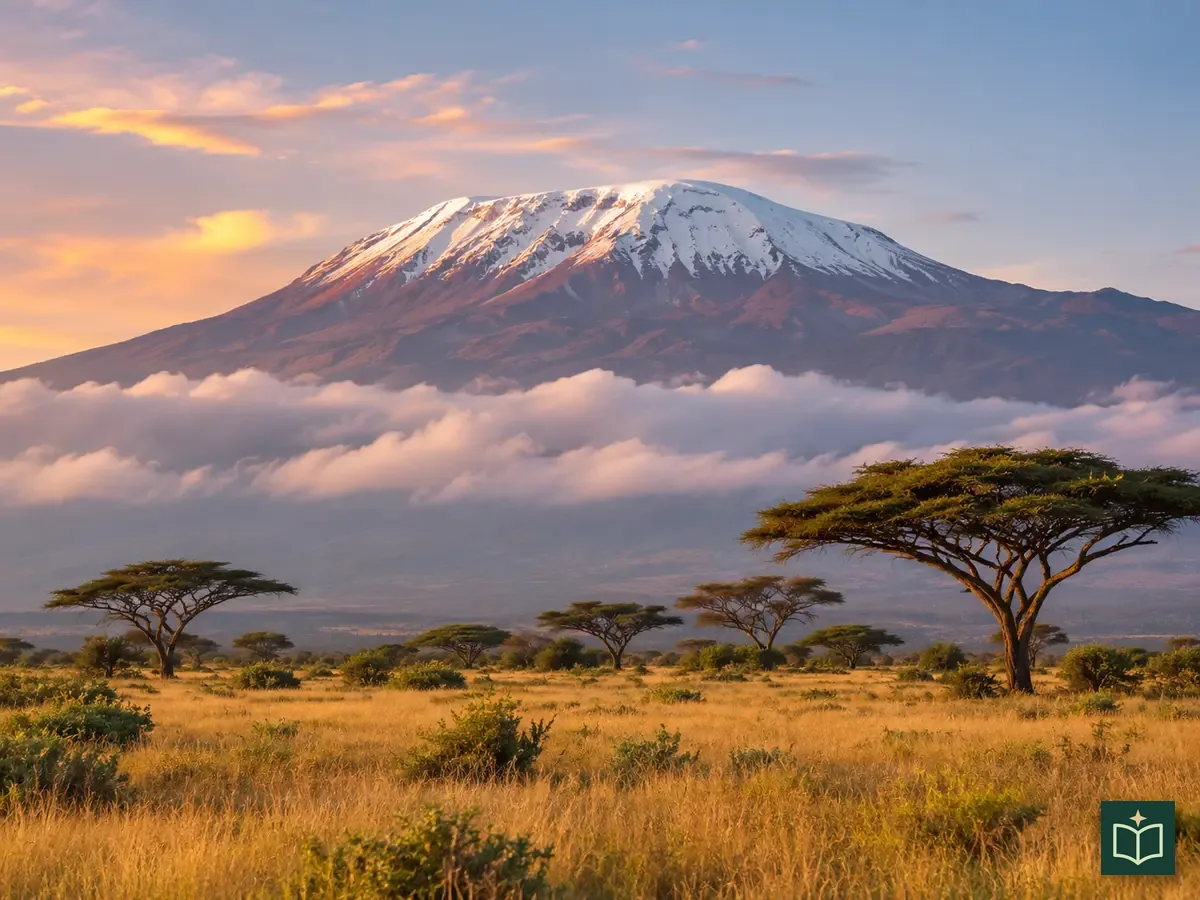
Kilimanjaro, in northern Tanzania, is a huge volcano made of three cones: Kibo, the highest, with its summit at Uhuru Peak, Mawenzi and Shira. It rises almost five kilometres above the surrounding plains, which is why it is often described as the world’s tallest free-standing mountain. Kibo is dormant rather than extinct. Because its main routes require no technical climbing, tens of thousands of people attempt the summit each year, although altitude sickness defeats many and should be taken seriously. Its famous ice fields have shrunk dramatically over the past century, and scientists expect much of the remaining ice to disappear within decades. It is a UNESCO World Heritage Site.
Mount Kenya
Mount Kenya, the second-highest mountain in Africa, is an ancient volcano heavily eroded by glaciers, leaving jagged rocky peaks rather than a smooth cone. Its highest summit, Batian, and its slightly lower twin, Nelion, require technical rock and ice climbing, unlike the walking routes on Kilimanjaro. Point Lenana, a lower summit, is the usual goal for trekkers. The mountain lies just south of the equator and gave its name to the country. Its forests and moorlands form an important water catchment for central Kenya, and its slopes support distinctive high-altitude plants, including giant groundsels and lobelias that look strikingly unlike their lowland relatives.
The Mountains of the Moon
The Rwenzori range, on the border between Uganda and the Democratic Republic of the Congo, contains six of the mountains on this list. Unlike Kilimanjaro and Mount Kenya, it is not volcanic but a block of ancient crust pushed upwards within the western branch of the East African Rift. The range is often linked with the Mountains of the Moon described by the ancient geographer Ptolemy as a source of the Nile. Its highest point, Margherita Peak, crowns Mount Stanley. Many peaks were named during a 1906 expedition led by the Duke of the Abruzzi, Luigi Amedeo, after whom Mount Luigi di Savoia is named.
Meru and Ras Dashen
Mount Meru, ninth, is an active volcano near the Tanzanian city of Arusha, within sight of Kilimanjaro on clear days. A minor eruption was reported in the early 20th century, and its steep crater rim makes a popular acclimatisation climb. Ras Dashen, tenth, is the highest point in Ethiopia and lies in the Simien Mountains, a dramatic landscape of cliffs and gorges that is a UNESCO World Heritage Site. The Simien are home to rare animals such as the walia ibex and the gelada, a grass-eating monkey found only in the Ethiopian highlands. Ethiopia contains a large share of Africa’s land above 3,000 metres.
Glaciers on the equator
Tropical glaciers on Kilimanjaro, Mount Kenya and the Rwenzori are among the most closely watched ice masses in the world, because they are retreating rapidly. Scientists expect many of them to vanish within the coming decades, which would remove a visible icon and alter local water flows, although the mountains’ forests capture more water than the ice provides. For travellers from the Gulf, East Africa’s peaks are relatively close: direct flights from Dubai to Kilimanjaro or Nairobi take around five hours. Kilimanjaro is about three times as high as Jebel Jais, the UAE’s highest mountain, a useful sense of scale for anyone planning the climb.
Sources & further reading
- UNESCO World Heritage · Kilimanjaro National Park ↗
- Britannica · Kilimanjaro ↗
- Britannica · Ruwenzori ↗
Figures are rounded and widely published; check the linked organisations for the latest editions. These organisations do not endorse this website.