What hardness means
Water hardness describes how much dissolved calcium and magnesium the water contains. Rainwater starts almost free of minerals. As it soaks through the ground, it becomes slightly acidic from carbon dioxide and dissolves minerals from rocks, especially limestone, chalk and dolomite. Water that has travelled through such rocks becomes hard; water from granite uplands or rain-fed reservoirs tends to be soft. Hardness is usually expressed as milligrams per litre of calcium carbonate. The US Geological Survey classes water up to 60 mg/L as soft, 61 to 120 as moderately hard, 121 to 180 as hard and anything above 180 as very hard. Other countries use degrees of hardness, but the idea is the same.
Signs at home
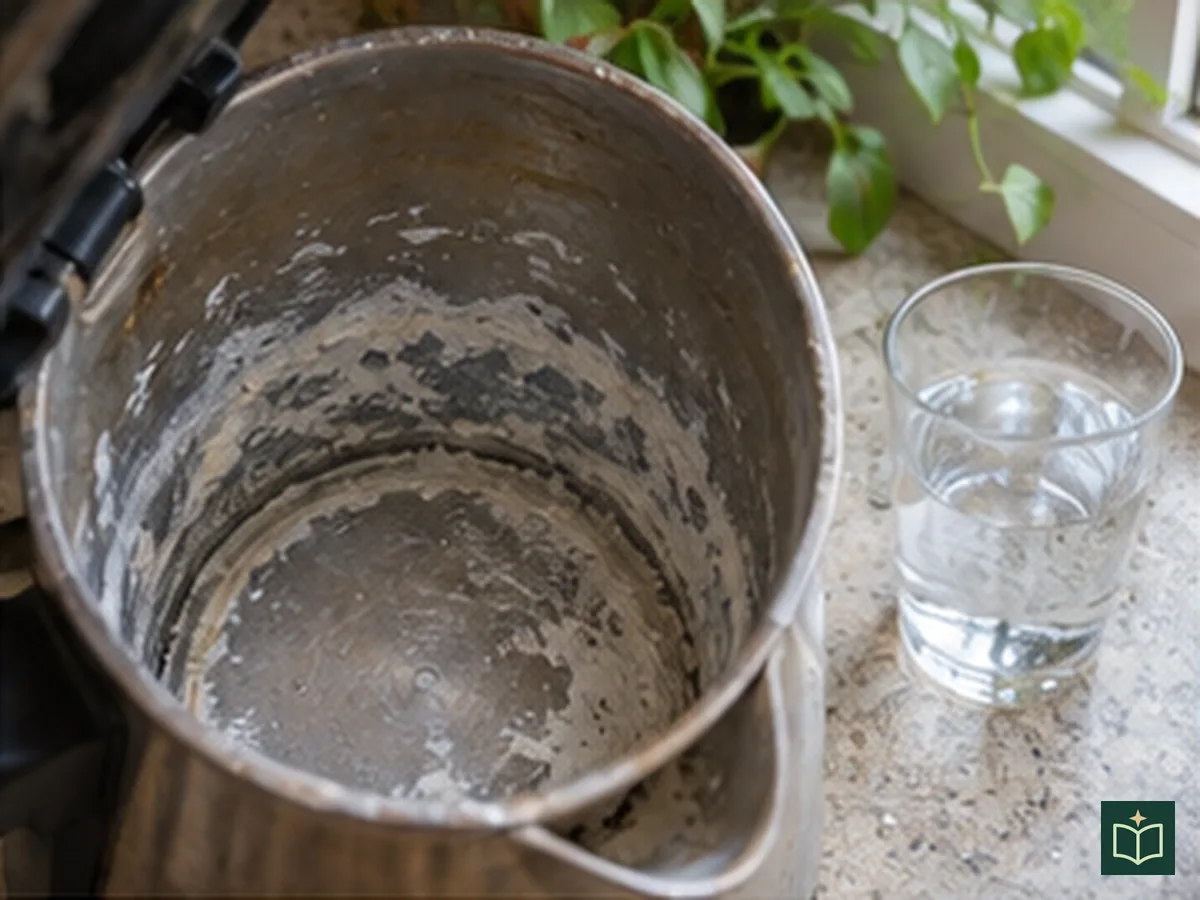
Hard water announces itself in several ways. Kettles and showerheads build up a chalky white crust, limescale. Soap and shampoo lather poorly, because calcium and magnesium react with soap to form an insoluble scum that leaves rings in baths and a dull film on glassware. Clothes washed in hard water can feel stiffer. Water heaters and boilers lose efficiency as scale insulates their heating elements, and pipes can narrow over years. Soft water does the opposite: soap lathers easily, sometimes so easily that it feels hard to rinse off, and appliances stay clean. Neither type is dangerous to drink, and many people prefer the taste of moderately hard water.
Temporary and permanent hardness
Chemists distinguish two kinds. Temporary hardness comes from calcium and magnesium bicarbonates. When the water is heated, these break down, releasing carbon dioxide and leaving solid calcium carbonate behind, which is exactly what limescale in a kettle is. Boiling therefore removes some hardness, at the cost of scale. Permanent hardness comes mainly from sulphates and chlorides of calcium and magnesium, which do not precipitate on boiling. Household water softeners deal with both by ion exchange. Water passes through a resin that swaps calcium and magnesium for sodium, which does not form scale. Because this adds sodium, some authorities advise keeping an unsoftened tap for drinking and cooking.
A quick calculation
Laboratory reports often list calcium in milligrams per litre, while hardness is quoted as calcium carbonate, so a conversion is needed. Calcium carbonate is heavier than calcium alone, by a ratio of about 100 to 40. Water containing 40 mg/L of calcium therefore has a calcium hardness of about 100 mg/L as calcium carbonate, which counts as moderately hard on the USGS scale. Magnesium is converted the same way, with its own factor, and the two are added to give total hardness. A test strip from a hardware shop gives a rough reading in seconds, and local water utilities usually publish typical hardness figures for each supply area.
Why Gulf water is so soft
In the UAE and much of the Gulf, most drinking water comes from desalinating seawater, either by distillation or by forcing it through reverse osmosis membranes. Both processes remove salt and nearly every other mineral, producing water so pure that it has a flat taste and is aggressive towards pipes, slowly dissolving metals and cement linings. Plants therefore remineralise the water before it enters the network, typically by passing it through limestone or dosing it with lime and carbon dioxide. This adds calcium and bicarbonate, stabilising the water so it does not corrode pipes, and improves its taste. The result is water that is usually soft to moderately soft at the tap.
Health and choices
The World Health Organization does not set a health-based limit for hardness, noting that calcium and magnesium in water are not harmful and can contribute small amounts to dietary intake. Some studies have suggested links between harder water and slightly lower rates of heart disease, but the evidence is not conclusive. For households, the decision to soften water is usually about appliances and comfort rather than health. People in hard-water areas may choose softeners or descale kettles regularly with mild acids such as citric acid. In soft-water areas, including most of the Gulf, scale is rarely a problem, though bottled mineral waters and filters can change the minerals people actually drink.
Sources & further reading
- USGS Water Science School · Hardness of water ↗
- WHO · Water, sanitation and health ↗
- Britannica · Hard water ↗
Figures are rounded and widely published; check the linked organisations for the latest editions. These organisations do not endorse this website.